


Sometimes, the nerds get it right.
Okay, they get it right a lot these days.
Baseball’s development staffs have gotten exceptionally good at taking information that sounds like complete gibberish to a normal person - seam orientation, induced vertical break, spin axis - and turning it into something much simpler:
A better pitch.
Dylan Dodd is one of those success stories.
A pitch-design session helped transform a sinker that wasn’t particularly interesting into something that moves suspiciously like a four-seam fastball. Pair that with the rest of his arsenal, and Dodd suddenly has the pitch shapes and repertoire of a late-inning reliever.
The next test is whether Atlanta starts treating him like one.
Let’s talk about it.
Sometimes, the nerds get it right
Dylan Dodd debuted back in 2023 as a fairly ordinary four-seam/slider/curveball starter, mostly the same guy he was when Atlanta took him in the third round of the 2021 MLB Draft.
It didn’t go well.
Dodd was shelled in his seven starts, allowing 29 runs on 53 hits (including nine homers) in just 34.1 innings pitched. He got only one more opportunity in Atlanta, pitching two innings in a blowout in 2024.
He re-emerged in 2025 as a reliever and was…fine, putting up a 3.60 ERA in 35 innings with 30 strikeouts. The transition is one that Dodd took to, though, expressing in the past that being a starting pitcher has a certain kind of anticipatory stress that he’s not well suited to handle.
But one of the key changes, along with role, has been what he’s throwing and why.
Dodd’s most effective pitch this season has been a sinker, allowing only a .149 batting average and .284 slug (and that’s mostly earned - the expected values are .170 xBA and .309 xSLG).
And that success comes despite the fact that the sinker…doesn’t sink. It gets almost nine and a half inches less drop than the average lefty sinker, in fact.
Because it’s not really a sinker. It’s a four-seamer, thrown with a two-seam grip.
You see, Dodd's a pronator, meaning his hand and wrist naturally rotate inward through release. That tendency can make it difficult to create traditional breaking-ball shapes, which is why the fastball/gyro slider/changeup combination is commonly called the "Pronator Triangle" by Tread Athletics.
SIDEBAR: Supinators, by contrast, are far more common in baseball. They have a wrist that is open at release and/or the forearm is externally rotated. These guys generate excellent spin and typically throw multiple breaking ball shapes, cutting the ball to get to their pitch shapes.
So Atlanta had him alter how he throws his fastball, going from a four-seam to a two-seam grip.
Dodd averaged 92.1 mph with his four-seamer as a struggling starter in 2023 and now averages 93.8 with the sinker. The improvement came from converting a “dead-zone” fastball with roughly 14 inches of carry into a pitch with 17 inches, not from suddenly throwing 97. His natural pronation and the two-seam grip created seam effects that unlocked the extra carry.
As a reminder, a ‘dead zone’ fastball has a predictable ball flight for a hitter based on how the majority of fastballs from that release point and arm angle will typically travel. These tend to get hit…hard.
The change was made in 2025, even if they didn’t exactly understand why at the time.
“This was in spring training of last year,” Dodd told FanGraphs earlier this season. “The initial thought was that it was going to sink or run, but that’s not what happened. I don’t think we even knew why it was moving like it did, but he (then-pitching coordinator Wes McGuire) said to keep throwing it. After dealing with the ups and downs of it for a year, I came to spring training and learned just why the pitch does what it does.”
And the reason is seam effects. Pitching coach Jeremy Hefner explained that there are some pronators - a subset within an already limited subset - that can harness the ball’s seams to create induced vertical break on a two-seam fastball.
“He’s a natural pronator, so he gets inside the ball,” Hefner told FanGraphs. “When you over-pronate a four-seamer, it turns into a bad sinker. If you put a two-seam into their hand, and they throw it the exact same, it ends up getting some carry.”
And among this rare subset of a subset is a great model for the type of reliever Dylan Dodd could develop into: Josh Hader.
Why this looks suspiciously familiar
You'd be forgiven if Josh Hader hasn't been top of mind this season. The Astros closer spent half the year on the injured list, and the Braves haven't faced him since 2024 (and that was on the road), but the lefty’s a six-time All-Star with 243 career saves and a 2.56 ERA.
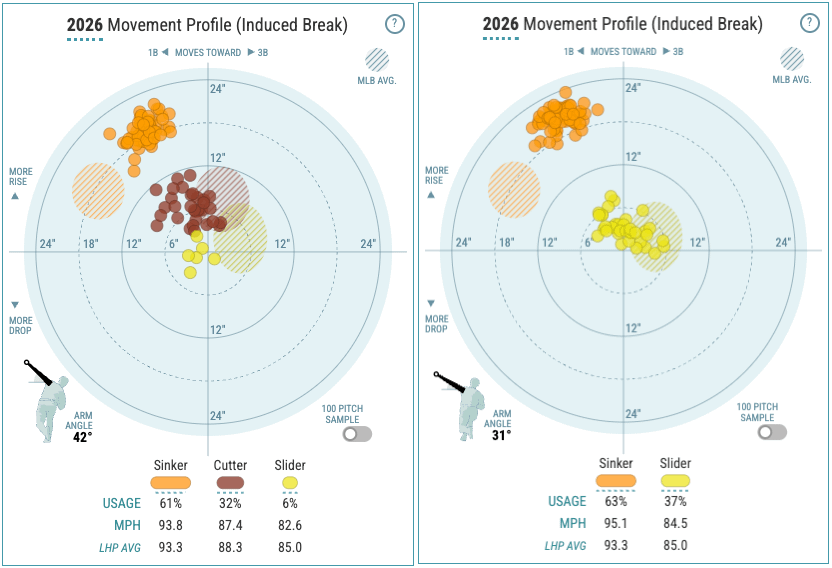
He’s also in that subset of seam-shifting pronators, and Dylan Dodd looks a lot like Hader. The sinker shapes are extraordinarily similar, although Hader has a bit more velocity at his disposal, a lower arm angle, and more swing-and-miss overall in his arsenal than Dodd does at the moment.
But “Diet Josh Hader” is absolutely a fitting moniker for what Dodd’s doing, both with his pitch usage and the characteristics of those pitches.
| 2026 metric              |    Dylan Dodd |    Josh Hader |
| ----------------------   | ------------: | ------------: |
| Primary pitch            | Sinker, 61.3% | Sinker, 62.8% |
| Secondary pitch          | Cutter, 32.4% | Slider, 37.2% |
| Sinker velocity          |      93.8 mph |      95.1 mph |
| Induced vertical break   |   17.0 inches |   18.4 inches |
| Arm-side movement        |    8.7 inches |    8.8 inches |
| Spin direction           |         11:00 |         11:00 |
| Active spin              |           95% |           99% |
| Extension                |      6.2 feet |      6.7 feet |
| Sinker whiff rate        |         24.2% |         31.3% |
| Overall whiff rate       |         28.1% |         38.2% |
| Stuff+                   |           108 |           117 |
| Fastball usage vs RHH    |           59% |           60% |
| Primary secondary vs RHH |   Cutter, 37% |   Slider, 40% |
| Fastball usage vs LHH    |           65% |           73% |
| Primary secondary vs LHH |   Cutter, 26% |   Slider, 27% |
Dodd’s cutter deserves special mention here, as well - it differs in basic shape from Hader’s gyro slider, but fulfills the same basic function. Against righties, Dodd uses approximately 59% sinkers and 37% cutters; Hader uses 60% sinkers and 40% sliders. Against lefties, Dodd moves toward 65% sinkers and 26% cutters, while Hader is at 73% and 27%. Dodd’s cutter occupies the same sequencing role that Hader’s slider does, even though the pitches have different shapes.
And let’s be clear, the improvement of that cutter is a big reason for this season’s breakout. Opponents slugged .464 against it last season; that is down to .213, with its hard-hit rate falling from 50.8% to 32.4%. Its 31.6% whiff rate is actually better than the sinker’s. The fastball shape gets the attention, but Dodd wouldn’t survive at this level without a credible answer for righties, and that’s the cutter.
And understanding how he uses primarily just those two pitches helps illuminate how there could be more in the tank here.
The results are following
One of the interesting observations from the “knows just enough to be dangerous” crowd has been that Dodd’s sinker isn’t getting ground balls, but in the context of this change, it makes sense. His ground-ball rate has fallen from 52% in 2025 to 31% this year, while his average launch angle has jumped from 8.0 degrees to 23.8. That sounds disastrous for a normal sinkerballer, but it makes perfect sense for a Hader-style fastball that stays above barrels and produces fly balls and popups. His popup rate has jumped from 3% to 17.3%, which is an even better batted ball type than a ground ball and absolutely a winning tradeoff.
The new arsenal has also turned Dodd into a reverse-split weapon. Righties are hitting .130/.178/.203 against him, compared with .170/.279/.340 for lefties. He has walked only 5.4% of righties and allowed one homer, compared with a concerning 11.5% walk rate and two homers against lefties. That makes him much more useful than a traditional left-handed specialist under the three-batter minimum.
And I think there’s a possible answer to the lefty ‘issues’ in his slider, again taking a cue from Hader. Dodd has thrown the slider only 34 times, but it owns a 121 Stuff+, a 60% whiff rate, and five strikeouts in eight plate appearances ending on the pitch. Those results come from only 15 swings, so they cannot be treated as more than the small sample size they are. Still, it’s an obvious pitch worth exploring more aggressively against lefties. Increasing it selectively against left-handed hitters could give him the genuine two-plane breaking component Hader possesses.
Give Dodd more leverage innings
Braves manager Walt Weiss has been trusting Dylan Dodd more, but it’s still not enough. He has nine holds and 14 FanGraphs “shutdowns”, but only 11 of his 135 batters faced have come in high leverage. His average leverage index remains 0.89, compared with Hader’s 1.68.
Weiss himself has acknowledged that Dodd has grown, telling the media earlier this year that “I said he’s going to be a big part of this, and he is. […] He’s really grown too over the last couple of years, you know? He’s a really reliable reliever now.”
The next step is trusting him when the game is actually on the line.
Robert Suarez, meanwhile, is approaching two months of dealing with elbow pain and still hasn’t successfully progressed through his throwing program. The Braves hope he’ll return by October, but they can’t construct their bullpen around that assumption.
That makes finding another trustworthy leverage arm increasingly important. They may have already developed one.
And the good news is that while Dodd might experience some slight regression - the 2.02 ERA is backed by a potentially unsustainable .183 BABIP and 85.3% strand rate - Dodd’s breakout itself looks legitimate.
Strikeout rate: 28.1%, up from 22.1%
xBA: .191
xSLG: .306
xwOBA: .252
Barrel rate: 5.9%, down from 8%
Hard-hit rate: 37.6%, down from 48%
Stuff+: 108, up from 103
Being able to throw that slider more to lefties than the current 9% usage is the key here. If Dodd can successfully ramp up that breaking ball while maintaining his control and effectiveness, “Diet Josh Hader” could go a long way toward helping Atlanta find its 27 outs in October.
The nerds did their part. Now it’s time for the Braves to use what they built.
Lindsay, this is the "nerd stuff" that makes my Braves Today sub a bargain! Thank you, Sir!
Fantastic explanation! Thank you. You’re analyses and discussions are the best in Braves-land and probably all of MLB. Baseball has plenty of keyboard GMs telling teams who to put on the roster. It’s a lot of fun. But you are the rare analyst that looks at how a team gets better by players on the roster improving. And the latter discussion will have a much bigger impact on how far the Braves go this season than the former. Fingers crossed you can write a similar analysis next month on Riley.