


The current Collective Bargaining Agreement hasn’t even expired yet, and I’m already tired of the discourse surrounding it.
Both MLB Commissioner Rob Manfred and MLB Players Association head Bruce Meyer came out with statements last week, essentially talking past each other to give their respective constituencies the message that they weren’t giving in. Manfred said the owners won’t compromise on adopting a salary cap and floor, while Meyer said the imposition of a cap was still a non-starter for the players.
And at face value, these sound like opposing negotiating positions. To me, however, they feel like statements being preserved for a future NLRB case.
The National Labor Relations Board is an independent federal government agency tasked with enforcing U.S. labor law as it pertains to collective bargaining and unfair labor practices.
Instead, it feels like MLB’s trying to establish that it presented a detailed proposal and revised it with several player benefits, only for the union to refuse to meaningfully engage.
The MLBPA wants to establish that the owners are negotiating in bad faith by predicating every economic conversation, concession, and discussion point on the PA’s acceptance of a predetermined outcome: the addition of a salary cap to baseball.
Both sides are preparing to explain why the other prevented a deal, instead of focusing on creating a new one.
The players are right to view a salary cap as a permanent and irreversible surrender of their agency and maximum earning potential. But simply saying “no” leaves MLB in control of both the public argument and, eventually, the factual record when it comes to declaring an impasse. The owners have launched a hard sales campaign to the public, but based on falsehoods and half-truths, with an actual proposal that is less generous and less straightforward than they make it sound.
Let’s talk about it.
Where the offers currently stand
Here are the details of the latest proposals from each side:
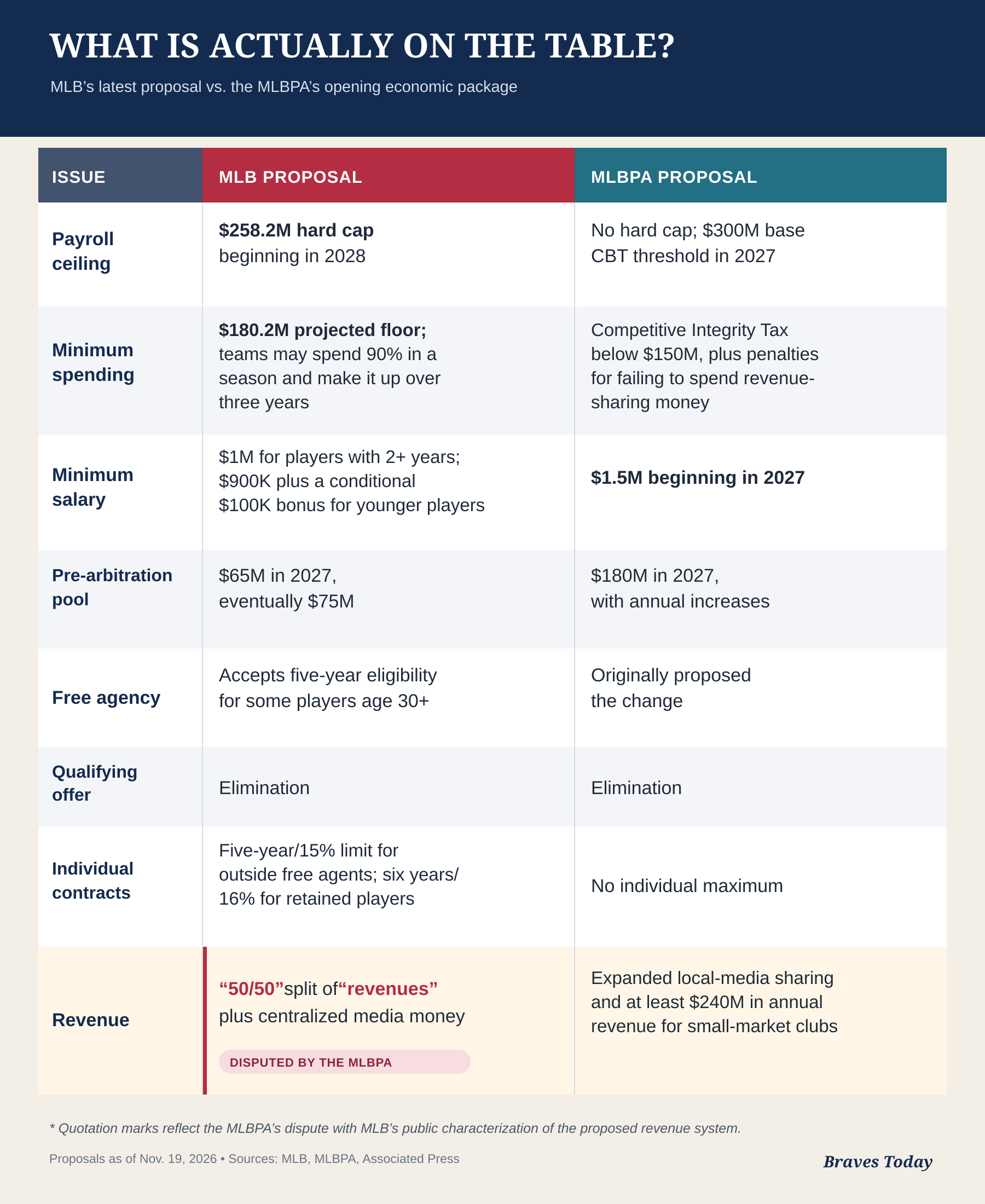
The union’s first proposal, which came back in May 2026, wasn’t just “no cap” - they had a host of changes, including higher minimums, increased arbitration eligibility, a significantly larger pre-arbitration pool, increased revenue sharing, and a mechanism to punish non-competitive payrolls that would simulate a salary floor.
MLB’s latest package is also not merely a cap. It includes slight tweaks to free agency eligibility for older players, elimination of the qualifying offer, less roster churn, and increases in compensation for early-career players. There are legitimate concessions there, although not nearly enough to compensate for the players accepting a cap.
The problem is that MLB has tied all of those concessions to the PA accepting the economic architecture of a salary cap.
Understand the risk of an impasse
MLB is expected to lock out the players after the CBA expires at 11:59 PM on December 1st, with no contact permitted between teams and players until a new CBA is negotiated. This is lawful activity under current US labor law, designed to exert economic pressure in support of a legitimate bargaining position.
But…there’s always a but.
What the owners are attempting to do, by both shutting down the sport and insisting they won’t budge on a cap, is to get the negotiations to the point where they can unilaterally impose a cap.
To implement new terms unilaterally, MLB would need to establish a valid impasse, which the union could challenge as an unfair labor practice. The NLRB would examine the entire bargaining history, including evaluations of the parties’ good faith, how long they negotiated, movement at the table, the importance of the unresolved issues to the overall agreement, and whether both sides held a reasonable belief that further bargaining would be futile.
If there’s any sort of continuing progress or a realistic prospect of a new union proposal that resolves any of the owners’ stated issues, a premature impasse claim could be significantly harder to establish.
But if MLB declared an overall impasse and that declaration survived an unfair-labor-practice challenge, the league could implement terms reasonably covered by its final pre-impasse proposals. Those terms would govern and be the starting point for continued bargaining; they would not constitute a new CBA on their own.
This is broadly what happened in 1994 and 1995. In December 1994, the owners declared an impasse and announced plans to implement a salary cap. The more direct legal trigger came in February 1995, when they unilaterally altered the expired agreement’s free-agency and anti-collusion provisions and eliminated salary arbitration.
The NLRB’s regional director petitioned for an injunction, arguing that MLB had changed mandatory subjects of bargaining before reaching a valid impasse. Then-federal judge Sonia Sotomayor agreed that the NLRB had reasonable cause to believe the owners had violated labor law and restored the previous system while bargaining continued.
That’s the course MLB appears to be heading on again, with Rob Manfred commenting at the owners’ meetings this week that “We’re going to have a Republican (NLRB), election results or not.” The Republican-leaning NLRB has taken much less aggressive action on labor-related issues than the previous Democratic-leaning NLRB, although it’s important to point out that the one Democratic member on the four-person panel is David Prouty, who previously served as MLBPA general counsel.
The legal standard for obtaining emergency relief is also more demanding than it was in 1995. In Starbucks v. McKinney, decided in 2024, the Supreme Court required the NLRB to satisfy the traditional four-part test for a preliminary injunction rather than the more deferential standard used in the baseball case.
What may additionally complicate matters for the players is that the President has personally weighed in, saying that he is supporting the owners. “If you don’t have a salary cap, you don’t have a sport,” he told reporters in June. “It's shocking, frankly, that they didn't put a cap on many years ago," he said at the time, referencing the 1994-95 strike. "They had a chance to do a cap, but they blew it."
MLB may believe the present legal and political environment gives it a better opportunity to defend an impasse declaration than it had in 1995, and that makes the union’s bargaining record unusually important.
But to be clear, we’re not at an impasse just because the MLBPA won’t accept a salary cap. Section 8(d) of the National Labor Relations Act expressly says that neither side is required to make a concession or accept a proposal in negotiation.
The union doesn’t have to legitimize the concept of a cap by negotiating inside that framework or counteroffering a slightly different salary cap. But it should keep presenting credible ways to address the problems that MLB claims a salary cap would solve.
What the players are doing wrong
The players association hasn’t had the best go of it this year, making some missteps in this process so far.
They are losing the public argument over competitive balance
I’ve not been impressed with the union’s messaging around the negotiations, where they’ve essentially spent months conceding the public relations fight to the league until just recently. The union’s May package is far more extensive than fans realize, and has several suggested fixes to competitive balance issues plaguing the league.
But all fans hear is the insistence that “Caps enrich owners,” which is a labor argument. The union’s recent messaging has relied on inflammatory language like the owners attempting to “blow up the current system” to “line their pockets” through the imposition of a “zero-sum system” without actually explaining what that means or publishing enough of the underlying math.
But fans worried that their teams cannot compete need a baseball argument.
What the union needs to do is to show how their proposal will also help competitive balance while preserving the ability for ambitious teams to break the bank for one player, even if it’s a terrible idea.
They very well may be right, but they’re not gathering much public support because they’re not showing their work. They’re not promoting the good in their packages, either, like the Competitive Integrity Tax that serves to replicate a salary cap’s system spending floor.
And honestly, the MLBPA would be well served to explain how they’re funding that $240 million minimum for every small-market club if they’re raising the CBT threshold. CBT collections are part of what funds revenue sharing, and fans shouldn’t need to reverse-engineer how the package fits together.
The union needs to promote their plan better, perhaps by publishing a side-by-side comparison answering:
The revenue comparisons in both systems, including why the players’ share under MLB’s proposal is a reduction in the share of revenue they’re getting, which they estimate to currently be “over 55%.”
How much would each service-time class receive under both proposals; the players have proposed a minimum salary significantly larger than the league’s proposal
How MLB’s escrow system would jeopardize the supposedly guaranteed contract
What a cap historically does to the middle-tier free agents in other sports, diverting from the league’s focus on superstars
But the messaging issue isn’t their biggest misstep here.
The MLBPA has not revised their economic package
The PA’s opening offer was presented in May, and it was aggressive: a $1.5 million minimum salary, a pre-arbitration bonus pool of $180 million, increased arbitration eligibility, and a $300 million CBT threshold.
Six months later, it has not publicly revised that core economic package, even though it has made separate proposals on transactions and, on Friday, international amateur acquisition. The union desperately needs to present another all-encompassing offer, and they can absolutely preserve their no-cap position while incorporating aspects that the league has offered in their cap-contingent packages, including:
Five years to free agency for qualifying 30-year-olds
Elimination of the qualifying offer
Restrictions on roster churn
Expanded media-derived revenue sharing
A strengthened Competitive Integrity Tax penalizing clubs that fall below minimum payroll benchmarks
Enforceable requirements that revenue-sharing recipients spend those funds on player payroll
Every continued proposal would force MLB to either negotiate within the current economic system or admit that competitive balance reforms aren’t their goal; the imposition of a salary cap is.
Additionally, adding areas of agreement to their continued offers would give further ammo to counter a claim of an impasse.
It is not protecting itself procedurally
More proposals do not require making concessions - Friday’s international player acquisition proposal did not concede an international draft. But it created evidence that productive bargaining remained possible.
If MLB eventually declares an impasse, the union should want a record filled with new package proposals, requests for financial information, alternative competitive-balance mechanisms, invitations to meet for bargaining sessions, movement on discrete issues, and proposals MLB rejected solely because they lacked a cap.
The union should make MLB keep saying no.
Friday’s proposal shows the way forward
The league and the union didn’t agree on the way forward on international signing rules, and that’s okay.
The negotiating process is what matters here: MLB proposed an international draft. The union rejected that mechanism, but instead of stopping at “no,” it presented alternative solutions to the underlying problems. MLB responded by withdrawing its proposal to exclude high-school players from the domestic draft, and the sides scheduled another meeting.
Friday’s proposal demonstrates the path forward here. It’s the clearest public example of one side proposing something the other rejected, then following up with an alternative intended to curb exploitation and competitive imbalance and give small-market clubs additional acquisition opportunities.
MLB then withdrew its proposal to make high-school players ineligible for the domestic draft in response.
There wasn’t a breakthrough there, but it was productive bargaining. The union identified a problem that MLB wanted to solve and offered different mechanisms to do it, producing movement from the other side without needing to compromise on a core principle. It also added another proposal to the record, which complicates any future claim by the league that the MLBPA refused to negotiate and caused an impasse.
Now, if only they could apply the same approach to core economic issues.
What MLB is doing wrong
While the league has a simple majority of the most vocal fans on its side, it hasn’t exactly nailed the process so far.
Its ultimatum damages its own good-faith story
Just last week, Manfred complained that the union has refused to move on their “no salary cap” stance, but in the same media availability, said that owners would not compromise on the same issue.
Hard bargaining is legal, and being inflexible in public does not establish bad faith in negotiations. But explicitly saying “we will not compromise” gives the union obvious evidence for a counterargument that MLB never sincerely intended to explore an agreement that resulted in anything other than its predetermined outcome.
Both parties are allowed to be intransigent. Only MLB is proposing to replace the economic foundation of the sport and demanding that everything else be negotiated inside that replacement.
MLB’s presentation is materially cleaner than its proposal
If someone from the league were to read this section, they’d argue that they’ve attempted to simplify the issues for their public messaging, but the reality is that the public description of their offers and what’s actually in the proposal doesn’t match.
For example, MLB’s advertising a $1 million minimum salary, but players with fewer than two years would receive a $900,000 salary and need to qualify for a conditional bonus to reach $1 million. If someone’s getting less than $1 million, that’s not the minimum.
MLB’s advertising a $180.2 million salary floor, but as that’s measured over a rolling three-year period, a club could operate at a payroll as low as $162.18 million in any given season and increase spending later to hit the rolling average for the floor.
MLB insists that the contracts remain fully guaranteed, but their proposed introduction of an escrow system to reconcile revenue means that compensation could be clawed back. This happened in the NBA, where the 2024-2025 season saw a retroactive 9.1% reduction in player salaries after revenue came in lower than expected. The individual NBA contracts remained guaranteed against termination, but the players’ ultimate compensation was still reduced by a collectively imposed revenue reconciliation. MLB should not describe contracts under its proposal as “fully guaranteed” without explaining that distinction; as with the minimum salary, if you ultimately receive less than the “guaranteed” amount in your contract, the contract amount is not fully guaranteed, now is it?
And most egregiously for me, MLB advertises a “50/50 split of revenues” under their proposed economic model, but has a host of deductions to that revenue figure before the remainder is divided with the players, including:
17% of local revenues and 22% of national revenues as “expenses”
Unlimited (uncapped) deductions for:
Construction and renovation costs for ballparks
Construction and renovation costs for spring training facilities
Expenses for MLB Network costs
“New ventures” from the league
Maybe this is the business-school education in me, but that is a 50/50 division of a defined net revenue base. It is not a 50/50 split of gross revenue, and MLB should stop marketing those concepts as interchangeable.
And that fact is a significant hold-up for the players association, with Bruce Meyer telling The Athletic’s Evan Drellich, “It’s no surprise that MLB would resort to deception in framing their salary cap proposals as ‘sharing equally.’ MLB hasn’t proposed a 50-50 ‘split’ of revenues. Any suggestion otherwise is misleading propaganda.”
At the end of the day, MLB advertises this as a competitive-balance proposal while including features that serve more as a restraint on spending, like limits on individual contract length and value, that reveal this is more about minimizing labor cost and player leverage.
MLB is trying to split the union—but has not offered enough
The last Collective Bargaining Agreement was approved over the complaints of the MLBPA Executive Subcommittee, who voted against the proposal, thanks to support from the rank and file of the players.
MLB is clearly targeting that same cohort this time, by targeting its concessions towards the players that likely won’t ever sign a nine-figure contract: earlier free agency, fewer options, a higher minimum and a larger pre-arbitration pool.
But as we pointed out this summer, the league isn’t doing a good job of incentivizing the rank-and-file to push their executive subcommittee to consider the proposal. MLB’s proposal includes benefits that are smaller than what the union has already proposed:
$900,000–$1 million versus the union’s $1.5 million minimum
$65 million versus a $180 million pre-arbitration pool
No meaningful adoption of the union’s expanded arbitration proposal
Contract restrictions that could eventually depress the market beneath the superstar tier
If MLB genuinely wants to get the younger and/or fringe players to push for consideration of their proposal, they need to “sweeten the pot” and make speaking up worth the players’ while. Instead, they’re asking them to accept a lesser deal than their union is currently fighting for, and to do it under a salary cap system their predecessors have fought against for decades.
The fan mandate is weaker than MLB claims
MLB repeatedly cites a November 2025 Morning Consult poll finding 79% support among avid fans. A newer HarrisX survey found 76% support for a cap-and-floor system among self-described baseball fans, based on 1,087 adults (and with only 615 baseball fans). The sample size is not inherently invalid, but the result is highly sensitive to how “fan” is defined and how the proposal is described.
A recent, nationally representative Seton Hall poll found support at 54% among MLB fans. It also found fans more likely to blame owners than players for a work stoppage.
There is public support for a cap, but it’s not nearly an 80% mandate for the owners to subject everyone to a prolonged lockout to get this specific cap-and-floor proposal.
What serious negotiating would look like
Here’s what both sides need to do this week, and going forward, to ensure we have as close to a normal season as possible in 2027.
The MLBPA should:
Submit a revised comprehensive economic proposal
Incorporate the areas where MLB has already accepted union ideas
Publish its revenue-share and compensation calculations
Explain its competitive-balance alternative to fans
Propose enforceable annual minimum spending
Continue negotiating every mandatory subject without conceding the cap
MLB should:
Stop making every player benefit contingent upon the cap
Define baseball revenue and exclusions publicly
Make the floor annual and enforceable rather than averaged
Match or exceed the union’s minimum-salary and pre-arbitration proposals
Abandon the individual contract maximums
Remove any mechanism that makes guaranteed salaries partially reclaimable
Negotiate competitive-balance reforms independently of cost control
The Players Association is not required to move towards a cap to establish that negotiations are continuing. Their job is to keep moving towards a deal without one, like what happened on Friday with the international player acquisition discussion.
At the same time, MLB’s job is not to make its cap sound painless through distorting figures in the media. It is to offer a majority of players enough value that a fundamental change to baseball’s economic system is at least something they would consider rationally, due to the additional benefits they would receive.
Right now, the players have a principle without a sufficiently proactive campaign, while the owners have a detailed proposal without an honest sales pitch. Both sides appear more prepared to explain who caused the lockout than to prevent it.
Friday showed another path. They need to take it.