


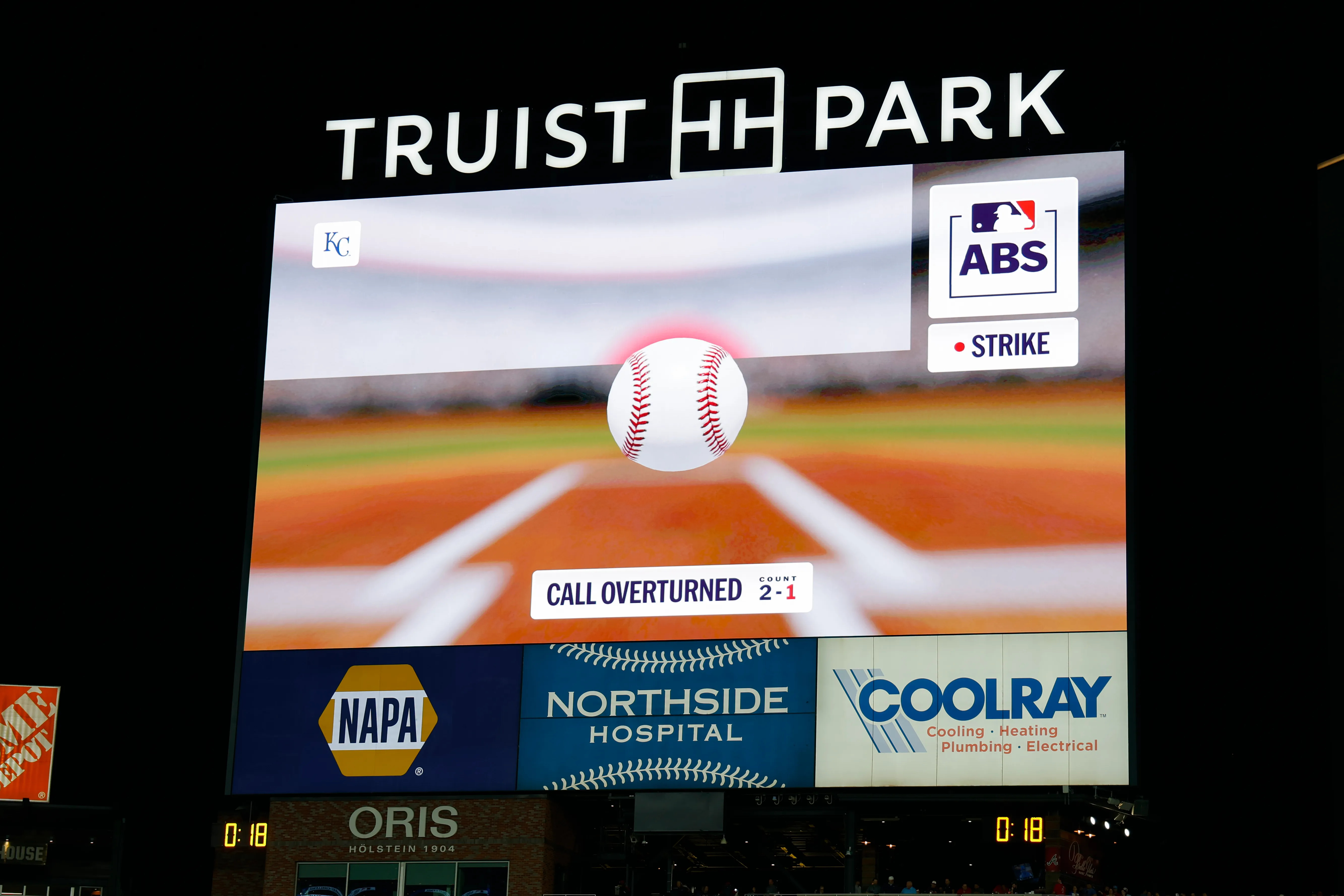
One of the biggest changes in Major League Baseball this season has been the introduction of the Automated Balls and Strikes challenge system. Just two weeks into the season, it’s already a familiar sight: The umpire makes a call of a ball or strike, and someone involved in the play, either a batter or the catcher (rarely the pitcher), taps their helmet because they disagree with the umpire’s judgment call. The umpire announces the challenge and attention shifts to the stadium’s video board, where the disagreement is resolved within seconds.
It’s been heralded as a much-needed improvement in an area of baseball that provided frustration and consternation in years past, and it’s already delivered some fantastic moments: Reds third baseman Eugenio Suarez challenging back-to-back strike three calls from home plate umpire C.B. Bucknor, winning both. (Bucknor would be overturned six times in that game, still the record this season for the single-most overturned calls in one game.) The Orioles ‘walking off’ a win via an ABS challenge that converted a ball call into a game-ending strikeout. Minnesota’s Matt Wallner unsuccessfully challenging a strike call on a pitch nearly five inches off the zone.
Several teams have gotten momentum swings from their successful challenges. But for the Braves, it’s been mostly perceived as a negative, with Atlanta being one of the worst teams at calling for challenges in all of MLB. Why, and is it fixable? Let’s talk about it.
How bad have they been?
Like a lot of things in MLB right now, it helps that the Colorado Rockies still exist when it comes to statistical “accomplishments.”
Atlanta’s offense is 29th in MLB for ABS overturns versus what would be expected, based on Statcast’s new ABS success dashboard. Through thirteen games, Atlanta has seen 3.6 fewer overturns than expected, based on what MLB calculates as a “reasonable” challenge opportunity.
But there’s an important distinction here: fewer overturns doesn’t automatically mean they’ve been bad at it.
Sure, it feels like they’ve been bad because of how often they’ve been wrong. Atlanta’s hitters are just four-for-14 on challenges through 13 games. But while their effectiveness hasn’t been great (29%, 28th in MLB), they’re also using the system more often, which naturally leads to more misses. Atlanta’s 14 challenges entering play on Thursday is 7th-most in all of baseball.
And yes, they’re not properly capitalizing on challenge opportunities - that’s the determination of MLB’s stat from earlier. MLB’s definition of a ‘reasonable’ challenge opportunity has three criteria, with just one of the three needing to be met:
The original call was incorrect
The pitch is within 3 inches of the strike zone’s edge and an overturn would gain at least 0.3 runs
The pitch carries an expected challenge rate1 of at least 20%
And Atlanta hasn’t been capitalizing on those ‘reasonable challenge’ opportunities. MLB’s model has identified 30 opportunities that met at least one of those criteria, but Atlanta initiated the challenge on just six of those. That 18% rate is tied for 16th in the league, middle of the pack despite the aggressive usage of challenges overall.
Diving into the numbers, of Atlanta’s 14 challenges on the season, only five of them came with either two strikes or three balls (and two of those were on full-counts - we’re getting to those.)
By contrast, the Braves have twice challenged the first pitch of the at-bat, once on 1-0, and twice on 1-1. All low-leverage moments that don’t meaningfully change an at-bat.
To recap: they’re challenging more than average, but at the wrong times.
But here’s the thing: When they win, it’s usually a game-changing moment.
When you sort by runs gained versus expectation, again using MLB’s model, Atlanta’s +0.4 is tied for 5th. Only three teams have flipped more walks or strikeouts in their favor; Atlanta is +4 on the season.
Let’s look at the important ones they’ve won, as well as the patterns in their ‘bad’ challenges.
Ronald flips a strikeout into a walk
Ronald Acuña Jr. has not been good at ABS challenges, having lost three of his five attempts this year. And several of them came at…inopportune times, like on a 1-0 pitch in the first inning against Kansas City or on a 1-1 count in the third inning against the Angels.
Both of those failed challenges had the ball at last 2.6 inches off the zone, so not only were they low-leverage moments, but also good pitcher locations to try and challenge.
But the notable win was huge, as it flipped a strikeout into a walk. It was the bottom of the first inning and a full count against Luis Severino and the Athletics, with Ronald successfully challenging a ball that was 0.6 inches off the plate but called a strike.
The run expectancy of flipping that strikeout into a walk came out to six-tenths of a run in Atlanta’s favor, although Ronald immediately squandered all of that by promptly getting picked off of first base. The decision was still a good one, independent of what happened in the next at-bat.
Ozzie flips a strikeout into a walk
If you want to see an overturn that actually resulted in runs for Atlanta, Ozzie Albies is your man. In the top of the 5th against Diamondbacks starter Ryne Nelson, Ozzie successfully flipped a strikeout into a walk after umpire Malachi Moore called a curveball in the zone despite it being over an inch out of the strike zone. Missing the call on a pitch both outside and high is impressive, but umpiring is hard.
Atlanta actually cashed this run in, too, with Dom Smith’s one-out walk pushing Ozzie to second, a defensive error by previously stellar defender Nolan Arenado loading the bases, and a Ronald non-ABS-aided walk bringing Albies in to score. This was the first of eight runs Atlanta scored in the inning, all but one of which came with two outs, so it’s arguable that this game could have been a lot closer had Albies been the first out of the inning.2
Where they’ve gotten it wrong
As we’ve explained at various points in this newsletter, the Braves have had a poor approach as far as when in the game to challenge pitches, as far as what locations they’re choosing to actually challenge.
Atlanta has popped a first-inning challenge three times, the same number that they’ve had in the 8th and 9th innings combined. Obviously, the first impacts the second, as there have been several contests where Atlanta is out of challenges by midgame, never mind the late innings.
The Braves have only four two-strike challenges, the same number of challenges as they have with no strikes.
Here are all the batters who have challenged on the season and their success rates:
Ronald Acuña Jr.: 2-5
Mauricio Dubón 0-3
Michael Harris: 1-2
Matt Olson: 0-2
Ozzie Albies: 1-1
Dominic Smith: 0-1
Anecdotally, there’s no obviously recognizable pattern to the missed challenges other than on the third base side of the plate, as they’ve won both low, outside, and high.
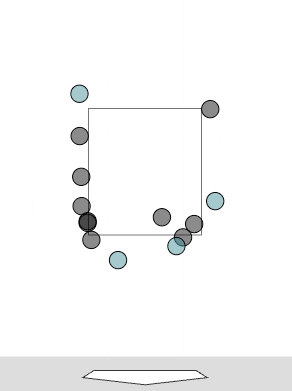
But there’s another side of this, and that’s challenges from the battery.
Atlanta’s fielding challenges are…unspectacular
Atlanta’s “fielding” challenges, which for the purposes of ABS consists of only the pitcher and the catcher, are 7-12 on the season. Jonah Heim is 5-9, with Drake Baldwin being 2-3.
They’re tied for 18th in baseball by overturns vs expected at +1.5 and their runs gained versus expected are 5th at +0.7. It’s a similar situation to the offense; Atlanta’s catchers (and it’s entirely them, as no Braves pitcher has challenged a pitch this year) are winning key challenges that are boosting their run expectancy.
Atlanta’s backstops have flipped four ball calls into strikeouts, one of which would have been a walk. They’ve also flipped a walk back into a 3-1 count, although Corbin Carroll would end up walking on the very next pitch anyway.
Unlike the offensive situations, there is a clear pattern here for Atlanta’s catchers: They’re excellent on the edges of the zone, especially on up and in pitches, but still hit-or-miss at the bottom of the zone.
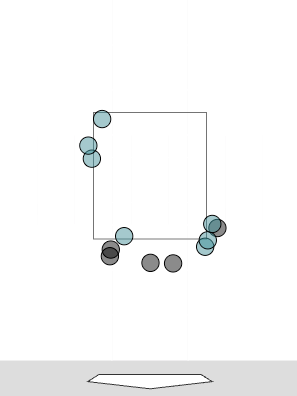
And if you think about it, that tracks - the sides of the zone never change, but the top and bottom is adjusted by ABS based on the hitter’s height. The ABS strike zone’s upper bound is 53.5% of the hitter’s measured height, while it’s 27% of that height on the lower end. Braves catchers are clearly more comfortable with the immovable sides than the continuously variable bottom of the zone, away from the direct sight line of the umpire and subject to parallax.3
Bad results, or bad timing?
So what’s the takeaway here?
The Braves haven’t been bad at ABS challenges; it just feels that way.
They’re using the system more than most teams, which comes with more misses. The real issue is when those challenges are happening, not just how often they’re winning them.
And the upside is pretty obvious: when they do win, they’re flipping at-bats in meaningful spots.
Clean up the timing, be a little more selective, and this probably looks very different a month from now.
This isn’t a broken system for Atlanta. It’s an untapped edge.
This is derived by a model that accounts for pitch location, number of remaining challenges, runners on, and ball/strike/out situation.
To clarify, run expectancy doesn’t give any extra credit for the runs that scored later in the inning - it’s looking at the probability of a run scoring on both sides of the specific count/situation/play and giving you the credit for the difference when you win.
I’m aware that this isn’t the exact definition of parallax, which is more related to the shift of an object’s position relative to more distant background objects caused by a change in the observer’s position. It’s most frequently observed when you ride in a car and look out the window; the objects closer to the vehicle appear to rapidly flash through your field of vision because the objects in the background look like they’re barely moving by contrast.
Timely and important topic. I'm a big fan of Weiss but I think he needs to lay down some guidelines for early in the game and non-critical situations. Your data is interesting but I still come away thinking that Acuna and Heim don't have the skill (at judging the strike zone) at this point to risk wasting challenges early on. What I think is really cool about the ABS is that everyone - players and umpires - is going to improve in their ability to judge a pitch as the season progresses.
I hope the ABS system leads to a relegation policy for umpires from the majors to single A.