


The home appliance brand Maytag launched a brilliant marketing campaign in 1967, featuring veteran actor Jesse White as “Ol’ Lonely”, an appliance repairman who worked for the company and was bored out of his mind. The premise of the campaign was that Maytag appliances were so reliable that he didn’t have anything to do.
It was wildly successful, with Maytag able to solidify a reputation for durability and reliability, which allowed them to charge a premium cost above the market at the time.
Atlanta’s rotation the last few seasons has been the exact opposite of that. Among pitchers with 50 or more innings as a starter in the last two years, a list that has 12 names on it, exactly two of them (J.R. Ritchie and Tyler Mahle) didn’t go on the injured list in that span. Of the remaining 10, eight of them have been on the 60-day injured list, with only Bryce Elder and Martín Pérez immune from a multi-month absence.
Bringing back Tyler Mahle, who is currently a free agent, won’t necessarily be exciting…but he doesn’t need to be if he’s the guy capable of keeping the refrigerators running.
Let’s talk about it.
Don’t confuse post-deadline Mahle with who you’re getting
No starter moved at the MLB Trade Deadline had a lower ERA than Tyler Mahle’s 1.99. Not All-Universe lefty Tarik Skubal, who had a 2.61 and will be the most sought-after free agent this winter. Not Freddy Peralta, who washed off the bad Mets juju with a 3.25 ERA in Tampa Bay as part of a World Series run.
But at the same time, context is important. He was not good early in the year with the Giants, partly owing to injury and partly to some arsenal changes they tried to force on the righty:
San Francisco: 94⅔ IP, 5.13 ERA
Atlanta: 54⅓ IP, 1.99 ERA
Full season: 149 IP, 3.99 ERA
And while Mahle’s results rebounded well in Atlanta when they simplified his approach down to almost essentially just four-seam/splitter, the process results show that he was still a bit lucky in his performance.
Mahle finished his Braves stint with an expected ERA of 3.59 - nothing to sneeze at, but an overperformance that even Alex Anthopoulos wasn’t expecting. When asked by 92.9 The Game’s Carl Dukes and Mike Bell about the trade, he was very clear that Atlanta didn’t expect that version of Tyler Mahle. “Hell no. Hell to the no. Did we think he was good? Yes. Did we think he’d be better (than he was in San Francisco)? Absolutely.”
But even a mid-to-high-3s ERA pitcher who can reliably post would be a benefit for Atlanta, which has injury concerns through the entire rotation and a need to find 200 dependable innings this winter.
Atlanta should not pay Tyler Mahle expecting another 1.99 ERA. FanGraphs certainly doesn’t, projecting the righty to get a two-year, $30 million deal in free agency and reward his signing team with a Steamer-projected 4.10 ERA in year one.
And honestly, a 4.10 ERA over 150-ish innings isn’t exactly sexy…but on this particular Braves roster, 150 mid-rotation innings has real value.
Why the Braves version looked different
Atlanta simplified Mahle’s arsenal after the trade and paired him with an excellent defensive catcher in Sean Murphy. They largely shelved the cutter and the slider, leaning a lot harder on his excellent splitter.
The downstream effects of throwing his better pitches more often were a bump in getting out of jams. Mahle had absurd luck at stranding runners, putting up an 87.4% Left On Base (LOB) rate with the Braves. With San Francisco, it was 69.1%. (For context, the MLB average for starters last year was 72.3% and Mahle’s career average is 74.7%).
Mahle was also better able to locate in general, lowering his walk rate from 3.5 BB/9 with San Fran to just 1.5 BB/9, a cut from 9.2% to just 4.3%. That, too, was well below Mahle’s norms, with the righty carrying a career 8.3% walk rate.
The additional splitters in the usage charts helped Mahle with his same-handed platoon issues, lowering his OPs from .848 before the trade to .573 during his early Atlanta run.
But the biggest thing Atlanta got from Mahle down the stretch is something replicable: proof of concept.
Pitching coach Jeremy Hefner already knows what he wants Mahle to do on the mound, and Mahle already knows that it works. This isn’t some sort of “give him a to-do list and send him to Maven during the lockout” hypothetical pitching-lab fix; the experiment’s done, and it worked.
Is he really dependable, though?
Regular listeners of the Braves Today podcast know my thoughts on pitcher health: there’s no such thing as a healthy pitcher, just one that isn’t currently hurt.
But even by those standards, calling Mahle “dependable” starts to sound a bit insane if you zoom out far enough. Across a three-year span, from 2023-2025, he threw just 125 innings across 24 starts due to needing Tommy John surgery and shoulder issues.
(Also worth pointing out: 2.66 ERA/3.99 xERA in that stretch. Maybe he’s just one of those guys that can perennially overperform the estimators a bit?)
Despite a brief IL stint for a hamstring issue in the 2026 season, he still surpassed that workload with a 27 start/149 inning season, a massive workload jump.
He’s not dependable in the “I’m Logan Webb and have thrown 980.2 innings over the last five seasons” sense. He just has the semblance of dependability as compared to the rest of Atlanta’s current rotation options.
And given what the Braves have dealt with over the last two seasons when it comes to their rotation, that might be good enough.
How much is boring worth?
I don’t know, and most of the market doesn’t, either. Mahle has massive variance in his free agency projections, with both the term and contract varying widely depending on who you ask and their methodology:
FanGraphs: roughly 2 years/$30–32M
Baseball America: 1/$20M, with 3/$45M floated if he wants security
MLB.com’s Braves coverage: asks if $15–18M annually over multiple years makes sense
Spotrac is way more aggressive: 3/$63.3M.
And honestly, those various amounts genuinely will probably change your feelings on the matter:
Two years and $32 million is a pretty easy yes - that’s $16 million a year, the same that Robert Suarez will get to close for Atlanta and less than four other players on the roster.
Three years and $45-54 million is still pretty defensible, as it’s $15-18 million per year. Honestly, my bigger concern there is with the term rather than that price - we’ve all been a bit burned by several pitchers (Reynaldo López, Joe Jiménez) making real money for multiple seasons while on the injured list.
But three or four years at $20+ million per starts to place a premium price tag, in both years and dollars, on “boring”.
The contract I’m most comfortable with, trying to find a reasonable middle ground here, is something like three years and $50-ish million. The team’s a big proponent of club options to get an additional year on the back end, but a pitcher might be the perfect use-case scenario for some sort of incentive-escalating-or-vesting option.
If injuries have been the limiting factor so far and you want reliability, incentivize that. Under the current Collective Bargaining Agreement, you can’t tie bonuses to ERA or strikeouts. You can, however, pay playing-time incentives (innings or starts) and award finishes are fair game.
What if Atlanta had a 3/$48 million structure as a base, but included bonuses for innings thresholds and award finishes? 150 innings could trigger a $3M bonus, or an escalator could raise the following season’s salary by $3M–$5M. We’ll also reward you for Cy Young votes, establishing bonus amounts for finishing in the top five, or even automatically vest the club option (or convert it into a player option) if you achieve certain combinations of innings and award finishes.
Here’s an example of that in practice: Jacob deGrom’s contract with the Texas Rangers. He has a $20 million club option for 2028, his age-40 season, but it can vary based on his performance in the prior years of the contract.
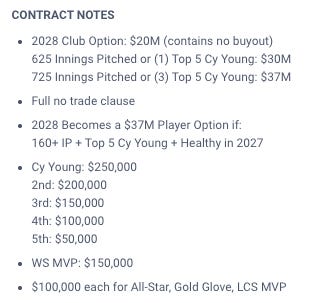
deGrom has both escalators in the contract for cumulative performance over the life of the deal (which he did not hit) and a 2027 vesting setup that both increases the pay and converts the club option into a player option if he has an absolutely amazing year in 2027.
Why not do the same for Mahle?
What Mahle allows Atlanta to not do
Assuming the righty’s pitching closer to his Atlanta version than his San Francisco version, bringing him back does a lot for the Braves.
For one, it prevents Atlanta from needing to depend on Spencer Strider to give 150 mid-rotation innings, and it allows them to remove all expectations from Spencer Schwellenbach. Just make it back to the mound, kid.
Having seen how Mahle’s stuff can work in October against some of the best teams in baseball, when he held the Phillies and Dodgers to just two earned runs in 13.1 innings, it also prevents Atlanta from needing to force Didier Fuentes into a playoff start after what would be the longest professional season of his career from a workload perspective.
And adding Mahle’s existing workload to this Braves rotation prevents Atlanta from needing to force JR Ritchie, Owen Murphy, or AJ Smith-Shawver into a full-time rotation spot just because one starter went down. (Hopefully it’s also enough to avoid needing to acquire a back-end starter at the trade deadline just to eat innings, but a lot of that depends on how those three do with their next rotation opportunities.)
Atlanta still needs to add some upside to the starting pitching group, whether that’s a jump from a prospect or the addition of someone with Stuff (like Dustin May’s 111 Stuff+) or the ability to miss bats (Kris Bubic’s 25.9% whiff, or Kevin Gausman’s 27.7% mark).
Bringing Tyler Mahle back doesn’t solve all the rotation’s issues. But it does change the number of things that have to go right.
The Braves have spent several seasons now trying to squeeze upside and value out of every rotation spot. Sometimes, that’s gotten you Spencer Schwellenbach. Other times, it’s resulted in Atlanta needing a random veteran waiver claim to give them four decent innings on a random Tuesday in August.
Mahle doesn’t win the press conference. No one’s photoshopping him in the Braves jersey when the deal’s announced. But Atlanta doesn’t need Mahle to be appointment television, always matched up against the opponent’s ace. It needs him to make sure nobody has to call the repairman.
The impressive aspect of Mahle's skills to me was his 93mph fast ball command. He was able to get ahead of hitters and get them out by nailing the perimeter of the strike zone. His splitter was helpful, too, of course, but hitting his spots without leaking into middle/middle is a great skill that the young guys like AJSS and Murphy would do well to emulate. Easier said then done.
I would support resigning Mahle ONLY if the resigning is in addition to signing a higher-level starter like Sonny Gray.