


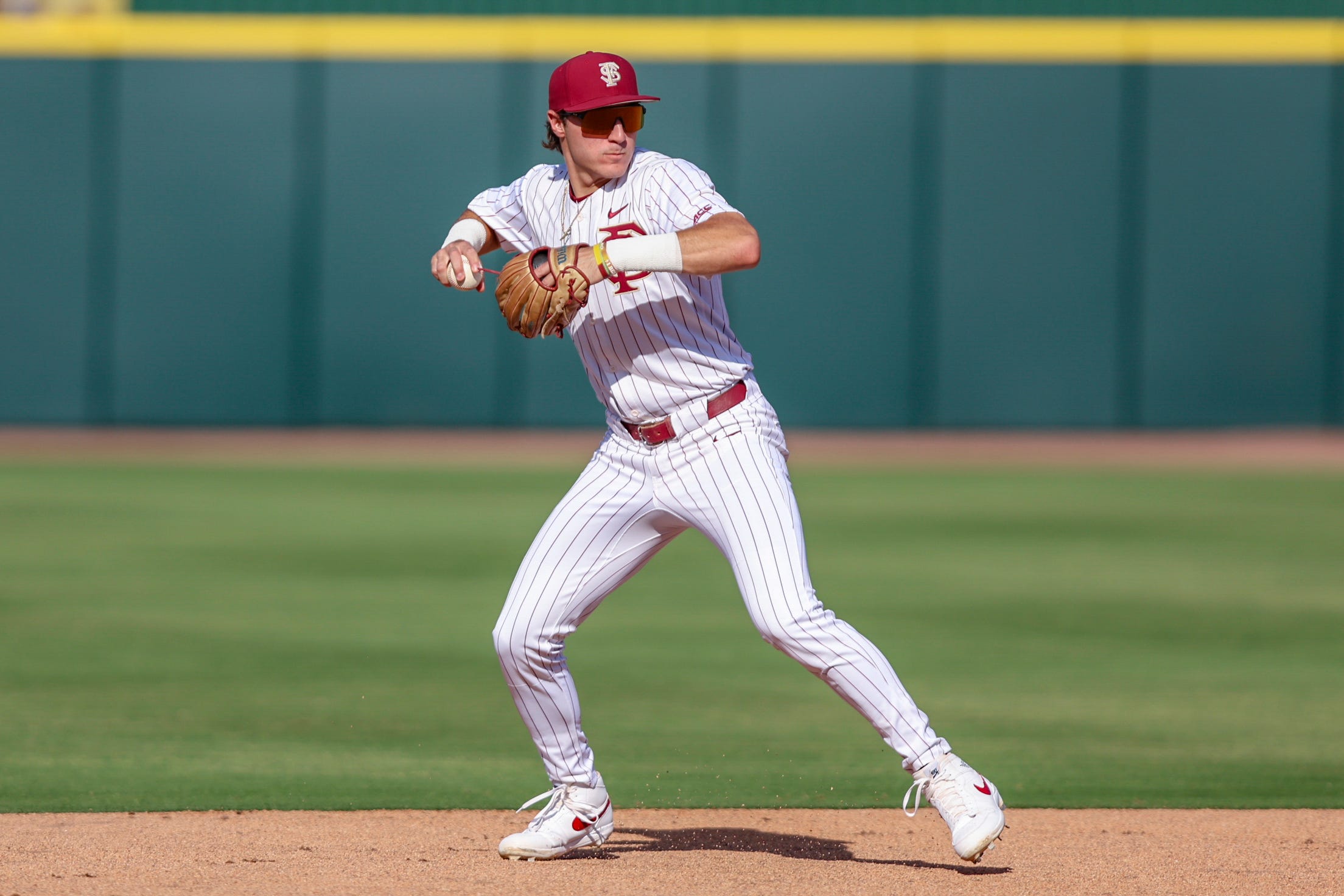
You’d be forgiven for thinking that shortstop Alex Lodise, taken in the 2nd round of last summer’s MLB Draft after a productive career at ACC powerhouse Florida State, would be a fast riser through the Atlanta Braves farm system.
A consensus All-American and team captain who won 2025’s Dick Howser Trophy, college baseball’s most prestigious individual award, Lodise finished 9th in the country in hits and 12th in hits per game while hitting .394/.462/.705 with 17 home runs and six stolen bases. That’s the profile of someone who debuts in the majors less than two years after being drafted, right? It sure sounds like the profile of a shortstop destined to join the league’s best at the position in short order.
Braves scouting director Ronit Shah said as much after day one, telling us, “He’s really impressive—speed, athleticism, power. Just the production he’s had in a big conference. It’s definitely a possibility (that he moves up quickly).”
Not so fast, my friend. Lodise fell to the 2nd round for a reason, being taken at pick 60. And while his defense is probably Major League caliber already, his offense might be a bit of a slow burn. Let’s talk about it.
Let’s talk about his professional debut
After Lodise signed his contract, he was assigned to High-A Rome on August 1st and got to work. Across 25 games and 109 plate appearances, Lodise hit .252/.294/.398 with one home run (on the road, naturally) and one stolen base.
He also struck out 42 times, opposite just five walks, which translates to a 38.5% strikeout rate and 4.6% walk rate.
For someone who struck out only 20% of the time last season at Florida State with a 9.8% walk rate, this was an alarming regression. What happened?
In short, his chase rate once again reared its ugly head.
None of that changes the long-term outlook, but it does clarify what the first phase of Lodise’s development will likely look like.
In college, Lodise was an incredibly aggressive hitter, swinging over 50% of the time and expanding his zone quite a bit. His 35.6% chase rate was 7th percentile among major conference players and rose to 41% against breaking balls.
When you look at his statcast card (below), it’s awfully reminiscent of some of Atlanta’s pre-Tim Hyers power hitters - lots of swings, chase, and strikeouts, but when they make contact, it goes a LONG way.
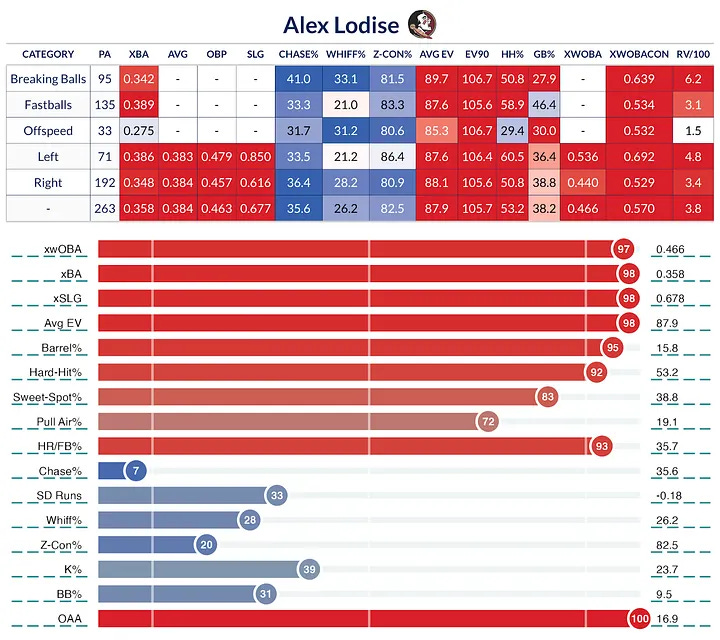
And in his defense, Lodise’s batted-ball metrics bear this out. He was among the best in college last year at both hitting the ball hard (92nd percentile hard-hit rate of 53.2%) and hard in the air (95th percentile barrel rate of 15.8%). He also excels at getting out in front of pitches, pulling the ball in the air almost 20% of the time, a formula that lends itself well to hitting for power in the majors.
That chase did not disappear in the minors, with his college swing rate of 53% being virtually matched by a 54% swing rate in High-A and a chase rate within mere points of his college figures.
In other words, he was the same player, but the pitching got better. Every arm in High-A was one of the best pitchers on their college or high school team, so it’s like facing a Friday night starter every single at-bat.
I recently spoke with Gaurav Vedak, Braves prospect guru for Battery Power and Peach State Prospects, who validated my feelings on Lodise.
“He was drafted with flaws, and that’s in his overall approach. His chase rate is pretty high. Last year, in his cup of tea in professional baseball, not the greatest numbers - lots of strikeouts. When you look at his at-bats, again, it was still chasing up high, trouble with some of the breaking stuff.”
The good news is that the Braves have made improvements in this area with several of their prospects.
How to build a hitter
I’m of the personal opinion that the best hitters are naturally gifted in a way that you can’t teach. But unless you’re drafting in the top five every single season, you’re going to add a player with flaws, and it’s the organization’s job to fix them.
There are two main schools of thought here when it comes to making a well-rounded hitter.
The first is to get a contact-oriented hitter and train them to make more impactful contact. The Cleveland Guardians have largely stuck to this approach with mixed results, although the Boston Red Sox have had some notable recent development hits in taking contact hitters like Roman Anthony and Marcelo Mayer and specifically training their bat speed.
The second approach, the one Atlanta has taken at times, is to find impactful hitters and work on their approach. This takes several different forms, but most commonly can be summed up by the mantra “Hit strikes hard”. The team is trading some whiff in the zone and a bit of chase in favor of punishing hittable pitches with an A swing. It’s a more ‘all-or-nothing’ approach, as these are guys that already have power but may never get to it if they can’t cut down on the swing-and-miss.
Isaiah Drake is a hitter that Atlanta has been successful with moderating the approach to cut back on whiffs and strikeouts. Here are his Single-A stat lines from his first two professional seasons after the Braves selected him with a 5th round pick in 2023:
2024: 69G, .163/.259/.252 w/ 32 BB, 100Ks (35.3% K)
2025: 84G, .260/.341/.364 w/ 39 BB, 82Ks (22.5% K)
Drake went on to get a month in High-A at the end of last season, hitting .303/.346/.336 with a 17.7% strikeout rate in a small 32-game sample.
Lodise needs this approach change, as well as some structural tweaking to his swing. It naturally grooves down-and-in, meaning he’s often under on fastballs and inside on sliders.
The defense will play
Baseball America classified Lodise as the best defensive infielder in Atlanta’s system, and team officials echo that sentiment. “He’s a plus shortstop in our eyes, no doubt about it,” said Shah on night one of the draft. “He’s making highlight plays, making the routine play look easy and also making the spectacular play look easy. We’re really excited about him.”
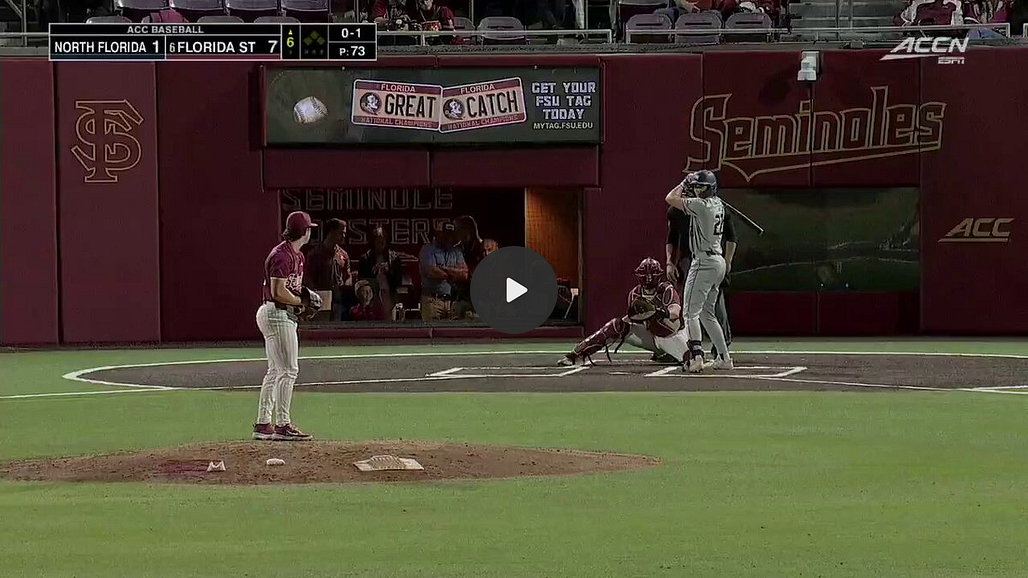
The stats bear this out. His Outs Above Average mark of 16.9 ranked in the 100th percentile among major conference players last season, while his arm and lateral agility both appear to be above-average to plus. Here’s an example of Lodise flashing both, executing the Derek Jeter jump throw to nail a North Florida runner during a midweek contest.

Lodise finished with a .977 fielding percentage and just five errors in 216 defensive chances, being named the ACC Defensive Player of the Year.
What’s the ceiling here?
I’m not a big fan of player comps - it’s too easy for fans to get outsized expectations if the wrong player is chosen as a comparison of the prospect’s potential major league production.
But stylistic comps, using another player to illustrate what his skill set could look like in a 90th percentile outcome, are right up my alley.
For Lodise, the package is reminiscent of Dansby Swanson for me - an above-average defender who can make all the routine plays (and several of the exciting ones) thanks to surprising range. Offensively, he likely won’t ever lead his club in batting average, but his power ceiling could be in the 20-25 homer area.
This isn’t a perfect comparison, as Lodise has a better arm than Swanson, while Dansby never ran a minor league strikeout rate over 20%. But the basic profile - a power over hit shortstop with a potentially special glove - absolutely tracks.
Now, can Lodise meet those expectations? Ask again in two years.
Independent soures seem unimpressed with last year's draft. Organizational Depth. Except Connor Essenburg.
He has Bat speed, power and Big Time thowing arm from left field.
They see Southisene in the outfield, probably centerfield. He does have power and speed if he can hit professional pitching.
The rest are considered utility players.
Serious doubt the NC pitcher can add to his fastball, small frame
Really like adding Jonah Heim at Catcher.
He hits lefthanders and is a fine receiver. As i remember him from his Oriole days
You’ve said a few times that you consider amongst the ss prospects we have as the floor option. I gotta disagree. I think given the profile when they came in he could be somewhat Austin Riley-lite with the offensive profile with a plus glove. But the approach has a long way to go. That sounds like a ceiling option to me.