


Modern fighter jets aren’t built around one hydraulic system anymore.
They’re built around backups for the backups, because engineers learned long ago that a single point of failure eventually becomes catastrophic.
Bullpens are starting to work the same way. And the Atlanta Braves, despite their reputation as a financially conservative organization, are spending like a team that understands it.
Atlanta’s bullpen currently carries the second-highest payroll in baseball, trailing only a Mets group inflated by starter Sean Manaea’s salary shifting into relief. And this isn’t some one-off splurge - they’ve been top six every year since 2020, including being the most expensive in 2024.
Around baseball, contenders are increasingly treating bullpen innings like a premium resource instead of an accessory. The Dodgers spent heavily to build layers of late-inning depth. San Diego did the same, albeit with a combination of money and prospect capital.
But the Braves aren’t building their bullpen quite the same way.
This isn’t just about paying for a closer and surrounding him with spare parts. Atlanta has quietly built a relief corps around flexibility, redundancy, and role conversion. They’ve moved starters into relief, relievers into starting roles, and appear increasingly willing to use pitching prospects in unconventional ways if it helps the major league roster.
That philosophy may explain why Reynaldo López ended up back in the bullpen after succeeding as a starter. It may also explain why top pitching prospect Didier Fuentes has been helping Atlanta this year, despite not being in a traditional rotation role.
The Braves aren’t just spending money on relievers. They’re building redundancy.
And so far, it appears to be working. Let’s talk about it.
Bullpens Aren’t Just Bullpens Anymore
Around baseball, starting pitchers are actually pitching less than ever before.
The share of the league’s innings through Saturday that were covered by relievers is an astounding 42.4%. As recently as 2016, that number started with a “3”, at 36.7%.
And not only are they pitching more, but they’re also better. The league’s average fastball velocity keeps climbing, with four-seamers sitting at a new high of 94.6 mph. League batting average continues to fall, dropping from .270 in 2000 to .255 in 2016 and sitting at just .240 this season. Strikeout rates are up, seemingly every single year, although this year so are walks, which players think is fueled by ABS.
Bullpens pitch more than ever, in a league where it’s harder than ever to get a hit and score runs, meaning that these innings are more important than ever. And this only increases in the postseason, as teams go from their regular-season strategy of avoiding a starter facing a hitter for the third time to sometimes pulling them before they get into the order a second time.
So is it any surprise that some of the top teams in baseball, the ones that have World Series aspirations every season, are investing in their bullpens?
The common consensus in free agency is that one WAR costs about $11M on the low end in free agency; it’s more expensive if you’re going from two WAR to four WAR than it is from one to two. But this math doesn’t track for relievers, as even the best relievers are dwarfed by midrotation starters. Matthew Boyd pitched 179.2 innings of 3.21 ball and earned 3.4 WAR last year, dwarfing reliever Cade Smith’s 36th-place mark of 2.7 WAR that led all bullpen arms.
WAR is an accumulation stat. Relievers just don’t have nearly as many chances to accumulate it.
If you think of the value of reliever spending not in dollars per WAR, as with most free agent acquisitions, but rather championship Win Probability Added, LA’s addition of Edwin Diaz at $21.02M for this season makes a lot more sense. The concept of large investments in the bullpen make more sense.
And that’s the pattern the Braves took. They learned a lesson from last season and diversified their investments, making sure they had a well-rounded and deep bullpen that’s added legitimate value to the roster by shortening games and allowing manager Walt Weiss to be incredibly aggressive about when he pulls his starters.
The way they did it is fascinating, too, because it’s a lesson in learning where your strategy failed and adjusting.
The Braves Learned Their Lesson
Last season’s bullpen was, charitably, Raisel Iglesias and “the boys”.
It wasn’t a good offseason for Atlanta’s relief corps. AJ Minter left in free agency after the 2024 season. Grant Holmes moved to the rotation, while Joe Jiménez had knee surgery and missed the entire year.
And among Iglesias’ remaining running mates, there were still cracks in the armor. Aaron Bummer’s stuff continued its downward slide, reaching its nadir last week in Miami and causing his outright release. Daysbel Hernández struggled with consistency and health, missing a month midseason and ending the season on the injured list. Dylan Lee, given a career-high 74-game workload, saw his home run rate skyrocket in the second half and took his ERA with it.
It meant that when Iglesias was struggling with homer issues on his slider in the first half and was briefly demoted in June, there was no one to logically step in as the closer in his stead. Curveball specialist Pierce Johnson gave up two consecutive walkoffs in San Francisco before the Braves pivoted, trying other options before quickly reinstalling Iglesias in the 9th.
So the Braves adjusted. They learned from their mistakes.
The first adjustment was adding another proven ninth-inning arm behind Iglesias. It worked in 2023 with veteran Kirby Yates, who had five saves while backing up Raisel Iglesias. It’s working now with free agent signing Robert Suarez, who went from leading the NL in saves last year with 40 to working as Iglesias’ setup man.
They also became a lot less rigid with their bullpen roles under new manager Walt Weiss. We’ve seen Suarez enter games as early as the sixth inning, because that was a high-leverage moment. We’ve seen the Braves ‘steal’ outs against the bottom of the order with lesser relievers, saving the top leverage arms for the most dangerous hitters.
We’ve also seen the Braves cast a wider net for relief help than just free agent signings.
The Reynaldo López Blueprint
The new modus operandi of the Braves can best be summed up by what they did with Reynaldo López - he was struggling in the rotation, with faulty mechanics that saw his velo drop to unsustainable levels, so they pulled the plug on him as a starter and moved him to the bullpen.
It’s a role that is familiar, as he was an elite reliever prior to signing with Atlanta.
From 2021 to 2023, López pitched 189 innings of 3.14 ERA ball, collecting just six saves but finishing 27 and climbing the bullpen ladder to become a desired setup man.
And with the velocity returning, the Braves suddenly have another potential leverage weapon.
The mechanical issue he’s been chasing for several years reared its head again this season - he was struggling to generate velocity because his kinetic chain was out of sequence, so he wasn’t adequately transferring force from his legs all the way into his right arm.
The good news is that the Braves seem to have fixed it.
Here’s a side profile video of a 97.1 mph fastball from his March 28th start.
Now here’s the same side profile shot, on the same mound, of an 89.9 mph fastball from April 14th.
It’s a subtle difference, but the timing of his weight transfer is delayed in the second clip, impacting his ability to transfer force from his legs into the baseball. You can see it a little more clearly in a freeze frame at the apex of his leg kick - the slower fastball features a more upright posture, indicating that he hasn’t yet begun to gather force downhill for the pitch.
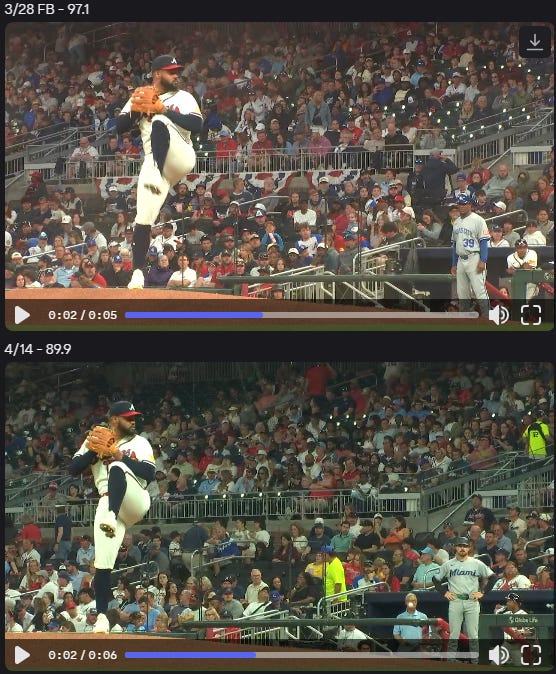
Without access to biomechanical tracking data, we’re mostly left analyzing the video frame-by-frame, Zapruder-style. I’d imagine a markerless motion capture biomechanics setup would be able to identify some timing issues with when his hip rotates, when his shoulder closes, etc that were all combining to disrupt his delivery.
Here’s a video from May 14th, the first time he threw over 96 mph since the bullpen move:
His original mechanics are back, starting the movement down the mound while in the leg kick, and with that change returned the velocity. His Stuff+ has increased, as well, rising from a combined 84 in the last start to an even 100 in this outing.
It’s still not where it was in 2023, when he sat at 113 for the season and had an absurd 131 Stuff+ on the slider, but it’s improving.
Suddenly, the Braves have a reliever that understands how to pitch in leverage, from his time as a backend guy, but also has the stamina and experience of pitching multiple innings from his last few seasons of rotation work. It’s another in a line of Atlanta “Swiss Army knives” they’ve found, like Grant Holmes in 2024 and as was the plan for Joey Wentz this season.
Didier’s Different Development Curve
Didier Fuentes was not ready when he was called up last year. Throwing only a fastball and a nascent sweeper he couldn’t really command, the youngster was knocked around for 20 runs in 13 innings, giving up six home runs and walking six.
He looks like a different pitcher now, in both stuff and in composure. Fuentes is throwing a hard gyro slider and a splitter, although the offspeed is still a work in progress.
And the Braves are using him in relief. I asked Alex Anthopoulos about this very possibility back in December, inquiring about why the team didn’t use starting pitching prospects in the bullpen more often.
The answer I was given was that it’s all about getting these guys reps as they’re developing, and that’s just too hard to do in a bullpen.
“You stick to these guys in the rotation from a development standpoint, right? Even though you ultimately might believe that they’re relievers, you want them to get as many reps as they can, as many innings as they can have, bullpens, side work, go deep into the games. You have a guy in the minors who’s a one-inning reliever, you might have a 10-pitch inning and not really get to work on things.”
He also alluded to their work on constructing the best bullpen with the pieces they have, and usually, a starting pitcher prospect isn’t part of that equation.
But Fuentes isn’t a typical starting pitcher prospect.
The youngster wields a unique fastball, one with very good velocity (avg 97.1 mph) and an outlier Vertical Approach Angle (-3.94) that makes it a deadly weapon up in the zone. He’s also overly reliant on it, throwing it upward of 65-70% of the time in spring training.
So they put him in the bullpen.
It served a few purposes. The first is allowing him to work on improving his secondary pitches, specifically the splitter, with the help of the MLB coaching staff. It also let him manage his workload, with the youngster’s 70 innings last year meaning he wouldn’t have been able to absorb much more than 115 or 120 innings as a starter this year.
But it’s also allowed him to spend time around fellow Latin relievers Iglesias and Suarez, which he said has been invaluable.
And just because Fuentes is learning how to be a leverage reliever, including pitching in his first back-to-back last week, that doesn’t mean he’s incapable of moving to the rotation next season. It’s a well-worn developmental path, whether it’s recent examples in Spencer Strider (2022) and Max Fried (2018) or even veterans like Chris Sale (2011).
Why This Works Financially
The Braves may never be in the running for the top-tier free agents, the ones that are either signing a contract for a total amount over $300M or an annual salary that’s clearing $30M or more.
But they are willing to spend heavily to get some certainty and options in the back end.
It’s got a few advantages. Bullpen depth protects the rotation, where Atlanta prefers to either build from within or find a value move like buying low on an oft-injured veteran (Chris Sale) or convert a reliever (Grant Holmes, López). If you’re concerned about the ability of a newly-stretched-out reliever to cover six innings, you can go five-and-dive knowing that there’s either a plethora of high-octane arms or a piggyback ready in the bullpen to finish out the game.
The value lines up better here, too, with even mediocre rotation options that can post commanding full freight in free agency.
But leaning into the flexible nature of the front of the bullpen with multi-inning options also means that there’s less need for a desperation trade or call-up. We wrote over the offseason about the Braves burning pitching prospect options too quickly. Most of this stems from an extraordinary number of injuries that have depleted the team’s rotation depth, but also from a lack of flexibility in the pitching staff as a whole to cover innings.
The Braves may not see a meaningful distinction anymore between anyone but the top starters and relievers.
They see innings. High-leverage innings. Developmental innings. Recovery innings. October innings.
And increasingly, they seem willing to pay premium prices and look everywhere to secure as many of those innings as possible.
Great analysis and article. 27 outs… it’s all that matters. In the game today, how you get them is changing and I give the Braves a lot of credit for adjusting in 2026. SPs are still extremely critical, but the injury risk (look around the league right now) and cost are out-of-whack. It struck me when Fried signed an 8 yr, $218 million comtract. I really wanted to see Fried stay in a Braves uniform. But, when you do the math… it’s a no-brainer to spread your investment over a greater number of arms and build flexibilty. The math: Assume Fried (not picking on Fried, it was close to a market contract) provides an average of 150 IP over the next 8 years. That’s $180k/IP. That investment could provide 5-6 quality arms?
Quite an elaborate article. You clearly have great admiration for AA et al. With McGuirk having his finger deep in the workings of the front office, I'm not sure I feel as confident - but given their great start to 2026 I am willing to give AA the applause he may be due. It may be that the best decision he made was hiring Weiss and a new pitching coach.
I really wish someone (you?) would do a retrospective (4 years?) tally of roster decisions (FA signings, trades, minor leaguers promoted, player extensions, players released or DFA'd). An ongoing tally for all MLB teams would be fascinating to follow and compare but would need a dedicated staff, I imagine. Just comparing the Braves to the Phillies over the past 4 years would be interesting. I'm sure AI could help.