


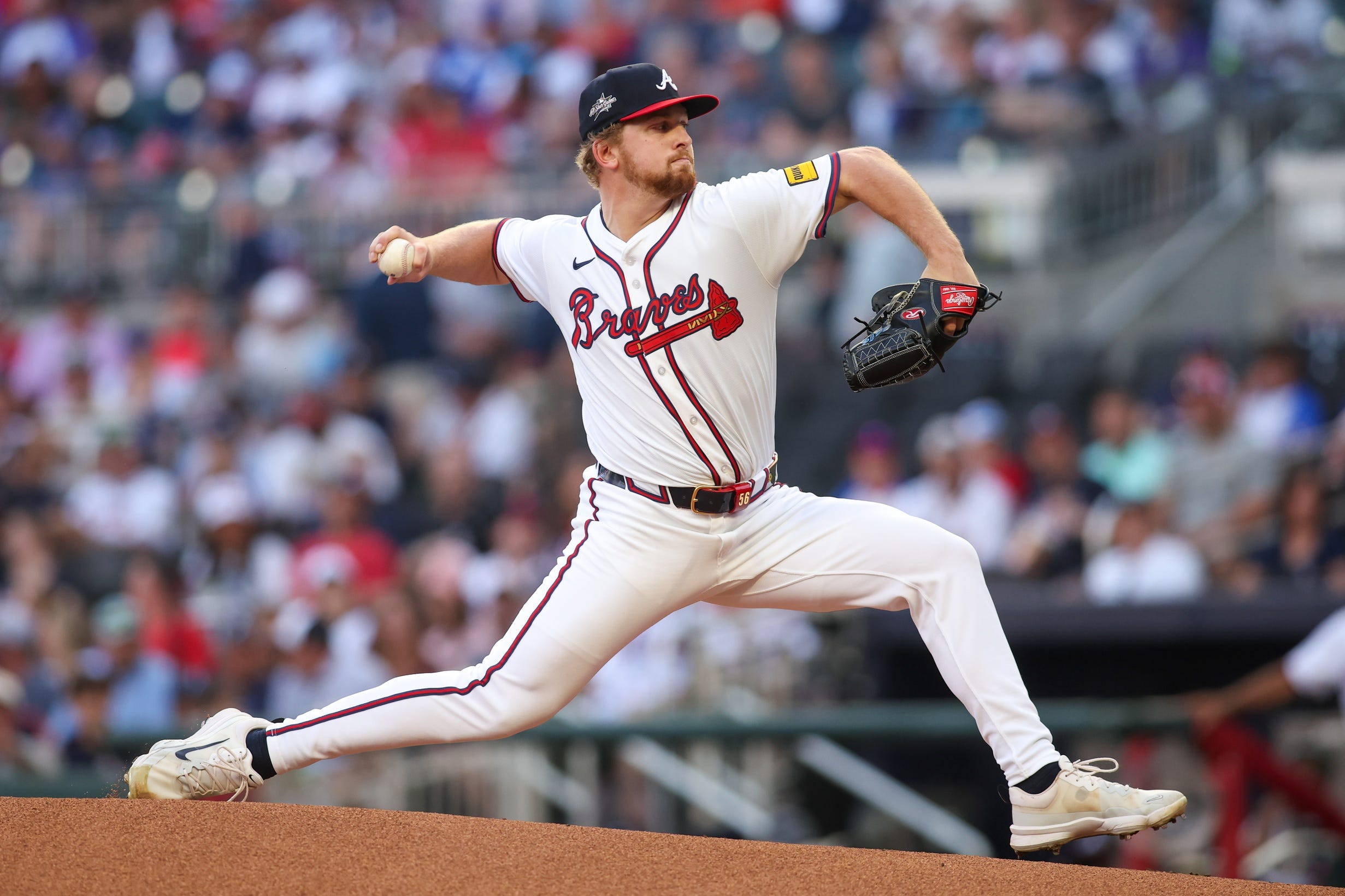
It wasn’t yet lunchtime on day one of Atlanta Braves spring training, and the team was already dealing with injury issues. Twenty-five-year-old right-hander Spencer Schwellenbach will begin the season on the 60-day injured list, per a team announcement, with right elbow inflammation. While Braves manager Walt Weiss said the team believes the issue is limited to bone spurs and that no surgery is currently scheduled, the news is a frustrating continuation of the pitching health problems that defined much of last season.
More importantly, it forces Atlanta back into a familiar early-spring question: can the organization once again patch together enough internal innings, or is this the moment to look outside the organization for rotation help? Let’s talk about it.
Yes, there are internal options
A logical first step is to see whether the Braves can reasonably cover the innings internally before exploring the trade or free-agent markets.
Atlanta does have some immediate depth options, though each comes with varying degrees of certainty. Bryce Elder has already shown he can handle stretches of a full-season rotation workload and remains the most straightforward plug-in candidate if a spot start or temporary turn is needed. Hurston Waldrep offers the highest upside of the upper-level depth arms, but the organization may prefer to keep his early-season innings managed at Triple-A rather than accelerate his usage in March. Grant Holmes and Joey Wentz also provide multi-inning flexibility and could serve as either spot starters or bulk relievers if the Braves choose a piggyback approach early in the year.
Beyond that group, the remaining upper-minors starters - including prospects still building workload capacity or refining command - are likely viewed more as midseason reinforcement than immediate Opening Day solutions. That reality is what makes Schwellenbach’s absence more complicated than a typical early-spring injury: Atlanta has options, but not many that project as clear, low-risk rotation answers over multiple months.
Assuming no external additions are made, the Braves now have four names vying for two Opening Day spots behind the remaining three ‘locked-in’ arms:1
Bryce Elder
Grant Holmes
Hurston Waldrep
Martin Pérez
That group can cover innings. The bigger question is whether it can cover quality innings over multiple months.
The issue here is that the Braves lost both ends of the injured pitcher gamble: It was a postseason starter, not a back-end arm, who went down, and the absence is long-term rather than a short multiweek setback. It’s possible that Schwellenbach’s bone spurs don’t resolve themselves without surgery, which would not only wipe out his 2026 season, but put the start of his 2027 season into jeopardy.
Despite having the quantity to replace Schwellenbach from within, Atlanta likely needs to go outside the organization to bring in another quality arm.
The timing of this matters, too
The other unfortunate part of this gamble is that the injury happened in spring training, not over the winter. Alex Anthopoulos told us ahead of the Winter Meetings that this offseason was atypical in that they were getting good health reports on their pitchers, not bad ones.
“Look, we’ve had winters where you get to this time of year and all of a sudden - that’s not something we announce teamwise, but you get to this time of year and a player, he reports into the training staff and says, ‘look, I’m a little sore. I’ve been throwing, I’ve been doing X’, and so on. So it’s actually gone the opposite this year, where everyone’s doing well and we have guys coming to the ballpark day in and day out and playing catch and throwing.”
While Anthopoulos has always insisted that they’d like to add depth over the winter, it’s entirely possible that the positive health reports they were getting on everyone led the team to prioritize a quality add over more quantity. If this injury had surfaced in December, do they approach the offseason differently and preserve more payroll space to address starting pitching at a higher financial level? I’d guess so, likely at the cost of bringing back Ha-Seong Kim or signing Mike Yastrzemski.
External options
At this point, there is no traditional ‘impact starter’ left on the market - it was true when we discussed it in late January, and no one’s suddenly become available in the last two weeks.
But there are options left on the free agent market. Chris Bassitt and Lucas Giolito remain the two most popular names among catastrophizing Braves fans on social media, with Bassitt in particular having a strong cheering section across Braves Country.
The question, as always, is money. Atlanta’s CBT payroll stands at $260.1M per FanGraphs, continuing to move in towards the third CBT tier of $284M. Anthopoulos has characterized that as more of a hard limit, expressing a concern for the draft penalties when teams exceed it.2
So the Braves have roughly $23M in spending room, with the understanding that the club would ideally want to keep $10M to $15M in reserve for the trade deadline. You see how this is difficult, right? Even if you project the Braves to have $13M available for an arm, the list of players who have signed for that amount or less is rather…underwhelming.
Dustin May (Boston to St. Louis) = $12.5M
Cody Ponce (KBO to Toronto) = $11M
Adrian Houser (Tampa Bay to San Fran) = $11M
Brad Keller (Chicago Cubs to Philly) = $11M
Tyler Mahle (Texas to San Fran) = $10M
Zach Eflin (re-signed with Baltimore) = $10M
Steven Matz (Boston to Tampa Bay) = $7.5M
Drew Anderson (KBO to Detroit) = $7M
Aaron Civale (Chicago Cubs to Athletics) = $6M
Chris Paddack (Minnesota to Miami) = $4M
José Urquidy (Detroit to Pittsburgh) = $1.5M
Erick Fedde (Milwaukee to Chicago White Sox) = Unknown, but likely not for much
Now, that’s not to say that one of the remaining free agent pitchers will lower their demands to get into a camp now that pitchers and catchers are reporting in Florida and Arizona. Going off the crowdsourced spending projections from Jon Becker of FanGraphs, Paddack was expected to get $7M, Eflin $15M, and Mahle $17M but they all took less to get a 40-man roster spot before camps started. Could the $18.5M projection for Bassitt or the $22.75M figure for Giolito drop enough for Atlanta to swoop in and get the deal done? Possibly, but that’s an unknown at this point.
On the trade front, there are still a few options thought to be remaining. Luis Severino of the Athletics, who was previously with pitching coach Jeremy Hefner with the Mets is believed to still be available, while the Minnesota Twins moving on from President of Baseball Operations Derek Falvey means the organization may re-explore potential trades of starters Pablo López or Joe Ryan.
Do they make a signing at all?
Here’s the thing: They have the numbers to field an Opening Day rotation without making any additional signings.
Now, whether or not that is a good idea is one thing - if I had asked you who would go down first this spring among the rotation, very few of us would have chosen Schwellenbach over someone like Holmes (UCL) or López (shoulder).
But it is entirely likely that the Braves continue engaging with the available free agent options to see what their prices are while evaluating the arms currently in camp. I still maintain that the calculus for adding another starter is roughly the same: finding a quality arm is more important than simply adding quantity.
Given the payroll constraints and the limited impact options still available, Atlanta may not feel urgency to force a move immediately. Instead, the club can evaluate its internal depth early in the season while monitoring the market for a quality addition. While the Braves are now beginning the season with one fewer postseason-caliber starter, the goal is not and never has been to stack the Opening Day rotation. The goal is to build the October rotation. And as long as nothing else happens, that is still an achievable goal.
And this doesn’t count swingmen Joey Wentz and José Suarez, both of whom can work out of the bullpen if needed.
AA’s exact quote here, referencing being okay with paying the Tier 1 or Tier 2 cash penalties but not Tier 3’s draft-related penalties, was, “If you have these teams that are well over, you’re losing draft position and things like that. There’s a real opportunity cost there. The opportunity cost [for us] is dollars. It’s not, in my view, the same as moving back in the draft and things like that.”
Action must be take to break this string of injury bad luck. Announce tomorrow, before anything else happens, that they’re bringing back Chief Noc-a-homa with his teppe just beyond the left field wall.
As much as i want to draft hitters at #9 and #26 when you look at the price of pitchers in the open market and how often pitchers break down you wonder......
Should we at least consider pitchers early (and often) ?