


The Atlanta Braves have not had a farm system considered even average for several years now.
The last time Atlanta’s minor leagues rated among the game’s top quartile is generally considered to be sometime early in the previous decade, before homegrown players like Austin Riley (2019 debut), Ronald Acuña Jr (2018 debut), and Michael Soroka (2018 debut) were promoted to the majors.
MLB Pipeline recently dropped the results of their “poll the executives” series, asking baseball’s front offices for their unvarnished opinions about the different franchises and selecting the best at selecting, developing, and trading (or hoarding) prospects.
Not only was Atlanta not one of the top pitching development organizations in the eyes of their peers, but they also weren’t even mentioned in the “others receiving votes” section.
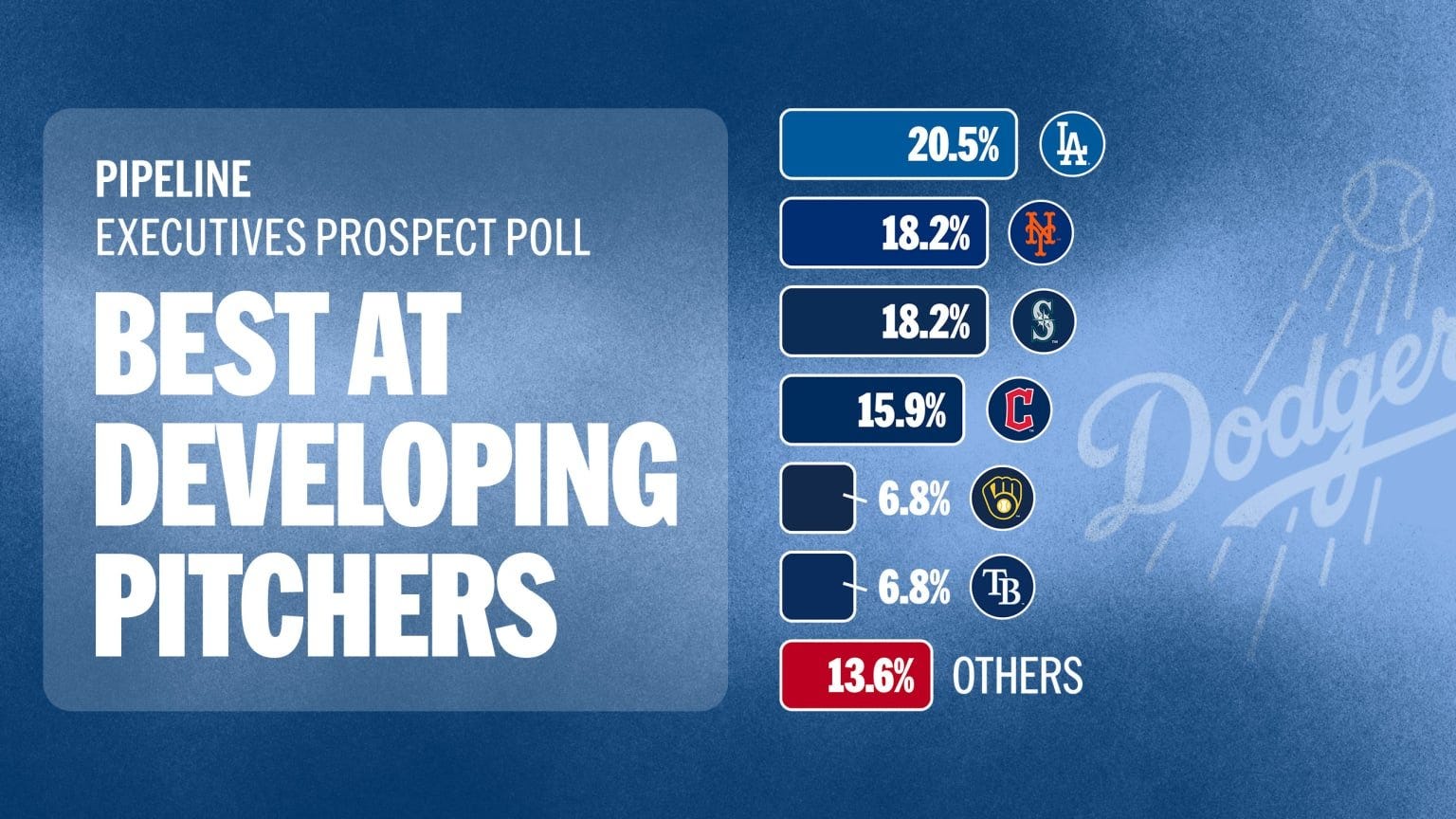
After the teams on the chart, the other organizations mentioned were the Blue Jays, Pirates, Reds, Royals, Tigers, and Twins, meaning the Braves are, most optimistically, the 13th-best organization at developing pitchers.
Which begs the question: Are the Braves just…not good at developing pitching prospects anymore? Let’s talk about it.
Atlanta’s producing major leaguers…
…but seemingly “out of nowhere,” as far as The Prospect Apparatus™ is concerned.
Let me explain.
Every season, the Braves seemingly get one or two major contributions from a rookie in the majors despite entering the year without any (or very few) Top 100 prospects
2025: Drake Baldwin, Hurston Waldrep
2024: Spencer Schwellenbach, Grant Holmes
2023: AJ Smith-Shawver, I guess?
2022: Michael Harris II, Spencer Strider, Vaughn Grissom (0.8 WAR in just 156 PAs)
2021: Ian Anderson
2020: Kyle Wright1
Of those guys, exactly three - Baldwin, Harris, and Anderson - were consensus top 100 prospects in either the season of or the season prior to their MLB breakouts.2
Some of this comes down to the way Atlanta develops their prospects - the Braves prioritize innings from their starters, but they also prioritize specific development tasks. I’ve spoken to prospects who were tasked with throwing a certain percentage of one specific pitch in an outing or an inning, a goal that persisted across multiple starts. A common development path that the Braves take is to ‘strip away’ various ancillary pitches from a starter so that they can work on their slider, only to reintegrate the curveball back in later (see AJ Smith-Shawver).
Often, this development is done at the expense of the actual performance on the field. This helps explain why Braves prospects don’t often pop up on the various Top 100 lists - they’re not trying to put up impressive minor league statistics, they’re trying to develop so that they put up impressive major league statistics.
(And the pitchers that do put up good statistics, like JR Ritchie, tend to be the ones that already have a full arsenal of pitches and are working on sequencing and optimizing.)
I’m not saying this is a problem, necessarily, but it’s part of the reason that Braves prospects don’t rate as highly as other organizations.
There are flaws here, though
Remember how I mentioned earlier that it’s a common development path for Atlanta to scrap a prospect’s curveball in favor of over-indexing on sliders to drastically improve the pitch?
In some corners of the baseball world, it’s not a good thing that Atlanta does that with nearly every single pitcher. Development should ideally be a bit more customized than that, simply because each pitcher is different and has their own respective strengths and weaknesses.
The current model here for Atlanta is clear: They want to build a ‘base’ for each pitcher, starting with their slider, and work out from there to a curveball, some sort of offspeed pitch (typically either a splitter or a kick-change), and then add the missing fastball types into the arsenal.
Spencer Schwellenbach: All three fastballs, a splitter, and both a slider and a curveball
Hurston Waldrep: All three fastballs, a splitter, and both a slider and a curveball
JR Ritchie: All three fastballs, a changeup, and both a slider and a curveball
Sometimes, whether because of motor preferences or some other reason, the Braves don’t always get there. AJ Smith-Shawver ended up as a four-seam/split-change/curveball/slider pitcher, although he might use the rebuilding time after his elbow surgery to add a cutter and sinker.3 Grant Holmes throws the above package minus a sinker, although his changeup is a seldom-used kick-change.
Is there a problem with issuing your top prospects a similar “starter kit” of pitches? Not necessarily, especially when it results in a robust and varied arsenal that allows for sequencing galore. But it’s also no longer at the cutting edge of player development.
Also, per folks I’ve spoken with, the Braves do not have a Mets-style pitching lab either in Atlanta or near the spring training facility in North Port, FL and do not plan to build one. While new pitching coach Jeremy Hefner recently said on MLB Network Radio that Atlanta’s capturing a lot of the same data, the lack of investment in a dedicated facility could potentially play a factor in convincing other teams and executives that Atlanta’s not as developed or advanced in that area as some of their peers.
Are the trades a factor?
When I first put this into our Braves Today discord, one of the responses I got was a question: Is it possible that some of this poor industry rating is due to our trade history?
After all, the commentator pointed out the pitchers that we’ve traded away haven’t been great, so the league might naturally think less of our abilities on that front. On the flip side, many were confused by the Los Angeles Dodgers holding the #1 rating in the poll. How are the Dodgers considered the best at developing pitchers when they don’t actually have that many homegrown starters on their roster at the moment?
In the words of Coach Lee Corso, not so fast, my friend. Sure, LA’s playoff rotation of Yoshinobu Yamamoto (FA), Shohei Ohtani (FA), Blake Snell (FA), and Tyler Glasnow (trade) wasn’t homegrown at all, but several of LA’s most-used pitchers outside of the top of their rotation absolutely were. Emmet Sheehan and Jack Dreyer both threw over 70 regular-season innings for LA last year with ERAs under 3.00; several other prospect starters worked in either relief or piggyback roles, while Tony Gonsolin, Dustin May, and the since-departed Walker Buehler all looked like potential Cy Young candidates until going down with Tommy John surgery.
Additionally, several of LA’s trades have featured ‘excess’ starting pitchers that have gone on to succeed in their new homes like Ryan Pepiot, who was part of the trade to acquire Glasnow from the Tampa Bay Rays.
Atlanta’s trades, by contrast, have featured starting pitchers moving out that have been…less than successful with their new teams. Several of Atlanta’s notable trade acquisitions, like Matt Olson, Sean Murphy, and Raisel Iglesias, were trades that had prospect pitching as a not-insignificant part of the package. Nobody’s longing to get Jared Shuster back, or Ryan Cusick, or Joey Estes, or Freddy Tarnok, or…well, you get the idea.
Even when the Braves have traded veteran pitching, it’s generally resulted in a win. Atlanta acquired Dansby Swanson and Ender Inciarte for starter Shelby Miller, a trade that was considered disastrous by Arizona Diamondbacks fans and team personnel alike. Miller went on to make only 28 starts across three seasons with Arizona, putting up a 6.35 ERA in the process, while Inciarte won three Gold Gloves in Atlanta and put up a 200+ hit season at leadoff. Swanson won the 2021 World Series with Atlanta, as well as two Gold Gloves and thrice received MVP votes, before going on to sign a mega-deal with the Chicago Cubs after the 2022 season.
Is it possible that Adam Wainwright, traded away from Atlanta in 2003, being the last prospect pitcher the Braves regret losing be a factor here? I suppose it’s possible.
Honestly, if the Braves call you and offer a pitcher via trade, you’d be best to just hang up. (Similarly, if the Tampa Bay Rays call you and want anyone out of your system, also hang up and go figure out why they want that guy.)
The system’s imbalance plays a factor, too
Atlanta has invested heavily in pitching prospects in recent drafts. From 2019 through 2024, the Braves were the only team to spend more than 60% of their bonus pool to pitching prospects. While most teams take more pitchers than hitters, it’s unusual to pay all those arms; many teams fill out their organization with cheap senior-sign pitchers on the final days of the draft.
Because of that investment in pitching, Atlanta’s position players to make the majors tend to come in spurts instead of waves. Michael Harris in 2022. Drake Baldwin in 2025. And the bulk of the visible development ‘successes’ must be carried by the team’s pitching prospects.
But the injury-caused attrition of those pitching prospects may be coloring the league’s perception of Atlanta’s skill at developing starters, as well. The Braves have seen several promising arms come to the majors before being felled by catastrophic injury. Michael Soroka was the 2019 runner-up for NL Rookie of the Year and the 6th-place finisher in the Cy Young voting after making 29 starts with a 2.68 ERA. But after tearing his Achilles in his third start of 2020 and ultimately requiring three different surgeries, he didn’t return to the majors until 2023 and has yet to regain that top-of-the-rotation form. Kyle Wright led all of baseball with 21 wins in 2022 but after multiple shoulder surgeries, has thrown just 23 minor league innings in the last two years. Ian Anderson had a no-hit shutout through five innings of the 2021 World Series in game three, but after having his own UCL repair in 2022, has thrown just 9.1 MLB innings and is currently a free agent.
If those players don’t suffer catastrophic injuries and/or are able to return to form after, is this development ‘grade’ given by the other executives more respectable?
If Atlanta’s 2026 rotation had all of those names, with Soroka taking the ball for his 8th-consecutive Opening Day, followed by Spencer Strider, Wright, Spencer Schwellenbach, and some combination of Ian Anderson and AJ Smith-Shawver, the Braves are at least getting votes in the poll.
And yer despite all of those injuries to potential frontline-caliber starters, the 2024 Braves still had the best rotation ERA in all of baseball. That group of starters was powered by an oft-injured veteran who was having his salary paid for by his previous team in Chris Sale, a lefty curveballer the Braves acquired as a prospect in Max Fried, a scrappy veteran who has tougher than a $2 steak in Charlie Morton, a converted reliever in Reynaldo López, and a former college shortstop who was figuring it out in the majors in rookie Spencer Schwellenbach.
Maybe Executive of the Year is a better award to aspire to, anyway.
Although his best season wasn’t until 2022, when he led baseball in wins with 21 and came in as 10th place finisher for Cy Young, just like Smith-Shawver’s best season was 2025 despite debuting in 2023
Waldrep was technically a Top 100 prospect in 2023, but fell back out of the rankings after his disastrous 2024 debut so we’re not counting him.
AJSS was drafted as a primarily FB/CB guy
Yea I don’t think AA is particularly great at recognizing and evaluating talent honestly .. I can support it in many many many ways.. everyone will catch on in the next two seasons tho. I just wonder what lie he will spin and who or how much will people eat it up.. I think he is bad and had a few strokes of different ideas and a few strokes of luck but for the most general overal AA is just bad
I was angry about that poll until reading this but not for the reasons you stated actually. They voted LAD the best cause they’ve made a couple relievers but then I thought about who if voting on this. The executives. The guys who pay soon to be a dh Juan Soto 70 million a year in perpetuity. Xander bogaerts signed forever. Tarik skubal offered 20 million a year. Maybe a lot of these executives are just morons. I can live with that. 2 of our top 3 starters are homegrown. Same with AJ and Hurston. The system is on the rise.