


In the span of one week, the offseason for the New York Mets shifted from a disaster to a success.
The Mets had already revamped their clubhouse this winter, shipping out veterans Brandon Nimmo and Jeff McNeil in separate deals while watching longtime first baseman Pete Alonso and closer Edwin Diaz depart in free agency (to the Baltimore Orioles and Los Angeles Dodgers, respectively)
While New York added Jorge Polanco for first base and Devin Williams for their closing role, fans were still anxious: Where were the upgrades? Where was the impact?
Mets boss David Stearns brought that impact in the last week. Toronto Blue Jays shortstop Bo Bichette signed to play third base, getting $42M a year on a three-year deal, while Stearns followed that signing with two trades. He acquired Chicago White Sox centerfielder Luis Robert Jr., hoping to get him back to his dominant 2023 form, following that up with his most impactful trade of the offseason: An ace pitcher for his rotation.
On Wednesday, the Mets acquired starting pitcher Freddy Peralta from the Milwaukee Brewers. Peralta, entering his final year of team control before free agency, led the National League in wins last season and immediately steps into New York’s #1 rotation spot.
Can the Braves respond to New York’s Peralta acquisition with their own impact starter, or do they even need to? Let’s talk about it.
Atlanta almost got Peralta themselves
I first talked about this on Thursday’s Braves Today podcast, but the Braves were very close to acquiring Peralta last month. Back in early December, I told the Braves Today discord that, per a source, Atlanta had a tentative deal in place to acquire Peralta from Milwaukee. While I didn’t know the full specifics of the deal, I knew that the centerpiece of the deal was going to be Atlanta’s top pitching prospect, J.R. Ritchie.
There was one issue: Peralta’s expiring contract.
The Braves reached out to Peralta’s representatives about an extension, but unlike the Chris Sale, Matt Olson, and Sean Murphy acquisitions1, Atlanta reportedly wasn’t comfortable fully consummating the deal without having the extension figured out ahead of time.
While I never got a final explanation of why the deal fell apart, it’s likely that the Braves and Peralta just couldn’t get close enough to the extension’s finish line for Atlanta to be comfortable with the deal, and it ultimately never happened.
And it’s a shame, too - if you think about it, Peralta would have been the perfect addition this winter. From a payroll perspective, Peralta’s $8M salary for 2026 meant that he would have fit under Atlanta’s current CBT payroll (currently $258.5M) and the Braves would still have had roughly $17M in “contingency funds” to spare for the trade deadline.
From a rotation perspective, depending on how you feel about his 2025 - his 2.70 ERA was 7th best in baseball but it came with a 3.64 FIP and 3.43 xERA - he’d have been one of Atlanta’s top postseason options behind the duo of Chris Sale and Spencer Schwellenbach.
But he’s now miscast in New York’s rotation as the ace and #1. Let’s look at the other options for Atlanta to add their own ‘impact starter’, as President of Baseball Operations Alex Anthopoulos termed it.
Any remaining free agents?
Framber Valdez and Zac Gallen are both still available, but I’m ruling them out. Both players declined qualifying offers from their original teams, so the cost to acquire either player is just too high.
As Atlanta was not a competitive balance tax payor last season, their penalty would be only losing their second-highest selection in this summer’s MLB Draft as well as $500,000 from the current international signing period…but as catcher Drake Baldwin’s Rookie of the Year win saw Atlanta awarded an additional draft pick after the first round, this penalty would be incredibly punitive. Atlanta’s additional draft pick is slated for #27 and it would be the highest pick ever sacrificed for a Qualifying Offer player were the Braves to sign either Gallen or Valdez2. Given the fact that Anthopoulos has previously said that even the team’s draft pick being moved back ten spots (the penalty for exceeding the CBT’s third tier) is untenable, it’s increasingly unlikely the team would sacrifice such a high pick and the ~$3.5M draft pool that comes along with it.
But despite Valdez and Gallen being off the board, the Braves might be able to find that impact starter…depending on what you consider “impact”.
If Atlanta wants someone who is a no-doubt postseason starter, the pickings are virtually nonexistent. But if you’re willing to project a bit and/or expand your definition of impact, there are a few options here.
The first is Chris Bassitt. A popular name among a large portion of the Braves fanbase this winter, Bassit has a career 3.64 ERA & four straight seasons of 30 or more starts. While he’s outpitched his peripherals over that stretch, with a 4.01 FIP, it’s still a reliable and consistent performance for a team that needs a little rotation consistency and reliability. The thought process here would be installing Bassit into the rotation as an immovable force, letting him pitch every fifth day and utilizing extra rest days for the rest of the team’s starters.
I talked to Anthopoulos about this in November (bottom of the article). While a six-man rotation isn’t sustainable for the long-term - “ I just don’t know how realistic it is to be able to do it for over the course of a season” - the Braves do things like use spot starters, pushing guys back, working around off days, etc to build in extra rest for the starting pitchers that need it to get a lot of the same effects without the “roster gymnastics” required to actually run a six-man. The system worked well in 2024, with most of the team’s top pitchers being available in September as the Braves pushed for the postseason.
While I think Bassitt could be fine making a postseason start, with two different pitches over 100 via Stuff+ and the veteran moxie to turn over a lineup twice before giving it to the bullpen, he’s only made three October starts in his career. In 2025, he was dominant for the Toronto Blue Jays in relief, allowing just one run on three hits in 8.2 innings with ten strikeouts, so there would be some flexibility on how to use him if Atlanta ultimately went this direction.
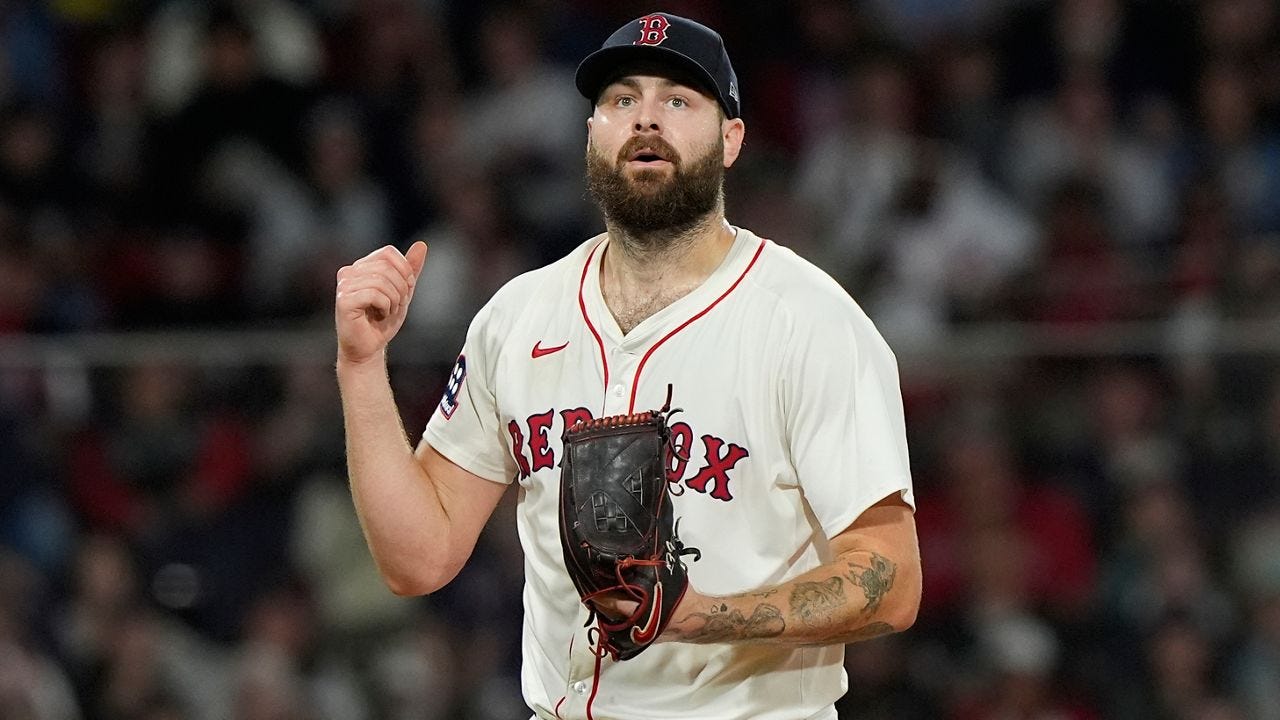
Another option could be Lucas Giolito. Returning from 2024 internal brace surgery for a UCL tear, Giolito pitched well for the Boston Red Sox last year (10-4, 3.41 ERA) despite middling peripherals (4.17 FIP, 5.06 xERA, a below-average 10.6 K-BB%). He missed the end of last season due to some elbow soreness, but is reportedly healthy and has finished his offseason throwing program.
It’s possible that Giolito could become a postseason-caliber starter under the tutelage of new pitching coach Jeremy Hefner. Giolito’s currently a four-pitch starter, throwing 93 mph four-seam fastballs just under half the time and supplementing it with a cutter-ish slider, an atypical high-vert changeup, and a seldom-used curveball with very little horizontal movement.
It’s a very unexpected movement profile, as you can see from a Statcast pitch plot:
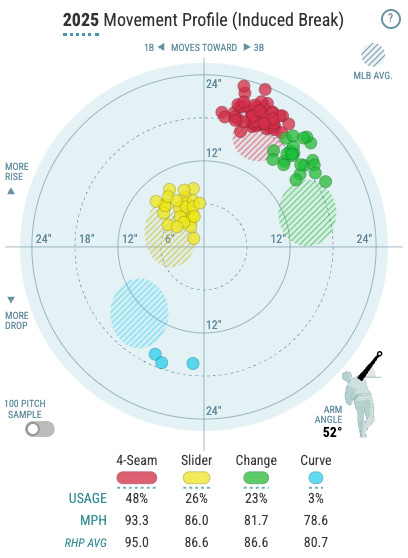
Without knowing Giolito’s motor preferences in detail, I think there are some obvious changes here. The first is to give Giolito the other fastballs he doesn’t currently have - while his fastball comes out as his best-performing pitch by Run Value (+5, 71st percentile), it’s also the worst at getting whiffs and can get pounded if overexposed. 3
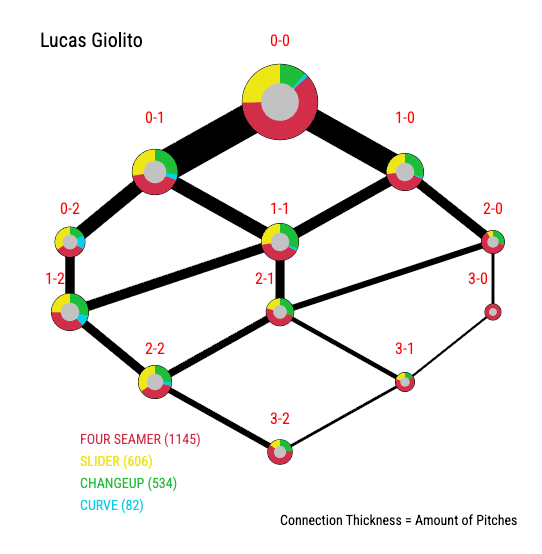
The second change is that I’d increase the curveball usage. Giolito threw only 82 of them last season, predominantly to lefties, but with the pitch being one of his highest-performing offerings via Stuff+ at 108, he needs to be willing to throw it more to same-handedness batters and in more situations than just two-strike counts.
The money here might work out better for Giolito than Bassitt, as well. While the 36-year-old Bassitt made $22M in each of the last two seasons and pitched well enough to push for a similar salary again, Giolito made $18M and $19M in the last two years and after ending last season on the injured list, will likely command less on any sort of new deal. MLB Trade Rumors, in their annual free agent predictions, have Giolito getting just $32M across two years on his new deal.
The final options here are a pair of Hall of Fame-bound veterans who aren’t quite ready to hang it up in Justin Verlander and Max Scherzer. I don’t particularly have an opinion here on which would be a better signing for the Braves, but it feels like it would be Scherzer simply because the Braves have no orange in their official colors and Verlander seemingly requires that from his team’s uniform.4
Do the Braves make a move at all?
I’m guessing not. If nothing else, the Ha-Seong Kim injury has likely shown the team that keeping funds available for the unexpected is crucial. If the entire offseason were to go according to plan and there were no injuries - AA told us in early December that they have only been getting good injury news to that point, opposite of how their offseasons normally go - then maybe I’d advocate for spending up to the base of the contingency fund and rolling into spring training fully ready to go.
But now that the Braves have already lost Kim for half the season to a non-baseball injury, it feels like preserving the financial flexibility to pivot were another injury to strike is the most prudent course of action.
Essentially, not panicking io make an addition and maintaining that flexibility is the response.
Standing pat also preserves the most depth, given how many pitching choices the Braves have with no minor league options. That’s why adding just any starter wasn’t going to work for Atlanta; AA’s said it needed to be an “impact” starter because adding a back-end starting caliber arm simply meant swapping out one potential fifth starter (Bryce Elder, most likely) for another.
The Mets added an ace because they needed certainty. The Braves are resisting because certainty is expensive, brittle, and often temporary.
Atlanta already has volume in the rotation. What they lack is a clear upgrade that justifies both the financial cost and the opportunity cost of blocking internal options. Freddy Peralta would have done that. Chris Bassitt might, at a price. Lucas Giolito could, if Jeremy Hefner finds the right levers to pull.
But absent a move that clearly elevates October upside, standing pat isn’t passivity. It’s a bet that flexibility, health, and internal optimization can matter more than winning the winter. Whether that bet pays off won’t be decided in March or even July. It’ll be decided when the Braves need four starters they trust in October, and find out how many they actually have.
The other three all had at least one more year of team control when acquired. Peralta is an unrestricted free agent after this season.
By contrast, were the Phillies to sign either player, they’d lose pick #64. The Los Angeles Dodgers, since both Edwin Diaz and Kyle Tucker had qualifying offers, are sacrificing their second (#104), third, fifth, and sixth-highest picks this summer.
Plus, Giolito’s briefly flirted with a sinker at times in his career, as well, so getting the pitch to MLB quality shouldn’t be that hard.
Verlander has only played for the Tigers, Astros, Mets, and Giants in his career. Feels like he’s bound for the Baltimore Orioles, right?
It really is a pleasure to be a Braves fan and get to read smart articles like these—so thank you for that.
As for the roster, I’m firmly in the stand-pat camp right now. If one of the QO guys is still hanging around after the qualifying offer drops off and wants to come in on a shorter deal, great. I’m all for it. But since that’s probably not how it usually plays out, I’m totally fine rolling with what we have.
What I’m really excited about is seeing what the new pitching coach can do with this group. There’s a ton of talent here, but a lot of these guys fall into that 4th/5th starter bucket and just need consistency. Early in the season, let’s see what Hefner can do with pitchers who are either on the cusp of being MLB-ready or, frankly, a little long in the tooth and in need of steady mechanics—like my favorite Braves fifth starter ever (since Kent Mercker), Bryce Elder.
By midseason, I honestly think JR Ritchie, Didier, and possibly Luke Sinnard could be kicking doors down. I also see guys like Lara and Burkhalter settling into bullpen roles and doing really well there.
And then there’s the depth everyone forgets about. Hurston Waldrep should be in AAA, stretched out and ready to jump in at the first injury. If Hefner can help him tighten the command, simplify the approach, and keep the stuff in the zone, Waldrep could be a real weapon.
Same thing with Joey Wentz and Grant Holmes. Even if both start the year in the bullpen as long men, that flexibility is huge. Those are guys who can soak up innings, spot start, or step into the rotation if needed. And honestly, if things break right, they’re also the type of arms that could allow the Braves to move on from or release another fringe arm without blinking — because they know Wentz and Holmes can cover innings competently.
That’s how you survive 162 games. That’s how the Braves always seem to find a guy.
So yeah, I’m very comfortable standing pat…
Which of course probably guarantees we’ll make a move anyway.
Just saying.
Thanks for this perspective. When AA said he wanted to add an impact starter at the end of the season, he should’ve added “at the right price”. The price for starters whether it’s an FA or via trade don’t make any sense. We’d all love to see Peralta on the Braves. But trading two top 100 prospects for one year of service is nuts. And an extension is likely to be >5 years and close to $200 million. The risk of pitcher fragility is very high, just look at the Braves last year. We could list a dozen of other examples (Cole, Nola, Wheeler…). The risk of relying on controllable emerging pitchers, which is a Braves strength, is probably much lower than making an enormous bet on a veteran. Let’s go with the young guys for SP depth.