


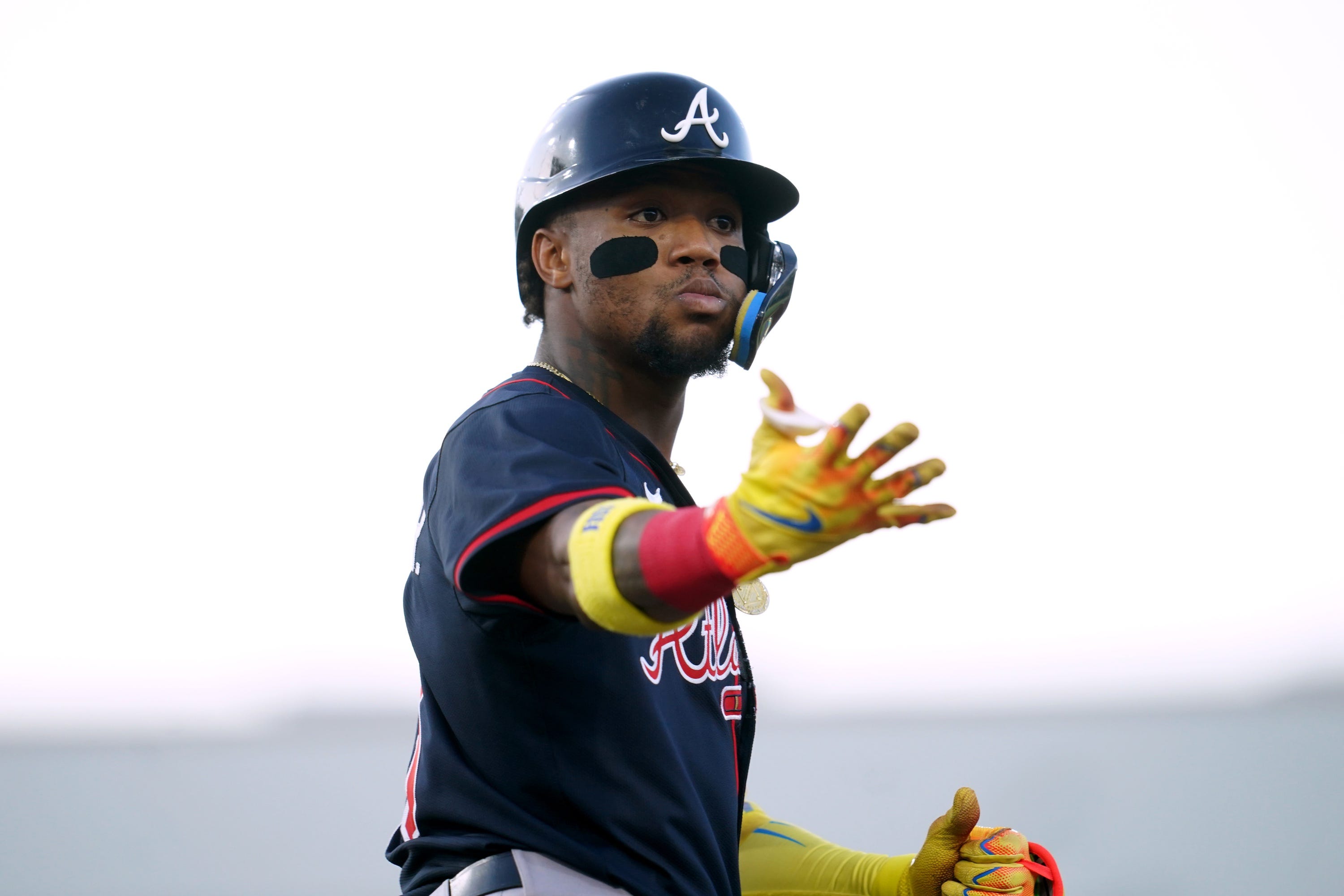
When Atlanta Braves youngsters Ronald Acuña Jr. and Ozzie Albies signed their long-term extensions in April of 2019, the consensus from the baseball world was that Atlanta’s front office was taking advantage of the pre-arbitration players.
Ozzie signed for only $35M over seven years, a $5M yearly average. He is currently in the first of two $7M club option years and, due to numerous injuries and underperformance, is not guaranteed to have his second option year picked up.
Acuña, by contrast, signed a more lucrative but still well under-market deal. The Venezuelan outfielder took $100M over eight years, a yearly average of only $12.5M. Heading into 2026, 34 outfielders are set to earn more annually than the 2023 Most Valuable Player.
The Braves have two remaining club option years, priced at $17M each, for the superstar, and then he becomes an unrestricted free agent for his age-31 season. While Acuña has expressed a desire to remain a “Brave for life”, is an extension actually possible, and what will it cost Atlanta? Let’s talk about it.
The myth of the ‘hometown discount’
There is this idea among fans that players should be willing to take less money to remain with their existing team when they reach free agency.
While you do occasionally see examples of the hometown discount being an actual thing - Chipper Jones notably took a little bit less to remain in Atlanta for the entirety of his career - it is not standard practice in Major League Baseball. The concept is flawed in both the macro sense and specifically for Ronald Acuña Jr.
For Ronald, it’s simple: He’s already given the Braves a discount. He signed a below-market extension just under one year of service time to guarantee himself and his family generational wealth. While it’s possible he does another - José Ramirez just did in Cleveland - it’s in no way a guarantee.
In the larger context of MLB, the main reason that players do not usually take discounted offers to remain with their original organizations is the fleeting nature of free agency. Let’s imagine a generic college player, drafted in the 2nd or 3rd round after a three-year college career. That player is typically 21 years old when selected. The organization controls their rights for at least four and up to six years in the minors and then six more years once they make the majors. While it’s an outlier example, playing out both scenarios to their extremes means that the player may not hit free agency until the age of 32 (or 33, if the team manipulates the date of their call-up to earn an additional year of control).
Under MLB’s current structure, that player likely has one large free agent contract ahead of them in their career. There’s a reason so many top-tier free agents have signed longer free agency contracts - this is likely their only chance to get long-term stability and security. While some players will continue to get contracts until they’re approaching 40, most will usually get one crack at free agency, if that. That’s why Shohei Ohtani signed for ten years, Xander Bogaerts for eleven, and Mookie Betts for twelve.1
MLB teams have gotten more and more hesitant to guarantee money to a player on the downside of the aging curve, though, resulting in the proliferation of this winter’s extremely high-AAV, shorter-term deal. Bo Bichette, who was projected to sign for seven years at $29M per, instead took three years at $42M each from the New York Mets. Same with Kyle Tucker, who bypassed the ten-year, $370M projection to take $60M a year for four seasons with the Los Angeles Dodgers.
So, to recap: The options for most top-of-the-market free agents is an extraordinarily high AAV on a shorter deal or a long-term contract, one that pays them less money per season but is likely the last contract they’ll ever sign in professional baseball.
Neither path is clean for Atlanta.
The issues with a ‘Brave-for-life’ deal
The difficulty the Braves would have with giving Ronald a lifetime contract extension, one that took him into his late 30s, are twofold.
The first is that that’s simply not something this current iteration of Atlanta’s front office has ever done. Under Alex Anthopoulos, the two longest extensions have been for ten years (Austin Riley) and eight years (Matt Olson), both of which would end with the players’ age 35 season. If you look at just contracts signed at age 31 or older, the most years given by the Braves under AA have been to outfielder Jurickson Profar and reliever Robert Suarez, both receiving three years.
If you lower that age down to 30, you can add in the four-year deal given to Marcell Ozuna after the 2020 season, one that took him through age 33 on the guaranteed years and saw the age 34 season’s club option picked up.
The second is that Ronald himself has a medical history that would make a long-term deal risky. Famously, Acuña has torn both ACLs, with the right one ending his 2021 season and the left one early in 2024. The road back hasn’t always been smooth, either, with Ronald having underwhelming stats in 2022 after coming back quicker than expected and then experiencing an ancillary injury later in the 2025 season.
Partially due to the numerous leg injuries, Acuña’s once elite sprint speed (97th percentile in 2018) has declined to ‘only’ 64th percentile last year. Additionally, he’s playing more cautiously than ever before, avoiding rundowns on the basepaths (which is how he tore his left ACL in 2024), not stealing as much, and being hesitant to leave his feet on fly balls in the outfield.
It’s easy to imagine another leg injury bringing down his sprint speed to roughly average, if not worse, sometime over a long contract. While his baserunning instincts remain top-tier, the lack of stolen bases and further erosion of his already-poor defensive ratings would reduce his overall value on the baseball field. At that point, his value becomes increasingly bat-dependent, which narrows the margin for error on a long-term deal.
The problems with a short deal
On the flip side, though, channeling the Bichette and Tucker deals with a four-year pact would require new territory for Atlanta’s front office.
As we’ve repeatedly discussed, no multi-year deal given by the Braves under Alex Anthopoulos has exceeded the ‘Atlanta Max’ of $22M per year
While the rumored offers to Freddie Freeman and Aaron Nola would have paid both men more than the Atlanta Max, neither deal was officially signed and the self-imposed limit remains intact.2
But while Acuña would not enter free agency with the same risk profile as Tucker or Bichette, there’s no way that Ronald would fit under the team’s $22M limit. The question here wouldn’t be ‘will the Braves exceed the Atlanta Max?’, it’s by how much they will need to exceed the Atlanta Max to get a short-term agreement with Acuña. I previously assumed $30M could be a reasonable starting point for negotiations, with the thought that possibly the player and team would agree somewhere around $35M.
Now I’m beginning to wonder if that’s the annual dollar figure on a long-term deal. After Bichette’s $42M and Tucker’s $60M, the fear is that Ronald’s starting point for negotiations will begin with either a ‘5’ or a ‘6’, and an offer of $35M a year might not be in his top five options.
Are the Braves prepping for this?
Without sounding like a conspiracy theorist, I’m starting to think that Atlanta’s front office is preparing for an eventual Acuña extension.
There is a significant amount of money dropping off the books after the 2026 season ($72.5M) with the expiring contracts of Ha-Seong Kim ($20M), Chris Sale ($18M), Raisel Iglesias ($16M), and relievers Joe Jiménez and Aaron Bummer (a combined $18.5M). Another $35M comes free after 2027 thanks to Jurickson Profar ($15M), Reynaldo López ($8M), and others heading to free agency.
While some of those departures will need to be addressed - who is the starting shortstop in 2027? - it’s possible the team is freeing up funds to pay Ronald Acuña Jr.
There’s also the possibility that the new collective bargaining agreement, which will be negotiated after this season, may address either the upper-tier of spending through a salary cap or some other player salary-limiting move or a team’s total payroll, allowing Atlanta to have an ‘out’ on paying Ronald full freight for his next extension.
Does the money even matter here?
The other aspect of this is that the front office may have learned from the public outcry that came after the free agent departures of Freddie Freeman, Dansby Swanson, and Max Fried.
All three moves have been frequently cited by disgruntled fans and outside observers as part of the reason the Braves haven’t won anything of significance in the postseason since the 2021 World Series, for better or for worse.
Does Atlanta’s front office now believe that allowing one of the most talented players in franchise history to leave in free agency will be the point of no return for a significant portion of their fans? If so, you could see the Braves get a bit irrational in their desire to retain Ronald for the long-term.
My personal belief is that, if an extension ultimately does happen, it’ll be agreed to prior to his final club option year of 2028. The extension would kick in after that season, giving Ronald $200M in new money in exchange for five years of service with Atlanta, with incentives for plate appearances and awards.3
This would take Acuña through his age 35 season, putting him at the same endpoint from an age perspective as both Riley and Olson. Ronald would likely need to be open to more time at designated hitter, which could start as early as this season, but it’s the best way forward for both player and team.
Does Ronald need to make a sacrifice here, in both dollars and years, to remain in Atlanta? He does, but the Braves are making an even bigger stretch by almost doubling the ‘Atlanta Max’ to retain their superstar outfielder into the back half of his career.
It’s a win for the fans, who deserve one for a change.
Can this actually happen?
The reality is that extending Ronald Acuña Jr. is not simply a question of willingness. It’s a question of structure.
Atlanta has built an organization around controlling risk: limiting long-term exposure, capping annual value, and avoiding contracts that run deep into a player’s decline years. Acuña is extraordinary, but he is not immune to those rules, especially given his medical history and the direction of the free agent market.
A short-term deal likely requires the Braves to shatter their internal AAV ceiling. A long-term deal asks them to bet against aging curves and injury probabilities they’ve spent years avoiding. Neither path fits neatly with how this front office operates.
If an extension happens, it will likely be later, narrower, and more conditional than fans expect. If it doesn’t, it won’t be because the Braves failed to value Acuña, but because the constraints around him finally caught up to one of the most team-friendly deals in baseball history.
Wanting Ronald Acuña Jr. to be a Brave for life is easy. Making that math work is not.
This isn’t something that started in 2019 or 2020, either - Giancarlo Stanton signed for fifteen years in 2015, and did it with the Miami Marlins.)
The Braves have gone over this limit on a one-year deal, most recently to Josh Donaldson. The third baseman received $23M in 2019, returning 37 homers and putting up 5.3 WAR before signing a multi-year deal with the Minnesota Twins that offseason.
The incentives would be a new thing for the Braves under AA, but it’s an easy way to compromise and pay Ronald more if he stays on the field.
Great break-down of a dilemma more complicated than I had realized. In spite of my efforts to move on, I can't help but ruminating on the Freeman debacle - he was in his prime, wanted badly to stay in Atlanta, and was a consummate player and leader that was turned away over an ego driven decision which I don't think this mid-level franchise will recover from this decade. And, as great as Acuna is, I'm not sure extending him would have the same value that extending Freeman would have. Among AA's many "accomplishments" is the deterioration of the Braves' minor league system. Depending on how the '26 season goes, maybe the best long term plan is to move on from Acuna and retool with young talent.
I think the real question with Ronald Acuña Jr. is talent—because he has more raw talent than any Braves player I’ve ever seen. But eventually, the elasticity of youth fades. At some point, Acuña will have to rely less on pure athletic dominance and more on playing smarter baseball.
The encouraging thing is: we’ve already seen flashes of that baseball intelligence. One of the best examples is when he cut his strikeout rate by roughly a third in a single offseason. That doesn’t happen by accident. That’s awareness, adjustment, and discipline.
Acuña can do anything he wants on a baseball field—at the plate or in the field. The question is whether he continues to evolve as the physical tools inevitably decline. I’m curious what Alex Anthopoulos really thinks about Acuña’s ability to age intelligently and maximize his game over the long haul.
Which brings up another question: is Ozzie Albies’ recent decline a potential warning sign? They’re both smaller players who relied heavily on athleticism early. That said, history also shows that smaller, skilled players—guys like Mookie Betts—often age better than the Judge-type physical giants. It’s not one-size-fits-all.
And zooming out, this is where I think the Braves philosophy needs to be questioned. At some point, you extend the Hall of Fame player—period. Instead of letting a sure-fire Hall of Famer like Freddie Freeman walk, or potentially losing players with real Hall-of-Fame trajectories like Max Fried, Dansby Swanson, or even someone like Kelenic if he fully clicks (LOL).
At some point, you don’t just build contenders—you lock in legacy.