


It is possible to pitch in MLB without an ulnar collateral ligament in your elbow. Former Braves starter R.A. Dickey famously did it. The Texas Rangers discovered he wasn’t born with a UCL after drafting him in 1996’s first round, dropping their bonus offer from over $800,000 to just about $75,000 in light of it.
Grant Holmes does have a UCL, but it was partially torn last season, ending his first full season in a starting rotation since before the 2020 minor league season was lost to the COVID pandemic.
Here’s the thing, though: He thinks it’s been torn for a while.
“That was the first image I’ve ever had on my elbow,” Holmes told the media in North Port on Tuesday. “So, nobody knows if that [UCL] tear was there beforehand and was really just a flexor [strain]. Honestly, I think that’s what it was, because if I had a tear in the flexor tendon and the UCL, that would have been a whole lot different. I wouldn’t have recovered as fast.”
Whether it was just the flexor tendon that caused him trouble or both, Holmes is fully healthy and has no restrictions as the Braves enter spring. “I feel strong and really healthy right now,” Holmes said. “My recovery has been really good.”
But Spencer Schwellenbach’s injury doesn’t just create a rotation opening. It raises a tougher question: can Grant Holmes survive a starter’s workload when his primary fastball is one of the least effective in baseball?
Let’s talk about it.
The basics
Working as a starter last season, Holmes threw a four-seamer roughly one-third of the time. But even with that limited usage, it was worth -14 Run Value, the 8th-worst individual pitch among any qualified starter in baseball.
Now, in Holmes’ defense, Run Value is an accumulation stat - the more you throw it, the more (or less) Run Value you can accrue. What if we look by rate, as in Run Value per 100 pitches (RV/100)?
It’s even worse for Holmes: His heater was -2.2 RV/100, the 7th-worst mark for any individual pitch among qualified starters.
While I don’t completely believe that a hitter’s stats off of a specific pitch tell the full story of its effectiveness - there are too many other variables in the at-bat - the slash line for opposing hitters off of Holmes’ fastball is too ugly to ignore: a .330 batting average and .651 slugging. Of the 87 put into play, ten were home runs, five more were doubles, and 36 were singles. The hard hit rate off it was 48.3%.
And this wasn’t bad luck, either; the statcast expected stats are a .300 xBA and .604 xSLG, so most of the opposing production off the pitch was absolutely earned.
But why was it so bad?
It’s a poor movement profile
Let me start here by pointing out that the Stuff+ for Holmes’ four-seam fastball last year was an 84…and that was an improvement over the 77 it put up in 2024.
It’s likely both the movement and the velocity.
The velo’s easy to understand, albeit underwhelming. His 4S averaged 94.5 mph, slightly below the 95.0 mph league average for right-handers.
But the movement profile tells a much bigger story.
On the whole last year, Holmes had 15.2 inches of induced vertical break on his fastball, below the league average of 16 inches but no egregiously so. But the horizontal movement was another story. Holmes had 5.2 inches of horizontal movement, a full 2.5 inches less than the average righty fastball. That’s nearly a full ball’s width.
And the result is a classic “dead zone” fastball.
I ran Holmes’ statcast info for the four-seamer through Los Angeles Dodgers Sr. Quantitative Analyst Max Bay’s Dynamic Dead Zone model and came up with the following plot. The red circle is his landing points for the fastball, while the series of blue circles are where the hitter would expect the pitch to end up, given the arm angle and release point.
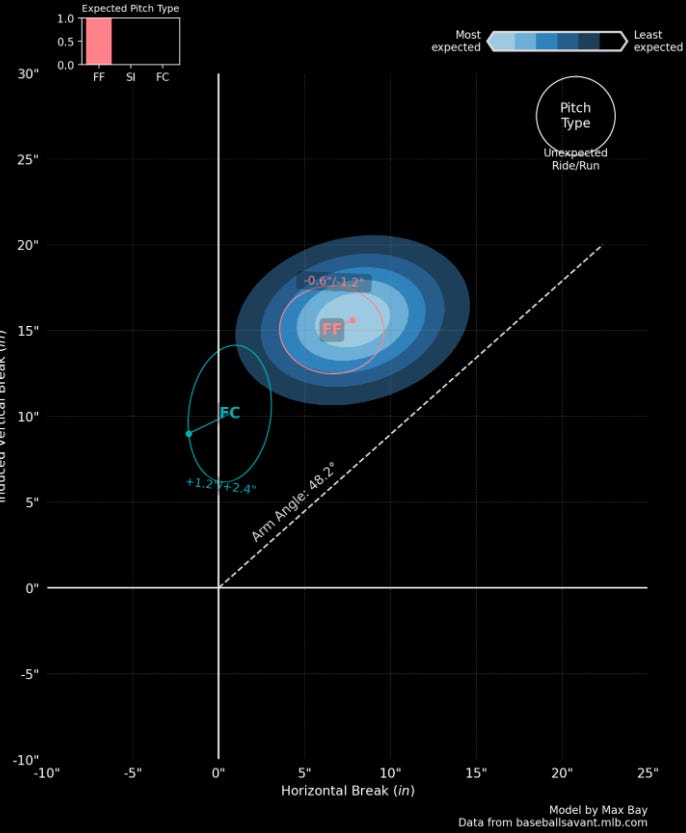
In essence, the fastball ends up exactly where the hitter thinks it’s going to, and they crush it accordingly. Per research from 2022, there is a clear and strong correlation between how much a pitch moves as expected and how poorly it performs in chase, whiff, wOBACON, and Stuff+.
Can this be fixed?
There are two main ways to mitigate a dead zone fastball: improve the movement profile or stop throwing it.
Hurston Waldrep suffered from this same problem and he just…stopped throwing it - after adding a cutter and sinker last year, Waldrep cut his four-seam usage to just 3% last season. In 56.1 MLB innings across 229 batters and 886 MLB pitches, he threw exactly 22 four-seam fastballs.
Holmes has always thrown a cutter and added a sinker, so there is a path there. The distribution’s still off, though; of his 936 fastballs, 2/3rds of them (639) were four-seamers. Given that his cutter is the most reliable pitch for him and a slider is his most-used breaking ball, shifting the mix towards slider/cutter/curveball would be the way to go here.
(And if he’d actually throw that kick-change he added last spring, I’d really appreciate it.)
Actually fixing a dead-zone fastball is a bit tougher. It’s a tweener pitch - not enough IVB to get over bats up in the zone, but not enough horizontal movement to run off a barrel. The typical paths here are to adjust the spin direction by 10-15 minutes, change the arm slot to prioritize the movement you want, or tweak the finger pressure or position to change the spin axis.
But by far the most straightforward adjustment is just to throw other pitches more. It worked for Waldrep, and it can work for Holmes.
What’s the solution here?
There’s no clear and obvious one. Do we really think the Braves haven’t already tried asking Holmes to narrow his fingers on the four-seamer to enhance the spin efficiency, or try to get around the ball more to add more cut-ride to it?
But maintaining fidelity to the idea of fastball diversity would be a good starting point. Thankfully, it’s a preferred philosophy of new pitching coach Jeremy Hefner, and hopefully that evolution is one of the positive changes to come out of the change from Rick Kranitz to Hefner.
FanGraphs predicts Holmes for 75 rotation innings with a 4.15 ERA/4.19 FIP.1 But with some simple tweaks and the opening created by the loss of Spencer Schwellenbach, he can take a rotation spot and run with it.
They also have him down for 24 bullpen innings, a total workload of 99 innings, a reduction of 16 IP from last season.
I don't have an account on substack, couldn't get in without joining and picking three subscriptions. Just cancel my subscription. I'll start over.
Impressive information - lots of physics involved. How can we be at all sure the Braves' pitching gurus understand even half of what your telling us?