


The Atlanta Braves have employed some of the most influential players in baseball history.
Hank Aaron redefined offensive greatness. Greg Maddux changed how we think about pitching command and efficiency. Chipper Jones became one of the greatest switch-hitters the sport has ever seen.
And then there’s Tyler Flowers.
Which sounds ridiculous at first.
Flowers wasn’t a Hall of Famer. He wasn’t an MVP. He never made an All-Star team. Most fans probably remember him as a defense-first catcher who occasionally hit a baseball 440 feet for reasons science still can’t fully explain.
But there’s a legitimate argument that Flowers helped reshape how modern baseball thinks about catching.
Let’s talk about it.
Not the beginnings you’d expect
The Atlanta Braves were so enamored with Tyler Flowers as a prospect that they drafted him twice. They took him in 2004’s 27th round out of nearby Blessed Trinity Catholic HS in Roswell before re-drafting him in the 33rd round the next year out of Chipola College.
And then they…traded him away. Flowers was shipped out, along with Brent Lillibridge and two other prospects, in the 2008 offseason for Atlanta to acquire starter Javier Vázquez. The deal was worth it on the field, with Vázquez giving the Braves a 4th-place Cy Young finish after 219.1 innings of a 2.87 ERA in 2009.
Flowers would go on to debut that next season with the Chicago White Sox and spend seven seasons on the Southside before heading to free agency, where the Braves brought him in.
His statistical impact on the field was good - Flowers hit .251/.349/.391 with 17 homers across five seasons with the Braves before retiring after the 2020 season, but his impact off the field will linger.
The revolutionary art of Flowers
Flowers was an excellent defensive catcher, although one perpetually overshadowed by more traditionally celebrated peers like Yadier Molina (nine NL Golden Gloves), Joe Mauer (three GGs), and Salvador Perez (five GGs).
But for Tyler Flowers, it was the way that he caught.
The standard for catcher defense at the time was based on what you did to keep the ball in front of you, through blocking, and what you did to control the running game, through your pop time and your throwing velocity to 2nd base.
Flowers was…okay at preventing stolen bases, with a career 22.4% caught stealing rate. He was fine at blocking.
But Flowers helped turn pitch framing from a niche skill into a core part of modern catcher development.
Flowers was among the first MLB backstops to study the idea of pitch framing, the concept of adjusting how to change your glove movements when catching a pitch to make a borderline pitch appear to be a strike, even if it wasn’t when you caught it.
Pitchers who threw to Flowers consistently saw better results, most notably more strikeouts per walk, versus when they threw to his peers.
In 2016, Tyler Flowers’s games had 2.68 strikeouts per walk vs 2.07 SO/W when throwing to A.J. Pierzynski. In 2017, Flowers produced a 2.28 SO/W while Kurt Suzuki was at 2.01. With those same two in 2018, Flowers produced a 2.61 while Suzuki improved to just 2.10. Even Braves legend Brian McCann, who returned for the 2019 season, could put up ‘only’ a 2.39 to Flowers’ 2.58.
The thing to understand about framing in 2026 is that it’s no longer a specialty skill. It’s baseline competency.
The “bad” framers in baseball today would have graded out much closer to average a decade ago, because the position has evolved so dramatically. Organizations now teach framing techniques throughout the minors, while amateur catchers increasingly arrive already exposed to one-knee setups and modern receiving mechanics.
In other words, Tyler Flowers helped win an argument the rest of baseball eventually accepted.
And eventually, framing stopped being just a skill Tyler Flowers possessed. It became the blueprint for how organizations taught catching.
The core concepts he pioneered
But it wasn’t just the idea of framing that Tyler Flowers pushed on baseball. It was the methods with which he did it.
Flowers was the main advocate of the “one-knee down” catcher stance, previously seen as anathema but now the standard across MLB.
For those of you who don’t know the difference, besides the obvious descriptor in the name, this refers to the catcher’s setup as the pitch is delivered.
Here’s former MLB catcher Ryan Lavarnway, from early and later in his career, showing the two styles.
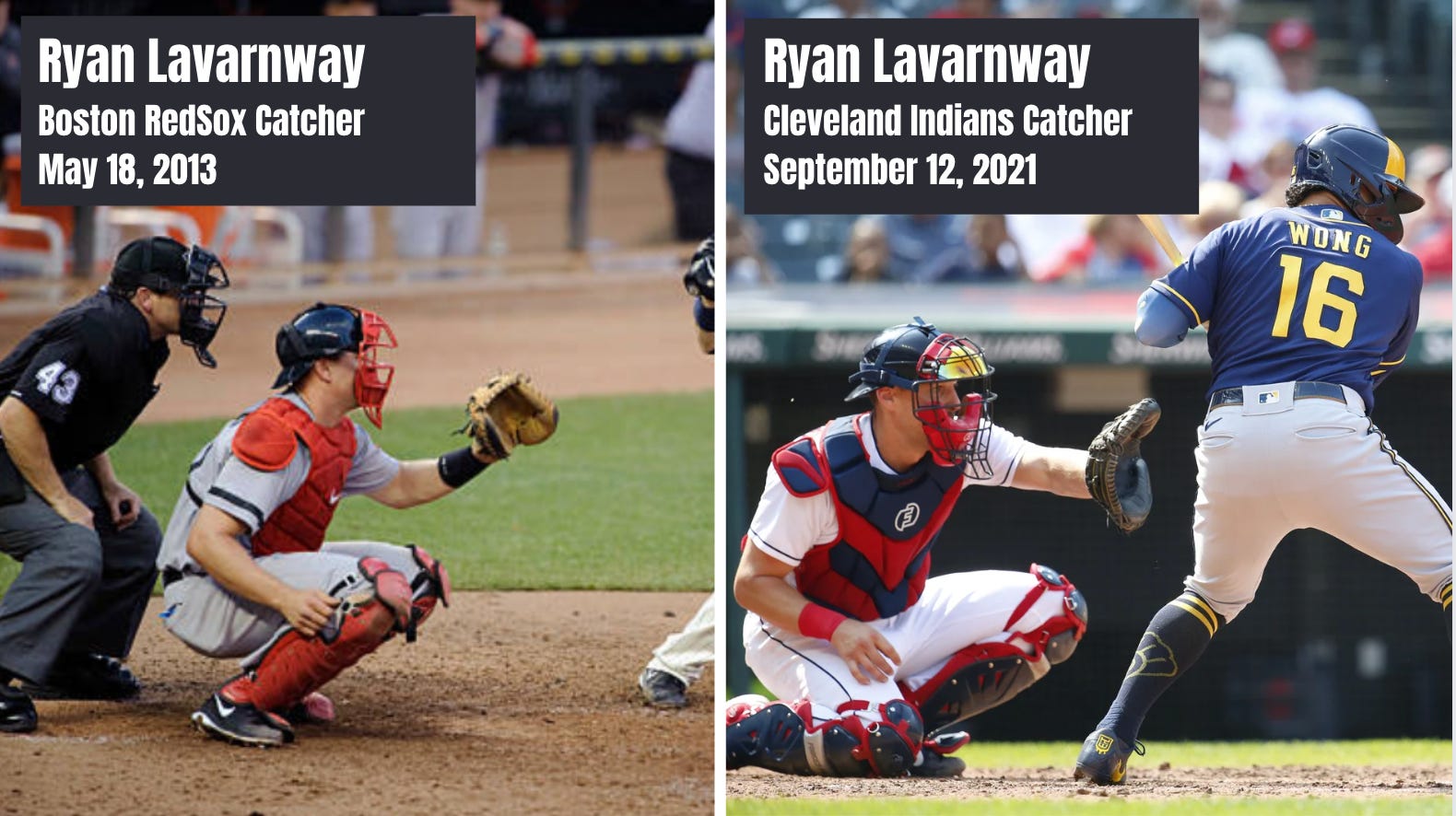
Coincidentally, Lavarnway learned the one-knee down stance from Tyler Flowers.
The two usual complaints/concerns about one knee down (“OKD”, as they now abbreviate it) were about the ability to block balls and the ability to throw out runners.
Recent research from Baseball America’s JJ Cooper shows that as OKD has become the standard across the majors - as of last summer, there were no traditional stance backstops remaining in MLB - passed balls and wild pitches have dropped to their lowest levels since the early 1980s. When you account for the difficulty of blocking in modern MLB, where velocity is at record highs (both peak and average) and more balls are thrown in the dirt than ever before, it can be argued that blocking’s never been better.
That was Tyler Flowers.
Similarly, caught stealing rates have shown not to be negatively impacted, although that’s harder to parse out due to MLB’s rule changes to encourage more stolen base attempts in recent seasons. As Flowers told Lavernway when he asked about the one-knee stance impacting his pop time, “If I steal an extra strike on a guy, he probably doesn’t reach first base…so then I never even have to throw him out. I helped get him out before he even got there.”
The other major adjustment Flowers popularized is flashing a target while the pitcher was coming set, but then dropping the glove as the pitcher began their throwing motion. It’s a technique that allows the glove to be moving up as it receives a low strike, meaning it’s a more natural motion to frame the low strike.
Here’s a slow-motion video of Astros prospect Walter Janek, showing how the two combined techniques make it easier to receive a low strike.
(Video credit of Baseball America)
The second clip in the video shows how you can still get out of the stance quickly for a throw to second. Pop times, on average, are roughly the same or better than when the traditional setup was prevalent. Is this partially a function of better athletes behind the plate? The time frame is short enough, 2018 to now, that I’m inclined to believe that can’t explain it, but rather catchers having enough experience with the technique and/or it not being a hindrance to pop times.
Teaching the next generation
Flowers retired early in 2021, telling MLB.com that a third degenerative disc in his back made it not “worthwhile” to go through all the rehab and training just to try and get back behind the plate.
But it wasn’t the end of Flowers' positive impact on catching in Atlanta. He’s worked in Atlanta’s front office since retiring, carrying the title of Special Assistant, Major League Operations and being involved in pitching plans and pregame preparation.
And when he retired, he was cognizant that his legacy would be related to fooling umpires. “If anybody knows my name, [pitch framing] is kind of what they associate it with,” Flowers told MLB.com. “Not that many people know my name across the country. If they do, they’re really into pitch framing and skilled strikes.”
Then-catching coach Sal Fasano was aware at the time that Flowers’ legacy would outlive his on-field career. “Imitation is the highest form of flattery. You look across the league now and see how many catchers are on one knee. That’s a tribute to Tyler and his ability to steal strikes. He was one of those transforming players.”
And because of Tyler Flowers and that transformation he pioneered, this game will never look the same.
UPDATE: Thanks to a reader who reached out with a reminder that Tyler Flowers also worked to improve player safety. The Force3 Defender Mask was created by the team at Force3 Pro Gear, with Flowers assisting on the design, and the primary difference from a traditional catcher’s mask is the addition of what they called a “Shock Suspension”.
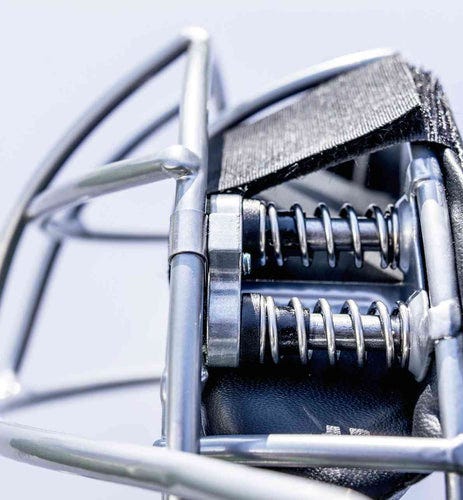
The idea here is that the front cage is supported by springs, allowing it to flex and absorb some of the impact of a foul ball. Certification testing showed a 50% reduction in Severity Index testing, the standard for facemask safety, and may help reduce the risk of concussions.
Flowers was the first to wear the mask in an MLB game, back in 2016, and not only gave up his previous paid catching gear deal to make the switch, but invested in the company. The mask is currently the only authorized official catcher’s mask of MLB Players Inc, the business arm of the MLB Players Association.
Never heard this before. Continuing to learn new things about baseball thanks to you.
One of your better pieces, and that's saying something.
As the compute-to-display interval for ABS reduces to an instant, hand held ump advisory (or fully determinative) version, does framing go the way of 8-tracks and Betamax?