


Mark Kiger owns one of the strangest careers in baseball history.
He appeared in two games for the Oakland Athletics during the 2006 American League Championship Series, both as a late-inning defensive replacement. He never came to the plate. He never appeared in a regular-season game. His entire major-league career existed in October.
Kiger was the first of only six players to make his MLB debut in the postseason. Guardians outfielder Chase DeLauter became the sixth last year, joining a group that also includes three players from the unusual 2020 postseason and two pitchers: Shane McClanahan and Ryan Weathers.
Blake Burkhalter could become the seventh, but the Braves should be trying to ensure that he never gets the chance.
If Atlanta believes Burkhalter could help in October, September should be his audition rather than a waiting room. Before Tuesday’s automaticpostseason-eligibility deadline, the Braves must decide whether one of Triple-A’s hottest relievers deserves a 40-man roster spot and an opportunity to pitch his way into their postseason plans.
Let’s talk about it.
Not a starter anymore
Burkhalter, an All-American closer at nearby Auburn University, was announced by the Braves as a starter after they took him with the 76th pick in the 2022 MLB Draft. It’s not that surprising; most teams will at least attempt to see if a guy can work as a starting pitcher before deciding he’s best suited to work in relief.
The additional value provided by even a marginal starter is part of the reason. But sometimes, as Alex Anthopoulos told me last winter, it’s simply because they can develop faster in the rotation.
“In the minor leagues, you stick to these guys in the rotation from a development standpoint, right? Even though you ultimately might believe that they’re relievers, you want them to get as many reps as they can, as many innings as they can have, bullpens, side work, go deep into the games. You have a guy in the minors who’s a one-inning reliever; you might have a 10-pitch inning and not really get to work on things.”
And Burkhalter followed that exact path. After undergoing Tommy John surgery in 2023, he made 32 starts across 2024 and 2025, but only two of those came after a July 2025 promotion to Triple-A. He was quickly moved to relief for the Stripers, where he’s thrived: since returning to Gwinnett after an early-season back issue this season, he’s put up a 1.48 ERA, holding opponents to a .214 batting average and .612 OPS.
And most of the damage against him is confined to one outing, when he allowed three runs on August 11 in two-thirds of an inning on the road against Norfolk. Since that appearance, he has a 0.84 ERA and 0.56 WHIP.
The stuff is exceptional
Burkhalter has improved his arsenal this season, with his overall Stuff+ rising three points to 104. Every pitch grades above 100 except his cutter, which received a 104 last season.
That cutter’s Stuff+ decline may be intentional. It has lost some horizontal movement, going from -3.1 inches to -2.3, while its zone rate has climbed 9.2 percentage points, from 47.8 percent to 57.0 percent. Its whiff rate has actually improved despite the reduced movement, rising from 23.9 percent to 27.1 percent.
The cutter is moving less and landing in the zone more frequently, yet hitters are missing it more. That is counterintuitive, but usage may help explain it. Against lefties, Burkhalter has increasingly used the pitch before two strikes and when behind in the count. Hitters with count leverage may be taking more aggressive swings, creating additional whiffs even though the pitch is reaching the zone more frequently.
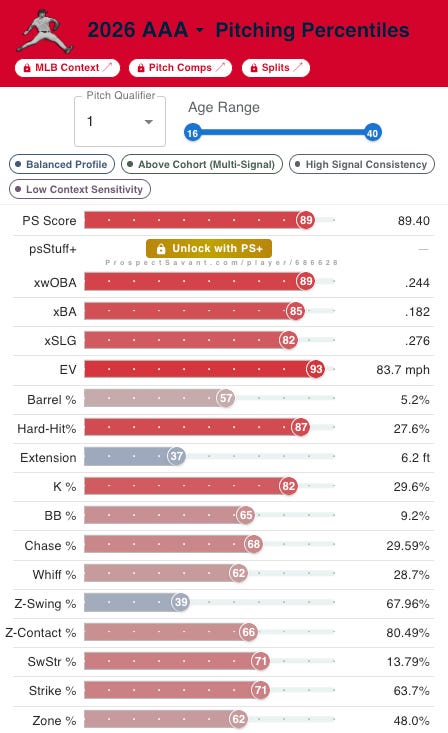
The rest of the arsenal consists of a four-seamer as the primary fastball, coming in with 18 inches of induced vertical break at 94, as well as an 86-mph changeup and a mid-80s, mostly vertically breaking curveball. All four pitches have whiff rates of at least 25% this season in Triple-A.
As he’s gotten farther away from the injury, he’s pitching better than ever. “Burky” has held opponents to a .173 average in August and has allowed only one earned run in his last 10.2 innings. He’s been providing useful relief length down the stretch, as well, picking up at least six outs in four of his last six outings.
That hot streak has coincided with an increase in his stuff. Burkhalter’s raised his average fastball velocity from 94.4 to 95.9 in his last three outings, while still reaching back to get high-90s velo. He used a 98 mph four-seamer that came in with 19 inches of induced vertical break to put away former top prospect Noelvi Marte last week.

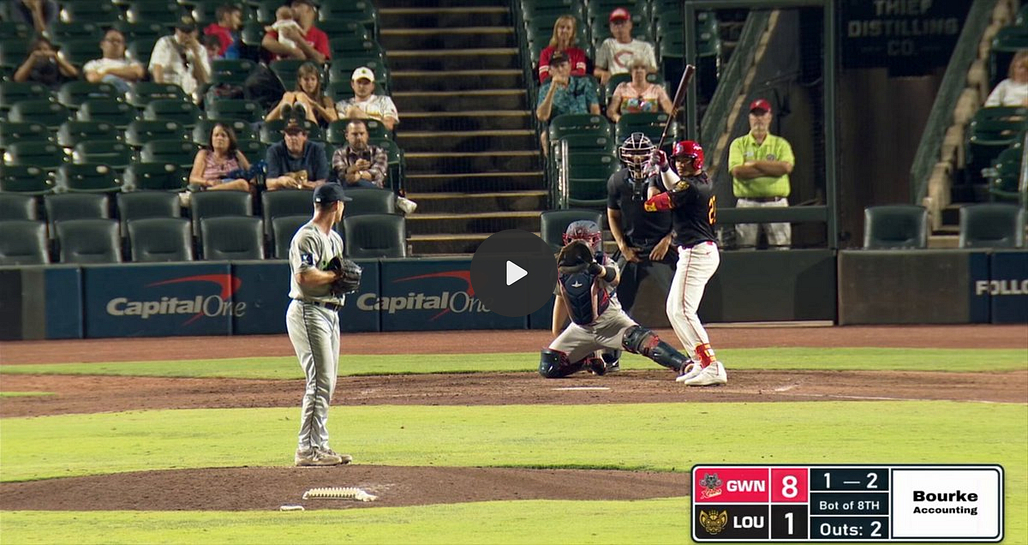
A multi-fastball guy who can go multiple innings? That’s right up Jeremy Hefner’s alley.
Can the Braves use him this October?
Yes, but they need to act fast.
MLB’s postseason eligibility rules specify how someone can be a postseason roster option, and it’s not “be in the organization.” Players must be on either the 60-day injured list or the 40-man roster to be eligible to be placed onto a postseason roster.
The rule also specifies a certain time for that to have been done, and it’s not the start of the postseason: It’s September 1st.
Yep, tomorrow.
Atlanta’s 40-man roster is currently full, so the Braves would have to create an opening, most likely by designating someone for assignment.
It’s important to point out that this isn’t the only way; it’s just the certain way for him to be postseason eligible. Any player that’s in the organization by August 31st can be eligible to be added to a postseason roster as an injury replacement upon petition to, and approval by, the Commissioner’s Office.
So tomorrow isn’t Atlanta’s last possible opportunity to make Blake Burkhalter postseason-eligible. It is the deadline to preserve the uncomplicated route - one that would allow the Braves to evaluate him in September against major-league hitters without making an October appearance dependent upon an injury-replacement petition.
Is there playing time for him?
That’s the harder part to figure out.
The major league bullpen is currently working one man short, as the Braves are running a six-man rotation to absorb the workload of this part of the schedule. They’re about to play the seventh game in a stretch of nine consecutive days tonight, and after Thursday’s off day, they will have 13 games in 13 days ahead of them.
And of the current bullpen, Atlanta’s seemingly divided everyone into one of three possible buckets. Raisel Iglesias and Dylan Lee are conventional leverage relievers, while Didier Fuentes and Dylan Dodd can provide multiple innings in leverage situations. Victor Mederos can provide leverage innings but primarily serves as a bridge arm, while Ray Kerr and Brent Suter are more traditional length arms, meaning five of the seven relievers can be - and regularly are - deployed as length options.
Barring an injured-list stint for one of those arms, it’s hard to see a scenario where one of those arms would get optioned to the minors for Burkhalter. (It’s important to note that Suter and Kerr, as well as the closer Iglesias, are all non-optionable).
And while there’s an additional pitching spot being created on Tuesday with the roster expansion from 26 to 28, there’s also the pending return of Reynaldo López to consider. ReyLo just completed his second rehab start in Gwinnett on Friday, pitching five innings with four runs allowed on eight hits. While the Stuff didn’t look great - only four whiffs on 35 swings and an average fastball velocity of 91.3 mph - the team could still attempt to bring him back as soon as this week. If they (probably correctly) wait for López to show better Stuff before he’s reinstated to the majors, there could be an opening for Burkhalter to get some run in the majors this week.
Complications
It’s not obvious that Burkhalter should receive the 40-man roster spot Atlanta would have to create.
For starters, he’s not the only candidate to get called up. Atlanta could select veteran reliever James Karinchak, who has postseason experience, or starter-turned-MLB-long-man JR Ritchie to the roster instead. Additionally, they could call up a spot starter this week so that they can optimize the rotation - right now, Chris Sale is lined up to start the Phillies series this Friday, but if they can find a way to push him later in the weekend, he can face them again in Atlanta the next weekend rather than facing the Rays at home in the series before.
There’s another, longer-term issue to discuss with a 40-man roster addition. Adding Burkhalter would also protect him from this winter’s Rule 5 Draft. Atlanta left him exposed last year and he went unselected, but his performance this season makes him considerably more likely to be taken this time. The complication is the threatened likelihood of an owner-imposed lockout after the current CBA expires on Dec. 1. Any player on a 40-man roster is prohibited from playing in the minors next season while the major leaguers are locked out by the owners, as they’re officially part of the MLBPA and subject to that CBA, not the minor league agreement.
A lockout would not necessarily mean regular-season games are missed; I’m not convinced the owners will blow up the season to get a salary cap, but that’s another newsletter. But if Burkhalter’s on the 40-man roster and the lockout persists, his remaining development could be delayed.
And let’s be clear, he’s not a finished product. There’s the acclimation to the caliber of major league hitters that all pitching prospects are required to master, and there are some outstanding questions there. Will the cutter induce weak contact against major leaguers who chase less than their AAA counterparts? Can his multi-inning effectiveness survive the jump in competition level?
There are also pre-existing questions to answer: Burkhalter’s struggled against left-handers in Gwinnett to the tune of a .296/.367/.465 line, with their .832 OPS being more than double the .352 he allowed to righties this season.
Diving into Statcast, the issue in this small sample appears to be damage allowed against the cutter, which is giving up a .357 xwOBA and 50% hard-hit rate. And that would track, as the cutter to a lefty is inherently a riskier pitch because the miss inside is likely an HBP, not a ball.
And while the rest of his stuff is good, nothing in the arsenal is overpoweringly elite to make up for the lack of effectiveness of one of his main packages. Can the changeup usage increase versus lefties to protect the four-seam fastball? Will the curveball still maintain a good-enough chase and whiff rate in those situations?
Does he get a shot?
Atlanta drafted an elite college closer, spent several years developing him as a starter and may now benefit from returning him to the role that made him a compensation-round selection. This version brings a larger repertoire and more experience than he possessed at Auburn.
Blake Burkhalter has ultimately done enough to earn Atlanta’s most important kind of September opportunity: not a ceremonial prospect debut, but a genuine audition for innings that could matter. The results are excellent, the fastball is trending upward, the four-pitch repertoire gives him more flexibility than a typical rookie reliever and the Braves can create a 40-man spot without too much trouble. Adding him by noon Tuesday would not guarantee an October role, but it would allow his pitching, rather than roster machinations, to determine whether he deserves one.
Good article. With Suarez still a question mark and Lee wobbling, the pen needs some help. I would rather see Burkhalter get a shot than going AA's usual route of DFA retreads.
I was hoping Cedric DeGrandpre would get the September call up. BA recently named him as having high Fantasy Value.
But his last few starts have been mediocre. When he's "on" he get about 1.3 strikeouts per inning.