


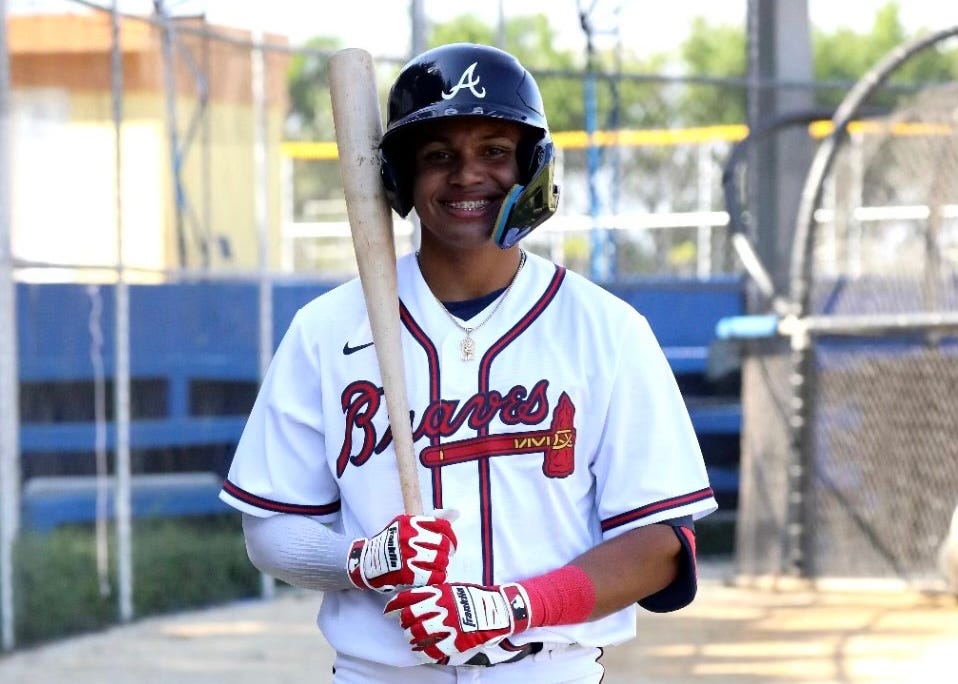
For years, the Atlanta Braves approached international free agency like a precision strike, concentrating resources on a small number of high-upside bets. This year, that model looks different. Instead of chasing one or two headliners, Atlanta appears to be spreading its investment across a much wider pool of players, a subtle shift that says a lot about how the organization is thinking about risk, development, and long-term depth.
Astute Braves Today readers will remember that we asked for this very change to be made back in July, pointing out that the available research into international free agency advocates against Atlanta’s previous strategy of paying a top-of-the-market bonus for one of the top prospects in a given year and then filling out the rest of the signing class on the cheap.
The data instead says that they should be trying to grab as many players as possible, expanding to two DSL teams if needed, so that they have as many ‘lottery tickets’ as possible. While the team isn’t reportedly in the process of adding a second team, they appear to be spreading their available bonus pool around much more evenly than in past seasons.
With the caveat that none of these signings are official until next week at the earliest, let’s talk about what we know of Atlanta’s 2026 international free agency class.
How is this different from previous years?
As I alluded to above, the Braves don’t have that massive “bonus baby” player that’s considered among the top five in the class, a departure from previous seasons.
In 2025’s class, they spent over half their $6.26M pool on outfielder Diego Tornes and added flamethrowing righty Raudy Reyes for almost $1.8M behind him.
In 2024, they spent $5M, nearly the entire bonus pool allotment, on shortstop Jose Perdomo, adding in a six-figure bonus for outfielder Juan Espinal.
In 2023, outfielder Luis Guanipa got $2.5M and four other players, including one of the team’s top shortstop prospects in John Gil, got six-figure bonuses behind him.
But this year, the largest bonus is reportedly going to Dominican Republic shortstop Jose Isaiah Mañon, coming in at just $1.5M. Baseball America’s Ben Badler has him as the #28 prospect, while Beisbol FR’s Francys Romero ranks him at #42. Both organizations explain that he projects to be capable enough to stick at shortstop defensively and has promising power potential, but Romero also discusses how contact and overall hit tool questions have resulted in a weaker market than expected.
Beisbol FR classifies Manion’s 6o-grade tool as the 4th-best in the class this year.
The 6-2, 180-pound right-handed hitter is part of the Amaurys Nina Academy and represented the Dominican Republic at the U-18 Pre-World Cup in Panama back in August of 2024.
After Mañon, Atlanta’s next most prominent prospect is Dominican outfielder Starling De La Cruz, a 5-9 sparkplug with explosivity and “fast hands” that allow him to play above his size. He’s considered a plus-plus runner (that’s a 70 in the 20-80 scouting scale) that has a “good chance” of sticking in centerfield, thanks to his good defensive instincts and good jumps off the bat. His bonus amount is believed to be about $1.2M, just about 20% of Atlanta’s overall $6.2M bonus pool.
That’s it for signings over $1M, a departure from previous seasons. Atlanta’s most likely next signee is a newer one - SS Edelson Cabral (Dominican Republic) had an agreement with the Arizona Diamondbacks but returned to the market and reached new terms with Atlanta, expected to be roughly $600k.
Per Romero, here is most of the Braves class that is known as of now. Not all of these players will sign on Thursday, but these are the ones that are known to the industry as being committed to Atlanta.
2026 International Free Agents:
SS Jose Isaias Mañón ($1,500,000) DR
OF Starling De La Cruz ($1,200,000) DR
SS Edelson Cabral ($600,000) DR
RHP Jonathan Hechevarria ($450,000 per Romero, $340,000 per Baseball America) CUB
C Jorwin Pulido ($375,000) VEN
INF Durban Arnedo ($275,000) COL
OF Sherrintely De Costa ($250,000) CUR
RHP Efrain Caminero ($200,000) DR
OF Luis Fortunato ($150,000) DR
RHP Giovanni Medina ($90,000) VEN
RHP Cesar Navarro ($80,000) VEN
RHP Darren Pereira ($60,000) PAN
LHP Josue Castro ($60,000) VEN
RHP Geowin Gomez ($55,000) COL
C Jose Nelo ($50,000) VEN
RHP Derek Torres ($35,000) VEN
Not a lot is known about these players, as they’re lower down the prospect boards and industry scouting reports often aren’t public. Gomez, out of Columbia, is the son of Cardinals IFA Luis Gomez, while Pulido is an uber-athletic catcher who projects to be a power bat in MLB and Arnedo is a contact-oriented hitter with the versatility to play all over the infield.
We’ll have more on the players that do sign next week, as the organization usually makes the team’s Director of Latin American Scouting, Jonathan Cruz, available to the media to discuss the signings once the first wave is official.
UPDATE (01/13): Baseball America has released updated international prospect rankings and there is one more expected Braves signings in the Top 100: SS Edelson Cabral at #84.
From Baseball America: “Cabral is a 6-foot-1, 170-pound shortstop with a tight, direct stroke from the left side of the plate. He recognizes spin well with a knack for putting the barrel on the ball with loft and an all-fields approach. It’s a hit-over-power game but the strength to drive the ball for hard, quality contact. Cabral is an average runner who should stick somewhere on the left side of the infield, with a chance to handle shortstop but potentially fitting at third base as well.”
UPDATE 2 (01/15). Baseball America has also given a scouting report on RHP Jonathan Hechavarria, who they report is signing for $340,000 and not Romero’s reported $450,000.
From BA: “Righthander Jonathan Hechavarria from Cuba was an outfielder whose stock went up after he moved to the mound. Signing for $340,000, Hechavarria is on the younger end of the class—he turns 17 in June—and is 6-foot-2, 200 pounds with a big fastball for his age, running it up to 94 mph. Especially for a player without much time as a pitcher, Hechavarria has a loose, fairly low-effort delivery. He has the look of a pitcher who could throw significantly harder with more strength and experience, pairing his fastball with a hard slider that should give him a second power pitch.”
UPDATE 3 (01/15): FanGraphs has released their board, allowing us to compare and contrast the respective rankings for several of Atlanta’s signees.
SS Jose Isaian Mañon: #42 (Beisbol FR), #26 (BA), #39 (FanGraphs)
OF Starling De La Cruz: >#50 (Biesbol FR), #36 (BA), #50 (FanGraphs)
SS Edelson Cabral: >#50 (Beisbol FR), #84 (BA), #18 (FanGraphs)
This is tough to get too excited about
Anyone who used to listen to my old prospect podcast, Locked On MLB Prospects, knows that I’m not a fan of international free agency in its current form.
As I alluded to above with the Cabral situation, these players that are sixteen when they sign have been in verbal agreements with teams for two years, having been identified as early as nine or ten years old and being sent to work with “trainers”, who develop and coordinate the agreements with the players in return for a percentage of the signing bonus.
While MLB has guidelines and an entire Trainer Partnership Program in place to verify ages, provide for drug testing, and help coordinate scouting opportunities, the entire system feels…wrong. They’re literal children, agreeing to verbal deals for millions of dollars at the age of 13 or 14.
MLB attempted to rectify this in the most recent CBA negotiations with the MLB Players Association, proposing to institute an international draft in return for ending the qualifying offer system for MLB free agents. Under their proposal, the order would be set similar to June’s Rule 4 draft, but with “hard slots” - teams could not over or underslot players, with signing amounts being set for each specific pick throughout the draft. Reportedly, the league’s proposal would have provided for larger bonuses for roughly 80 to 85% of drafted players and more money overall being paid than the current international bonus pool system.
Reportedly, current and former international players were the ones most vocal about not wanting to make the change. Despite the money being better for a majority of players and more dollars being paid overall, the inability to choose your destination was the main reason the proposal was rejected.
Let’s be clear here - every single option has its flaws. Without the leverage of bonus demands, like the summer’s Rule 4 draftees have, the international players would be completely unable to steer themselves towards their preferred organization (or away from someone they don’t want to play for) in a hard-slotted draft. But the current system is also pretty flawed. Something needs to give here; will it be player autonomy or the teams’ willingness to make verbal contracts with fourteen-year-olds?
Even more proof that the Braves Org. reads Braves Today
One other thing Lindsay.
I really enjoyed todays newsletter. And the daily podcasts this week.
But they're going back to the BIG BONUS next year when that Dominican Shortstop , Sena, eceives a $5.8 million dollar signing bonus.
That's got A.A.'s fingerprints all over it.