


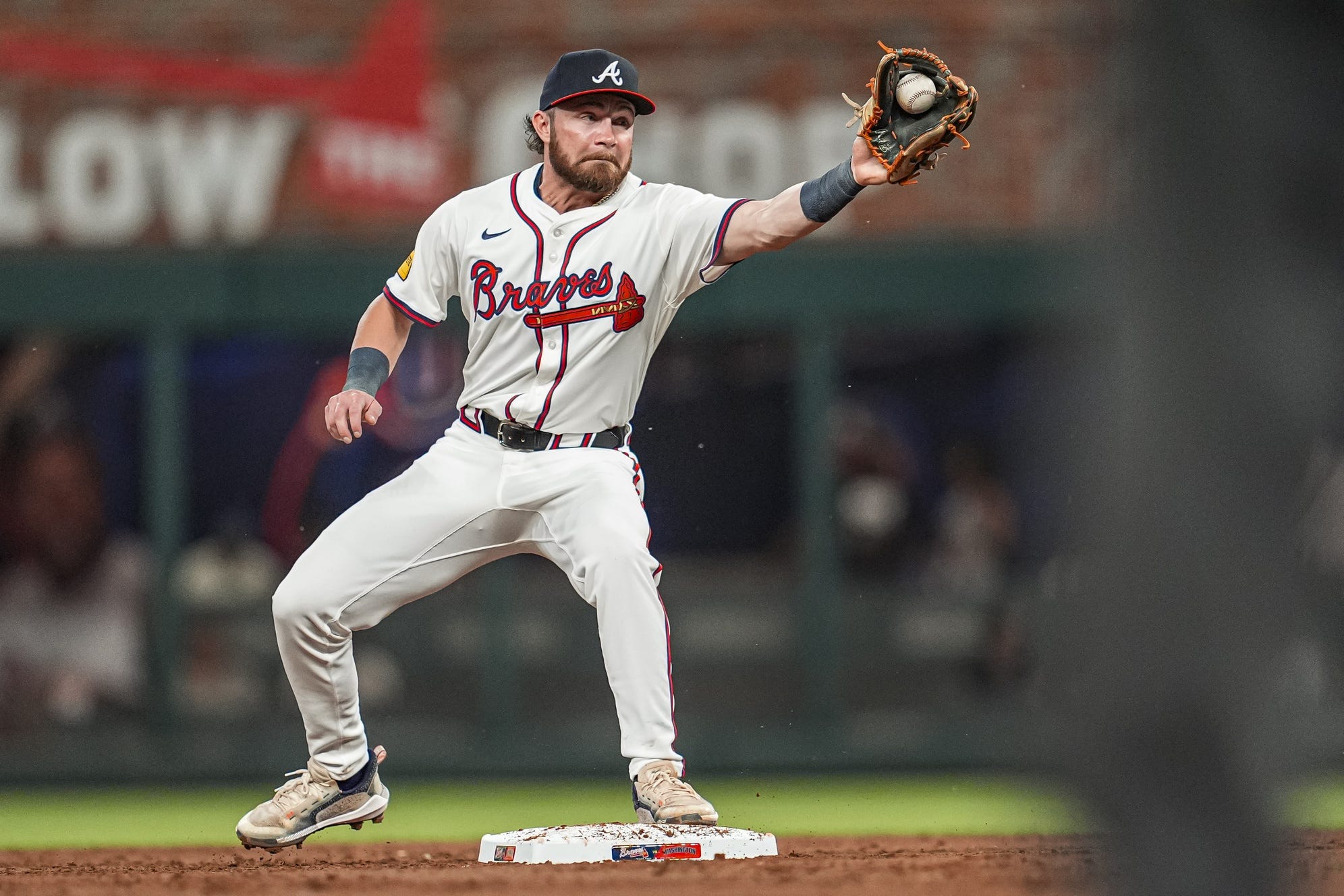
The ultimate fate of the 2026 Atlanta Braves rests on the performance and health of some of the stars - Ronald Acuña Jr., Austin Riley, Chris Sale, etc. But here at Braves Today, there is no detail too small to get overlooked or dismissed. With Atlanta’s designation of Vidal Bruján for assignment on Thursday afternoon, it’s now a bit more of a mystery as to who will occupy the final spot on the bench, or if that player is even on the roster. Let’s look at the options.
The leader in the clubhouse
Let’s talk about Brett Wisely.
A 15th-round pick of the Tampa Bay Rays in 2019 out of Gulf Coast State College, Wisely was traded to the San Francisco Giants after the 2022 season and eventually waived by San Francisco late last season. The Braves signed him and put him into four games late, entirely at second base, after losing Ozzie Albies to a fractured hamate bone.
Across parts of three MLB seasons, Wisely’s picked up 466 plate appearances and has a .214 average with seven home runs and five stolen bases. It’s been a struggle to translate his minor league .280/.369/.457 line to the bigs for Wisely, to say the least.
That doesn’t mean he hasn’t provided any value, though - Wisely’s started at four different positions in the bigs and has played everywhere but right field and catcher, earning himself 0.6 WAR in his career.
If you’re not feeling particularly enthused about this profile so far, I can’t blame you. Wisely appears to be a perfectly cromulent 13th position player for the team’s bench, someone who can be thrust into a game at almost any position, even pitcher, and finish the game for you.
As Wisely is the only bench candidate currently on the 40-man roster (working on the assumption that the optionable Nacho Alvarez spends every day in the lineup for Triple-A Gwinnett), he’s the de facto favorite for the position at the moment. There are other options in the organization, though.
Two more utility profiles
Atlanta has added two more minor league infielders in the last few months with their free agent signing of Aaron Schunk and trade acquisition of Jim Jarvis.
Schunk, a Colorado Rockies 2nd-round pick in 2019 out of the nearby University of Georgia, has hit .222 across 55 major league games, but generally failed to earn an everyday spot with the Rockies. The power-challenged infielder has played all across the diamond in his career, but spent the majority of his time at third base in both college and pro baseball. Schunk’s minor league deal, which he signed in December, included a non-roster invite to spring training.
Next to him is yet another SEC alum, Jim Jarvis. The Detroit Tigers took Jarvis in 2023’s 11th round out of the University of Alabama but sent him to the Braves midseason in return for reliever Rafael Montero. Jarvis has predominantly been a shortstop in his baseball career, crosstraining at both second and third base in the minors. He’s hit .245 across parts of three minor league seasons, although he flashed much-improved power in the Arizona Fall League thanks to some swing adjustments that helped him more consistently elevate the ball (a 48.2% groundball rate in 2025).
While I’m optimistic that Jarvis can develop into a major leaguer, everyday playing time in Gwinnett is infinitely more useful to him than sitting on Atlanta’s bench and getting two at-bats a week. The last man on the roster is a veteran’s game, needing someone who can stay locked in and then perform at a moment’s notice.
What about a non-utility internal option?
There’s another scenario here for the final bench spot, one that gives Atlanta the maximum flexibility to deploy Drake Baldwin’s bat on a near-everyday basis: Carry a third catcher.
There is a quirk in the MLB rulebook that says if a designated hitter has to change over to a defensive position, you cannot just insert a different hitter into the DH spot and keep on playing. Instead, you lose the designated hitter completely and from that point forward, the team needs to either let the pitcher of record take an at-bat or utilize a pinch hitter.
While it might not be the worst scenario in the world if Spencer Schwellenbach took some at-bats - he hit .282 with a .829 OPS in three seasons at Nebraska - most MLB pitchers were already poor hitters when they were being prepared to occasionally pick up a bat. Carrying a third catcher would give Atlanta the ability to swap that veteran backstop into the lineup if Sean Murphy suffered an injury in-game and Drake Baldwin were the designated hitter.
It’s also not a very common scenario, so I completely understand if the Braves don’t want to spend an entire roster spot on this very rare and unlikely outcome. But the concept - add a player to do one specific thing - is still valid.
Fill a specific need
Whenever looking to make a change - modifying a pitcher’s arsenal, adding a player to your roster, etc - it’s important to understand why. What does this change accomplish for you?
One of the common complaints from some jaded and/or cynical fans this winter has been that the Atlanta Braves didn’t do enough to add offensive threats this winter, choosing to believe that one blockbuster signing like a Kyle Schwarber or Pete Alonso for DH would have been more productive than the team’s approach of building depth and raising the floor.
So, what if the Braves took the approach of adding an offensive threat with that final roster spot? If you assume a lineup with both catchers in it, that leaves a bench of a super-utility in Mauricio Dubón, a strong-side platoon bat in Mike Yastrzemski, and a speedy outfielder in Eli White that can be a pinch runner or defensive replacement. Those three cover most scenarios that will come up in the late game.
Why not use that last bench spot on a power threat, someone that can change the complexion of the game with one swing of the bat?
This is not intended to be a direct pitch to sign a veteran Marcell Ozuna to some sort of cheap deal in spring training, but I’m also not avoiding the conversation, either. Provided he’s healed from last season’s hip injury, adding a veteran bat that’s well liked in the clubhouse and one year removed from a MVP-4 finish isn’t the worst use of $5M or $8M of whatever it might take to get the deal done. While that kind of financial expenditure likely requires good health reports on both Sean Murphy and Joe Jiménez, it would give Atlanta both some veteran leadership as well as a potent pinch-hitting threat off the bench.
This also gives you some injury insurance - if either a catcher or a outfielder go down, you can let Ozuna have almost full-time reps at designated hitter.
But either way, there are options with the roster that the Braves have not had in quite a while. While that last spot on the bench may not spend much time on the field, Atlanta is primed to get more utility out of that player than in previous seasons.
Surprised yesterday when i heard Brujan sent down. Thought he would be in Atlanta.
Just read a report on Pinstripes Alley, i lthink, saying the price tag on Mackenzie Gore would be less than Edward Cabrera's.
Gore is someone i would pay for if Washington would deal in the Division.
You get your wins any way you can, and having a skilled person to fill the role off the bench when you have an injury prone and aging roster is a smart way to grab wins. Anything that takes at bats away from the Zack Short's of the world is helpful.