


Something I like to do every Spring Training is come up with five hot takes for the upcoming season. This year, Lindsay was gracious enough to let me share those predictions in an article that you can read here.

When I put together my five takes back in March, the goal was to find a balance between predictions that were genuinely bold and ones that were still realistically attainable. Of course, being the competitive person I am, I wanted nothing more than to go a perfect five for five.
As anyone who follows baseball knows, that’s a whole lot easier said than done.
Ultimately, I fell short of that goal. However, what made looking back at these predictions interesting was that the reasoning behind a few of them actually held up pretty well, even if the predictions themselves didn’t quite come true.
My mind is already racing with ideas for 2027, but before I get too far ahead of myself, I owe it to everyone to revisit my five takes from this past season. So, let’s see just how well they aged.
Michael Harris has a 30/30 Season
At face value, this hot take was a miss. However, I’m still giving myself a little credit for this one.
Michael Harris II finished the 2026 season with a career-best 26 home runs, coming just four shy of the 30 I predicted. Unfortunately, after battling a quad issue throughout the year, he stole just 12 bases. While the stolen bases never materialized, the offensive production certainly did.
He put together the best offensive season since his rookie campaign, slashing .294/.321/.491 with an .812 OPS and 121 wRC+. Harris II’s 26 home runs, 79 runs scored, and 87 RBIs were all career highs.
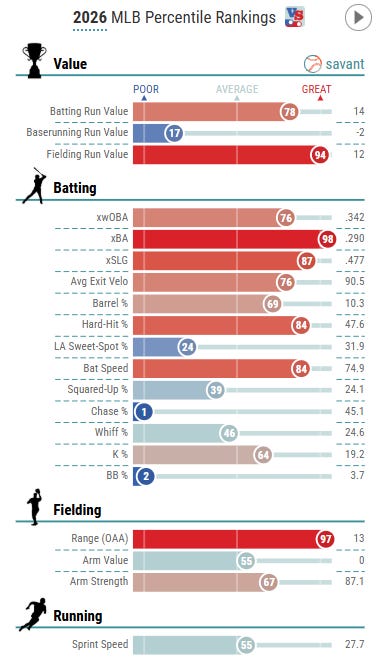
Now, one thing we have to accept about Harris II is that he’s probably always going to be an aggressive, free-swinging hitter. I know that drives plenty of Braves fans crazy, and understandably so. After all, his 45.1% chase rate ranked in the first percentile across baseball. That’s not exactly a recipe for success for most hitters.
However, there is a way for someone with that approach to remain productive, and it’s by doing significant damage when pitchers actually throw strikes. Sounds pretty simple, right? Well, executing that against MLB pitching is a whole different story. Fortunately, Harris II did exactly that in 2026.
Harris II’s 47.6% hard-hit rate ranked in the 84th percentile across baseball, trailing only his 2023 campaign for the best mark of his career. He also posted a career-best 10.3% barrel rate, good for the 69th percentile.
Even more encouraging was his career-best 88.8% zone contact rate, meaning when pitchers challenged him and he swung, he was putting the bat on the ball at an impressive clip. And when he made contact, he wasn’t exactly tapping the ball around the diamond. His 90.5 mph average exit velocity ranked in the 76th percentile.
Of course, hitting the ball hard is only part of the equation. To really maximize that kind of contact, you need to get the baseball in the air, something Harris II has struggled with at times. This season, his groundball rate dropped to 44.2%, three percentage points below his previous career low.
Looking ahead, my biggest hope is simply that he can stay healthy. I’d love to see his sprint speed climb back toward the 28-29 mph range we’ve seen from him previously. Between the injuries and the physical limitations he dealt with this season, we never really got to see the stolen base potential I still believe he possesses.
If Harris II is fully healthy in 2027, I would expect him to get back to at least 20 stolen bases. And with the offensive strides he made this year, I still believe a 20/20 season, or even that elusive 30/30 campaign, is very much within reach.
A Non-Acuña Brave Will Finish Top 10 In MVP Voting
Victoryyyyyyy! Johnny Drama voice
I’ll admit, this wasn’t necessarily my boldest prediction heading into the season. However, considering how the 2026 campaign unfolded, it might have been a little more impressive than it originally sounded.
When the MVP results were announced and Pete Crow-Armstrong was crowned the unanimous National League MVP, Matt Olson quietly found himself sitting in 10th place. I’ll happily take that as a win.
Olson received one vote each for third, fourth, fifth, sixth, seventh, eighth and 10th place, along with three ninth-place votes, giving him just enough points to finish nine ahead of Kyle Schwarber and secure that final spot in the top 10.
While it wasn’t necessarily the type of season we’ve grown accustomed to seeing from Olson, he still managed to put together an impressive year. He slashed .251/.321/.502 with an .823 OPS and 122 wRC+. Perhaps most impressively, he quietly launched 41 home runs, the second-highest total of his career behind only his ridiculous 53-homer campaign in 2023.
Throw in his fourth All-Star selection and third career Gold Glove, and I think it’s pretty difficult to argue against his placement in the voting. But Olson wasn’t the only Brave who received MVP consideration.
Chris Sale finished 12th in the voting, just nine points behind Schwarber. Atlanta’s ace also finished third in the NL Cy Young race after putting together yet another season as one of the most dominant pitchers in baseball.
Then came two more Braves who finished directly alongside one another in the voting. Ozzie Albies finished 18th, while Michael Harris II came in at 19th.
Albies certainly didn’t have the best regular season of his career, but he more than made up for it with some clutch performances when Atlanta needed him most in the postseason. He ultimately received a single sixth-place vote.
Harris II, on the other hand, was someone I actually would have expected to finish ahead of Albies. As we just discussed, he enjoyed his best offensive season since winning Rookie of the Year and was also one of Atlanta’s most productive hitters during the postseason. However, Harris II received just one eighth-place vote and one ninth-place vote. That left him tied with Albies at five points, but Albies’ sixth-place vote gave him the tiebreaker.
Regardless, seeing four Braves receive MVP votes, including Olson cracking the top 10, was certainly a welcome sight. And more importantly for this exercise, I can officially put a checkmark next to this prediction.
The Atlanta Braves Starting Rotation Will Finish Top 10 in fWAR
Here’s another prediction that technically missed the mark, but one where I still feel pretty good about the reasoning behind it.
Atlanta’s starting pitchers combined for just 10.7 fWAR in 2026, ranking 16th across baseball. Not exactly the top 10 finish I was hoping for.
So, how can I possibly look at a rotation that finished in the bottom half of baseball in fWAR and still consider this something of a win? Well, let’s look a little deeper.
Despite their fWAR total, Braves starters combined for a 3.76 ERA, the sixth-best mark in baseball. Opposing hitters managed just a .238 batting average against them, while the rotation also produced 2.47 FanGraphs Wins Probability Added. Both of these ranked eighth across baseball.
Atlanta’s starters also did a tremendous job limiting damaging contact. They allowed the fifth-lowest barrel rate in baseball at 7.4%, while their 38.5% hard-hit rate ranked 11th.
That’s a pretty impressive collection of results for a rotation that was seemingly held together by duct tape for stretches of the season. And when you consider the circumstances surrounding the rotation, I think those numbers become even more impressive.
Only Grant Holmes, Chris Sale, Martín Pérez, and Bryce Elder made at least 20 starts. Reynaldo López was next on the list with just 13.
Holmes put together a very respectable season, finishing with a 3.57 ERA. Among the 120 starting pitchers who threw at least 100 innings, that ranked 36th across baseball. Chris Sale was, well, Chris Sale. He put together another impressive, Cy Young-worthy season. Bryce Elder also continued to show why he’s a capable major league starter, recording 15 quality starts across his 26 outings.
Then there’s Martín Pérez, who honestly might deserve consideration as one of the Braves’ most valuable players this season. Remember, this is a guy Atlanta signed to a minor league deal. All he did was go out and make 26 starts while posting a 3.12 ERA, the 22nd-best mark among pitchers who reached that same 100-inning threshold. For what the Braves invested in him, I don’t think you could have asked for much more.
And then, of course, there’s Tyler Mahle. I’ll be the first to admit that Mahle probably wasn’t the starting pitcher most Braves fans were hoping Atlanta would acquire at the deadline. With names like Tarik Skubal, Casey Mize, Kevin Gausman, and José Soriano being discussed, Mahle wasn’t exactly the flashiest addition. But looking back, he ended up being the most productive of that group following the deadline.
Across nine starts with Atlanta, Mahle posted a remarkable 1.99 ERA and 0.96 WHIP. Not too shabby for a guy many fans weren’t particularly excited about acquiring.
Could this rotation have been better? Absolutely. But when you consider how its pitchers actually performed, particularly compared to some of the names Braves Country spent the offseason and trade deadline clamoring for, I think it’s fair to call this a highly successful group.
Don’t forget the bigger picture either. Spencer Schwellenbach didn’t throw a single pitch all season. Spencer Strider and Hurston Waldrep both went down with injuries, while Reynaldo López struggled for much of the year. With all of those obstacles, finishing sixth in ERA and eighth in opponents’ batting average is something worth recognizing.
So no, I didn’t get my top 10 fWAR finish. But I still believe the underlying point of my prediction, that Atlanta had the pitching talent to be one of baseball’s better rotations, was largely validated. I’ll take the partial credit.
Owen Murphy Makes His MLB Debut
Another win for the prediction column! Although, admittedly, the actual performance left a little more to be desired than I had hoped.
Murphy began the season with five starts at Double-A, where he experienced some early struggles before earning a promotion to Triple-A Gwinnett. Once there, he made 18 starts and posted a 3.07 ERA, 1.07 WHIP, 24.2% strikeout rate, and 8.7% walk rate.
Those are certainly respectable numbers for a 22-year-old pitching at the highest level of the minor leagues. However, I have to admit I was expecting a little more dominance from Murphy. Before and after undergoing Tommy John surgery, Murphy had routinely posted strikeout rates in the upper 20% range. Seeing that number dip below 25% was a bit disappointing.
He continued to demonstrate an ability to throw strikes, but opposing hitters were making more hard contact than I would have liked, even at Gwinnett. Still, the biggest part of my prediction came true on July 6, when Murphy made his major league debut against the New York Mets.
In his lone inning of relief, he allowed one hit and one earned run while striking out one batter. He would later receive his first MLB start on July 18 against the Texas Rangers. That outing didn’t go particularly well, as Murphy lasted just 2.2 innings while allowing five hits, two earned runs, two walks, and striking out two.
Altogether, Murphy pitched 12 innings in the big leagues, surrendering 17 hits, eight runs, four home runs, and three walks while recording nine strikeouts.
Obviously, we’re talking about a very small sample size here. However, some of the underlying contact metrics were concerning. Opposing hitters posted a 48.8% hard-hit rate, 11.6% barrel rate, and 92.4 mph average exit velocity against him. That’s not exactly what you want to see from a pitcher whose arsenal has historically generated plenty of swings and misses.
But here’s where I think we need to keep things in perspective.
Murphy is still just 22 years old, and he reached the major leagues after already having to navigate Tommy John surgery earlier in his professional career. Getting that first taste of MLB competition is an incredibly valuable experience, even when the results aren’t pretty.
We know he possesses legitimate swing-and-miss stuff, and we’ve seen his ability to attack the strike zone throughout his minor league career. The next step is finding ways to better utilize his arsenal so hitters aren’t consistently making such hard contact against him. That’s obviously easier said than done, but the tools are there.
With Murphy’s pedigree and Jeremy Hefner now in the fold, I’m extremely confident we’ll see him take another step forward in 2027. For now, I’ll happily count this prediction as a win while acknowledging there’s still plenty of work ahead.
Diego Tornes Earns a Double-A Plate Appearance at Age 18
This one honestly pains me to revisit, primarily because the biggest obstacle wasn’t necessarily the player’s ability. Instead, we saw yet another highly regarded international signing have his development interrupted by injury.
Diego Tornes was the headliner of Atlanta’s 2025 international free agent class, receiving a $2,497,500 signing bonus after being ranked the 15th best international prospect in his class.
At just 16 years old, Tornes appeared in 32 games in the Dominican Summer League, slashing .279/.395/.402 with a .796 OPS and 118 wRC+. What really stood out to me, though, was his approach at the plate. His 21.8% strikeout rate was respectable for a player his age, but it was his impressive 15.6% walk rate that really caught my attention. Those are the types of numbers you love to see from a teenager getting his first taste of professional baseball.
Fast forward to 2026, and Tornes came stateside at just 17 years old. He even received a brief opportunity during MLB Spring Training, recording two official at-bats, drawing a walk and striking out once.
Atlanta eventually assigned him to the Florida Complex League, where many, myself included, expected him to perform well enough to earn a relatively quick promotion to full season ball. Unfortunately, things didn’t play out that way.
Across 124 plate appearances at the complex, Tornes struggled to a .196/.274/.304 slash line, .578 OPS, and 47 wRC+. Interestingly, his strikeout rate remained exactly the same as the previous season at 21.8%. However, his walk rate dropped significantly, falling from 15.6% to just 6.5%.
Then came an injury that ultimately ended his season. Obviously, that’s not what anyone had envisioned for Tornes heading into the year, especially considering how much excitement surrounded him following his DSL debut.
However, I still think there’s plenty of reason to remain optimistic about his future.
For starters, Tornes will enter the 2027 season at just 18 years old. There’s absolutely no reason to rush into any major conclusions about a player this young, particularly one who has already shown such an advanced approach at the plate. And while the surface numbers were disappointing, some of his underlying metrics at the complex suggest there was more to like than his slash line would indicate.
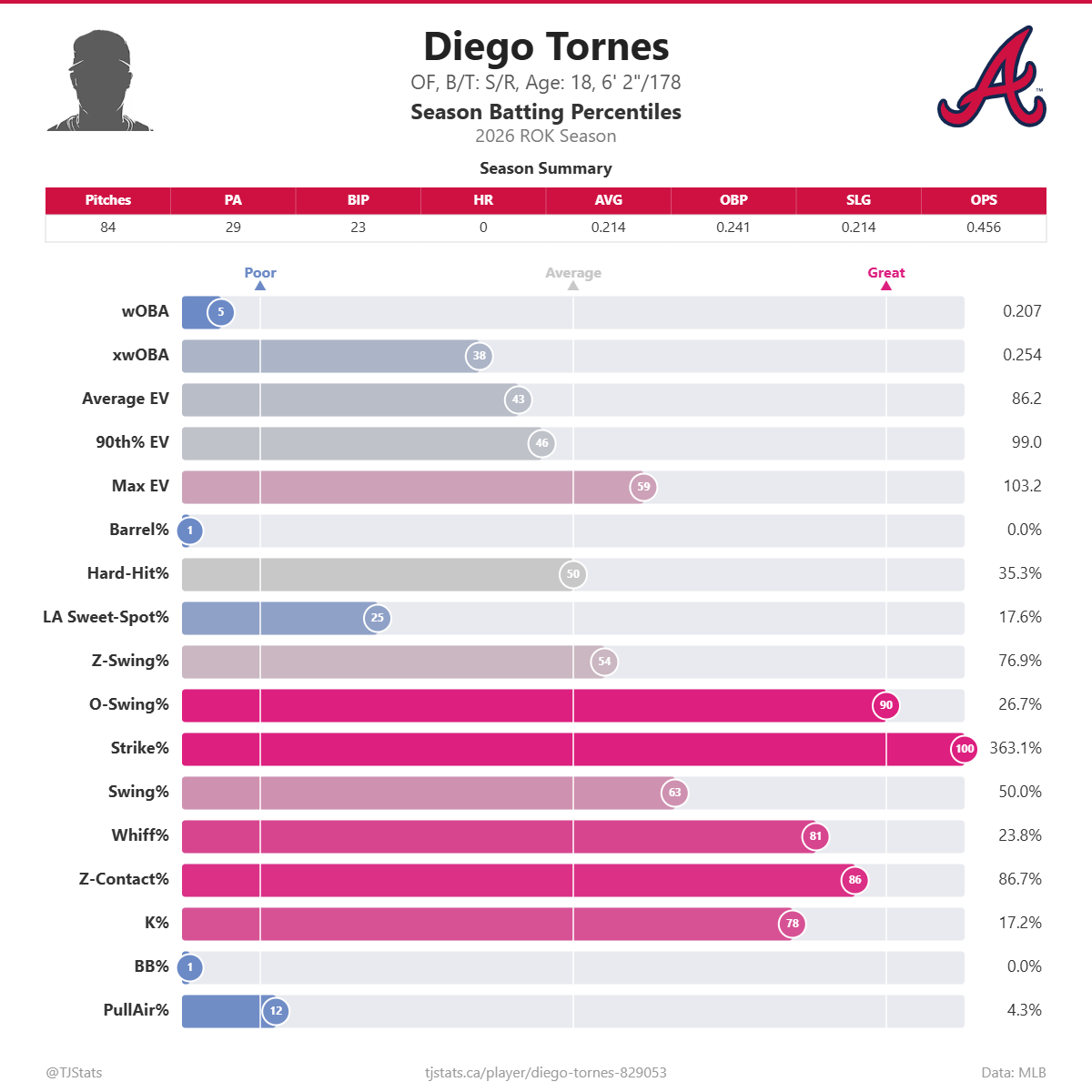
Remember all that talk about his patience and mature approach? Well, despite the overall struggles, those traits were still evident. Tornes posted a 23.8% whiff rate, ranking in the 81st percentile among complex league hitters. His 86.7% zone contact rate was even better, landing in the 86th percentile.
Perhaps most encouraging was his ability to lay off pitches outside the strike zone. Tornes chased just 26.7% of pitches outside the zone, a mark that ranked in the 90th percentile.
For someone who struggled as much as he did offensively, that’s an encouraging sign. The power and overall impact certainly weren’t there, but the underlying approach that made Tornes such an intriguing prospect in the first place never completely disappeared. And that’s why I’m not particularly worried about his long-term outlook.
At 6’2” and not even 180 pounds, there’s still plenty of room for Tornes to develop physically. A full, healthy season stateside, whether that’s at the complex or eventually in full season ball, should do wonders for his strength and overall development.
Was predicting a Double-A appearance at 18 a little ambitious? Looking back, absolutely. But given the talent, maturity, and approach Tornes showed before his injury, I still understand why I was so excited about his potential heading into the season.
I’m looking forward to seeing what a healthy Diego Tornes can do in 2027, and hopefully we’ll be talking about a completely different season this time next year.