


(Today’s newsletter was submitted for publication prior to the Atlanta Braves signing shortstop Ha-Seong Kim to a one-year deal for the 2026 season. We went live for a quick recap pod and we’ll have something out later today or tomorrow on that.)
Many former relievers who move into (or back into) the rotation credit their time working in MLB bullpens as factors in the success of their second acts as starters, a sentiment that Alex Anthopoulos shares.
“I think guys like Reynaldo López got better as a result of it, right?” Anthopoulos told me last Sunday, ahead of the MLB Winter Meetings. “You’re coming in [with] guys on base, there’s traffic, stress, things like that.”
Not only can those players typically come out of a bullpen with better stuff, retaining a good portion of their relief ‘velo bumps’, they’re also better equipped to escape jams and get outs with traffic on the bases.
And maybe, just maybe, they could become an effective postseason weapon for you, too. Here’s Anthopoulos again. “ I mean, when we signed Lopez, that was the thought: let’s see how he does as a starter. If we get to the postseason and we have five starters that would be ahead of him, the guy could transition to the bullpen.”
Ahead of reports about the Atlanta Braves reportedly being interested in starter-turned-reliever Brad Keller, let’s talk about the right-hander and what drove his breakout in 2025.
Plenty of experience as a starter
Keller was drafted out of nearby Flowery Branch High School in the 8th round of the 2013 MLB Draft by the Arizona Diamondbacks. He worked almost exclusively as a starter in the minor leagues for four seasons until being taken in the 2017 Rule 5 draft by the Cincinnati Reds and immediately traded to the Kansas City Royals.
Keller spent six relatively underwhelming years with the Royals, pitching to a 4.27 ERA in 150 appearances (114 starts). The inability to miss bats (17.2% strikeout rate) and walking too many (10.3% BB rate) is what ultimately doomed Keller, with Kansas City moving him to the bullpen in his final season before letting him walk in free agency.
And so began a walk through the wilderness for Keller. After undergoing Thoracic Outlet Surgery after the 2023 season, he debuted in late April of 2024 and underwhelmed with the Chicago White Sox and the Boston Red Sox. Across a combined 41.1 innings, he pitched to a combined 5.84 ERA with just 32 strikeouts.
But just as we discussed on Monday with James Karinchak, finally getting healthy might have been the trick for Keller. Signing with the Chicago Cubs for 2025, he had his finest season as a professional: A 2.07 ERA/2.82 xERA/2.93 FIP across 69.2 innings, striking out 75 (a career-high 27.2% strikeout rate) and even picking up three saves in the process.
“It’s being healthy, first and foremost,” Keller told David Laurila of FanGraphs back in October. “I battled TOS for a couple years, and it really came to a head two years ago. Ultimately, I had surgery, and I feel better now than I have my entire career. I’m recovering better than I ever had. That along with some tweaks I made mechanically have helped me max my velo. Overall, I’m just a better pitcher. Stuff-wise, sequencing-wise, using my pitches well. There was basically a revamp of everything.”
Yep, the breakout was partially because of health, but partially because of drastically altering both the pitches he threw and the way he threw those pitches. Let’s look at it.
What did he change?
When he debuted in 2018, Keller was a 4S/slider/sinker/changeup righty, going with heavy fastballs to lefties and mixing the four-seamer, slider, and sinker almost evenly to righties. The velocity was…fine, coming in a bit above average at 94.3 mph on the four-seamer.
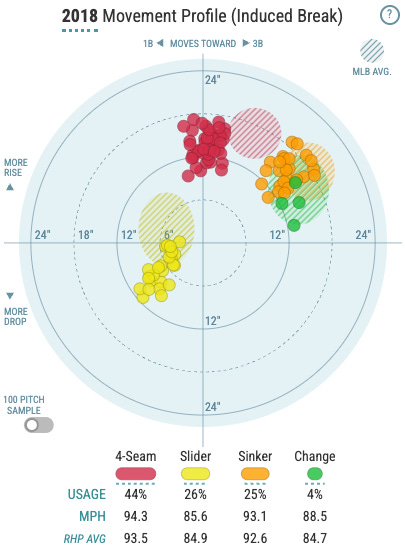
He’s been some variation of that guy above for most of his career, tinkering with stuff but not really deviating from that basic three-pitch profile.
But last season, he really leaned into the secondaries. He threw his newer sweeper a career-high 14% of the time, mostly to righties, for instance, but it wasn’t the most impactful change.
“I’m incorporating more sinkers this year,” the 30-year-old right-hander explained. “I’m also incorporating more changeups. It’s kind of a split-change, if you will. I also have the sweeper, which I didn’t have a few years ago. Outside of that, I still have the hard slider I’ve had my whole career, as well as the fastball.”
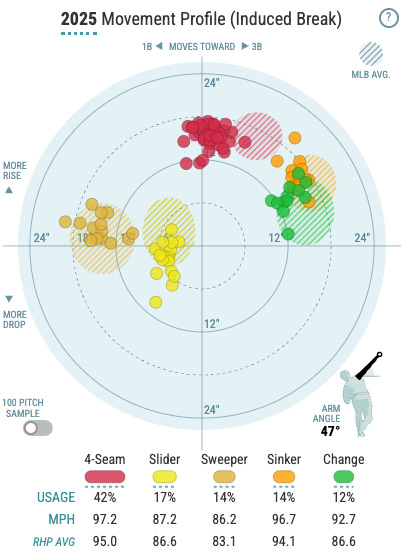
The changeup note was really interesting to me. Keller went from a standard changeup, thrown about 88 mph, to throwing it about 92-93 and with a hybrid grip that incorporates elements of both a two-seamer and splitter. He also ramped up usage of the sinker, from 2024’s <5% mark to 2025’s 14.4%, just a few ticks above the changeup at 11.7%.
In essence, what he did was make about one in every four pitches something that looked like a two-seamer, but with about four mph and four inches of induced vertical break difference between the two.
A two-seamer/split-change pairing isn't common, but it’s effective. I’ll let Keller explain.
“The changeup is the big thing I always struggled with,” the lefty told Laurilia. “I tried so many grips over the years. I eventually went to a two-seam fastball that I threw slower. I called it a BP fastball. That was probably the most success I had with a changeup.”
He’s also throwing with more velocity overall - again, a reliever velo bump, although Keller thinks it’s more than just throwing single innings at a time. “When I was in spring training, throwing three innings, I was still sitting 97-98,” he said. “In my mind, I’m not exerting a whole lot more effort than I would if I were to go multiple innings. Cleaner mechanics, a cleaner arm path — being healthy obviously helps — has allowed me to add a little more velo.”
What could Atlanta do here?
For those of you keeping score at home, that’s five pitches, including two different fastballs, two sliders, and an offspeed. In previous seasons, he’s tinkered with a knuckle curve (2023 & 2024) as well.
Sounds like a guy that could move back into the rotation, right? Keller’s not completely sold on the idea, but he’s open to the conversation.
“I mean, I’d started my whole life, and I love starting,” the free agent told Laurilia in October. “But again, I like where I’m at now — I like the role — so we’ll see. Maybe we won’t see. Maybe we’ll try it out. I’m not sure.”
But as we’ve previously discussed, both Atlanta in general and pitching coach Jeremy Hefner in particular like the idea of broadening arsenals and attempting to get starter innings out of bullpen arms. The Braves have now done it in just the last few seasons with Ray Kerr, Reynaldo López, and Grant Holmes, while Hefner’s most recent success story was free agent signing Clay Holmes last year while with the Mets.
If the Braves were to make someone like Keller their final major signing of the winter, the path forward for the rotation is pretty clear - the fifth starter competition is some combination of Holmes, Bryce Elder, the optionable Hurston Waldrep, and Keller. Most of the losers of that competition - except for Waldrep, as he can go to Gwinnett - would then be moved to the bullpen as either long relievers (Elder) or high-leverage relief (Keller, Holmes).
It’s the addition of a high-leverage arm without the knowledge of who exactly will be filling that high-leverage role right now. The downside is that, if that 5th starter falters, you’ve already sent the other stretched-out starters to the pen and they’ve got to ramp their innings back up.
But ultimately, with limited funds remaining for the winter, this is the next best alternative to swinging a trade for a frontline starter, one that will cost a lot in prospect capital. The median projection for Keller is 2/$22M, an average of $11M, which represents either a value for a starter or a high-but-not-impossibly-so total for a setup man/high leverage reliever, which is the fallback option.
Lindsay,
There's some yahoo on Youtube saying the Braves could trade Sean Murphy to San Diego for 34 year old lefty reliever Wandy Peralta and a gifted Dominican minor league reliever just turned 22 in November. I forget his name
It would free up Millions more if they wanted to get a starter. And add a Solid ground ball lefty reliever
Not to mention that 22 year old stud minor leaguer to our puny farm system
Well i'm happy.
If they didn't resign Kim, i would have just started a rebuild. Tear it all down.
Still might be facing a rebuild in a year or two.