


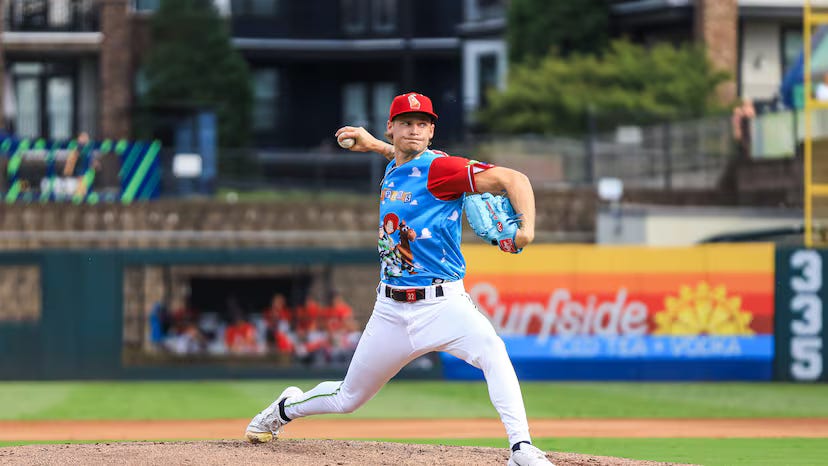
There may not be a more universal truth across Braves Country than this:
The Atlanta Braves need to add an impact starter.
But the most interesting question about this year’s trade deadline, scheduled for August 3rd at 6 PM, is this:
Is one impact starter enough?
Atlanta's rotation is, charitably described, Chris Sale and the boys right now. Everyone else at the back end of the rotation, while carrying ERAs in the high 3s, appears to be missing the swing-and-miss that's usually a prerequisite to survive in October.
And the rotation’s need is interconnected with the rest of the roster. Can Atlanta afford to both add two starters and still reinforce a beleaguered bullpen and find a bat to hit lefties?
It's an optimization problem that won't appear in an introductory calculus class: If you only have so many prospects and so much payroll to spend, where do you invest those resources to maximize your chances of winning a championship? That level of need means tradeoffs, and understanding which weaknesses you can afford to leave unaddressed and which you need to throw resources at fixing.
That calculus changed a bit on Wednesday afternoon:
AJ Smith-Shawver is back.
Let’s talk about it.
AJ Smith-Shawver Changes Everything
The righthander’s debut today is the culmination of almost fourteen months of rehab for a surgical repair of his UCL.
And it happened at the worst possible time, too.
Already down to his final minor league option, Smith-Shawver saved it by breaking camp last year in Atlanta’s starting rotation and looked rather impressive - a 2.33 ERA in his first seven starts, striking out more than a batter an inning while allowing just three home runs.
And then the injury trouble started. Smith-Shawver was blasted for seven runs on eight hits and three walks in just three innings against Washington, suffering an early loss of control that could have been a harbinger of what was to come. The next week, he reported feeling a “pop” in the third inning of his start, left the game, and was diagnosed with the injury.
But after a year of rehab, AJ returned to the mound and has looked better than ever. He has a 1.53 ERA through his five rehab starts, spread across Single-A Augusta and Triple-A Gwinnett. The last two, coming against Toledo and Iowa, saw Smith-Shawver combine for 8.1 innings with just one unearned run while striking out ten and walking just two.
And even better than the results have been the stuff. His four-seamer is averaging 97.5 mph in Triple-A, an increase of nearly 2 mph over where he sat in the majors last year, and three different pitches have put up a Stuff+ at or over 100, including a 114 for the splitter.
Today’s start may answer one of the biggest questions Alex Anthopoulos has to answer before the deadline:
How much confidence should the Braves have that AJ can be one of their three postseason starters?
Let’s talk about each scenario.
Scenario A
AJ looks like he did before the injury…and maybe even a little better. He’s missing bats, capable of giving you length when he’s cruising (like the eight scoreless, one-hit innings against Cincinnati last year), and just generally mowing through batters.
Suddenly you're no longer shopping for two playoff starters. You're shopping for one ace, and spending a significant portion of your prospect capital on just one player makes a lot more sense. Tarik Skubal becomes an actual possibility, and the postseason rotation of:
Chris Sale
Tarik Skubal
AJ Smith-Shawver
is not only a legitimate October trio, but one of the best in the entire postseason.
Scenario B
AJ looks…fine. He’s able to miss bats, mostly, but the control isn’t exactly dialed in, and the walks and contact are making him battle through the outing.
Now he’s competing for a starting spot in Game 3, not penciled in to be the guy. Maybe he gets the ball, but with a quick hook and a pen that’s ready to throw a Grant Holmes or Reynaldo López in bulk for a few innings.
Now you still need a game-two starter, but you likely also need to find someone who can give you length for the final two months of the regular season out of the rotation. That need to find two starters, even if it’s a veteran innings eater, likely caps the cost you can pay that frontline guy.
Scenario C
AJ isn’t ready. This wouldn’t be the biggest shock in the world; a lot of guys coming back from Tommy John surgery take a while to get back to their best form.
But this means that you absolutely need two starters. You might be able to plan on Smith-Shawver unleashing his stuff in October out of the bullpen, which helps you map out your 27 outs in the postseason, but this becomes a completely different trade deadline.
One Star...Or Four Good Players?
If Smith-Shawver looks like a DUDE this afternoon, the Braves may only need to buy one postseason starter. If he doesn't, Alex Anthopoulos suddenly has a much longer shopping list.
Can you afford to shoot for the moon with that game two starter?
Option A
Trade for Tarik Skubal. It’ll take some of your top prospects, but this is the highest ceiling-raising add you can make between now and next Monday.
Skubal slotting in behind Sale would immediately give the Braves the best Game 2 starter in baseball come October. That Sale/Skubal combo also dramatically changes the geometry of a short series, with even average offense leading to the Braves winning a best-of-three (Wild Card) series rather handily and staking Atlanta to a likely 2-0 lead in any best-of-five matchup.
However, acquiring Skubal will probably limit everything else you can do at the deadline. With Detroit wanting a near-MLB starter with upside plus other top prospects, the Braves likely need to stick with either Sean Murphy as the vs-LHP offensive add or stick with the current internal options for the bullpen.
Option B
Spread resources around.
Examples:
Plus
leverage reliever, like Adrian Morejon on the high end and…Antonio Senzatela on the low end?
Plus
bat versus lefties, like Lane Thomas or Taylor Ward
A roster usually wins playoff series, not one player, and while this makes the roster as deep as possible, it’s a lot of smaller ceiling-raises versus one massive rise. Rather than guaranteeing that competent offense can give you a game two win behind Skubal, you merely improve your chances of winning both games two and three.
The Forgotten Need: Hitting Lefties
One of the likely responses to the trade-offs required if you’re spreading the investments will be to not worry about the offense against lefties.
Let me caution about that.
Heading into Tuesday’s action, Atlanta’s 92 wRC+ against lefties was tied for 19th in baseball. Their walk rate of 7.1% is better than only the San Francisco Giants, and the team’s slugging against lefties is only .398.
Hitting southpaws is most notably a weakness for Atlanta in the outfield, with Atlanta’s best left field option against lefties being Eli White’s 103 wRC+ (2023-2026).
But while the easiest-sounding solution is to find a right-handed hitter to slot in against southpaws, there’s one caveat here:
It doesn’t have to be a right-handed hitter, it just needs to be someone who crushes lefties.
Now, more often than not, is that person going to be a righty? Of course. But similar to how we don’t fret about the platoon splits for Raisel Iglesias, because he doesn’t really have them, a good-enough hitter will be able to handle pitchers of either handedness.
The problem is those are the best hitters in baseball and they’re hard to acquire.
Catcher Sean Murphy’s expected return likely helps with this, a bit. Even in his underwhelming 2025 season (.199/.300/.409), he still had a 123 wRC+ versus southpaws and put up an absurd .271 ISO off of them, hitting seven home runs in just 96 at-bats.
Murphy being back behind the plate, which could also meaningfully improve the run prevention of the pitching staff through his exemplary gamecalling and defense, allows the team to add a lefty-masher to the lineup. It also allows Drake Baldwin to take over as the main designated hitter three or four days a week, likely spelling the end of Dom Smith’s tenure on the active roster.
But it doesn’t fix the left field problem. There are some rental bats out there that could, however, including Taylor Ward (148 wRC+ vs LHP, T25 in MLB) and Lane Thomas (124, T-57th).
Package Deals Are the Hidden Advantage
Know what’s easier than making two trades for two players?
One trade for two players.
Package deals, where the Braves go to the same team and get multiple players, could reduce the acquisition cost compared to making two separate deals. I’m going back to the Max-Scherzer-and-Trea-Turner megadeal in 2021, where the Dodgers were able to flip two prospects in Josiah Gray and Keibert Ruiz for both a rental of Scherzer and one-plus years of Turner.
I tried to identify some realistic deals that could fill multiple buckets at the same time.
Starter + outfielder
This is the easiest, as a lot of the teams that have rental starters also have a rental outfielder they could move. It’s likely also the most expensive, as starters as seen as the premium currency this trade deadline.
Michael Wacha as a veteran #3 starter to give you length in the postseason, paired with outfielder Lane Thomas, is probably the most straightforward out there, but buying multiple seasons of Angels starter Reid Detmers and outfielder Jo Adell, while more expensive, would help prevent this same conversation from popping back up next summer.
One important note: MLB Insider Ken Rosenthal reported on Tuesday afternoon that there’s still some acrimony in Toronto towards Alex Anthopoulos, so the possibility of trading for starter Kevin Gausman and outfielder George Springer is unlikely.
Starter + reliever
This one’s easy to understand - every team, virtually every year, has at least one and sometimes a few relievers on expiring deals.
The Angels could pair either Detmers or Jose Soriano with your flavor of reliever, anything from veteran former closer Kirby Yates (a former Brave) to middle reliever Brent Suter.
Outfielder + reliever
This might truly be the best bang for your buck, as both corner outfielders and relievers are usually plentiful at the trade deadline. Sure, finding the right outfielder, like one that mashes lefties, isn’t always the easiest thing to do, but if you need to grab someone to stand in the outfield and a reliever to throw the 6th or 7th inning, this can be done with likely one mid-level prospect or two.
Assuming the Mets would trade inside the division, they could offer a reliever like old friend A.J Minter or Luke Weaver and pair them with anything from a gamble on Luis Robert Jr. re-discovering his ceiling to a veteran floor in Tyrone Taylor (109 wRC+ vs LHP in the last three years, including a 156 this season). If you’re looking for additional control of the outfielder, Jake McCarthy or Brenton Doyle of the Rockies could pair with flamethrowing converted starter Antonio Senzatela and you’d have a $14M club option on the pitcher, to boot, if you thought getting him out of Colorado and into your pitching development system would fix his career 5.08 ERA.
What Success Actually Looks Like
Until yesterday, the Braves were planning a trade deadline without AJ Smith-Shawver. Now they have to decide how much they believe in the pitcher returning from the injured list.
Today’s start won’t determine the Braves’ deadline.
But it may determine how aggressive they need to be.
Remember what John Smoltz told me? “You need three hot hitters, three hot starters, and three hot relievers to win in October.”
If AJ Smith-Shawver looks like a DUDE today, Alex Anthopoulos already has two of those hot starters and suddenly has the freedom to chase the biggest fish in the pool to be the third.
But if he doesn’t, the Braves may be better served spreading those same resources across multiple holes.
That’s why this afternoon’s game matters long after the final score.
Another 3-2 game. Why get a seasoned starter when we can't score more than 2-3 runs/game? Why not play Mateo at SS against lefties? Why not play Mateo at 3rd? Or, go after a big right handed bat that can play 3rd/left field and allow Dubon to "float"? What did you think of AJ today? I think we need to see another outing or two prior to pencil him in as #2 SP.
I know I may be in a minority here, but I do not want to "break the bank" for two months of Skubal.