


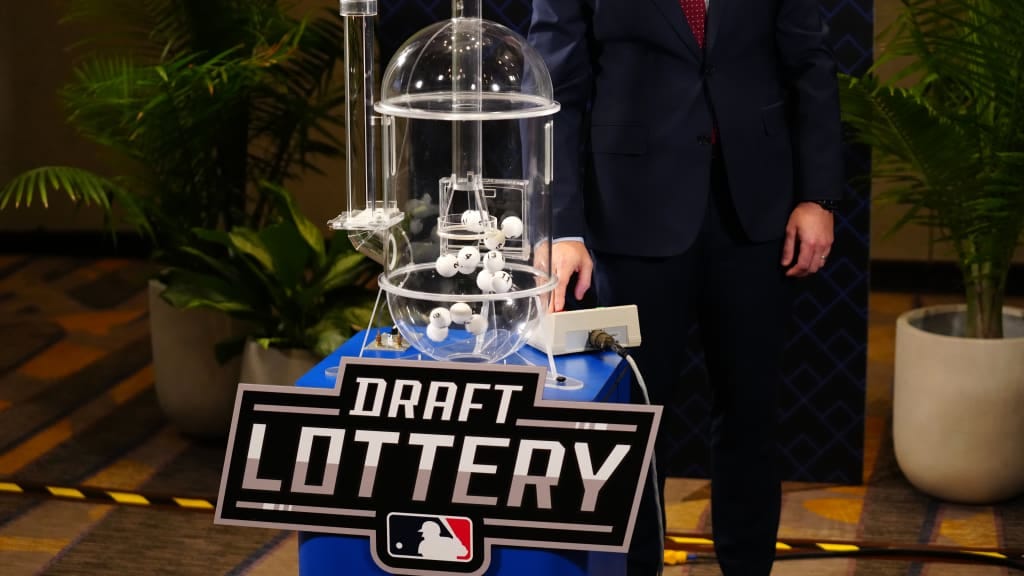
The MLB Draft Lottery, held on Tuesday night, could not have gone worse for the Atlanta Braves.
Entering the day with the 6th-best odds of winning the #1 overall pick, the Braves instead fell to the lowest possible pick they could have had: 9th, in the final slot before the three lottery-ineligible teams1 were already placed.
But despite the disappointment, it’s not the end of the world.
The Atlanta Braves now have three picks in the top fifty of 2026’s draft, with the team pairing #9 with the additional pick at #26 that they received for Drake Baldwin’s Rookie of the Year win and their standard-issue 2nd round pick, which will come in at #48.
Let’s talk about the different approaches that Atlanta can take with three Top 50 picks.
This happens almost every year
Since the creation of the Prospect Promotion Incentive program in the most recent CBA, seemingly every single season has a team with three picks inside the top 50. This is normally due to a team either receiving an extra competitive balance or compensatory pick, or by winning a PPI pick.
2022: Arizona Diamondbacks pick at #2, #34 (Competitive Balance pick), and #43
The Diamondbacks took 2nd-generation outfielder Druw Jones with the #2 overall pick before taking injured Mississippi State pitcher Landon Sims at #34 and following them up with Texas first baseman (and Golden Spikes, Dick Howser, and National Player of the Year winner) Ivan Melendez, aka “the Hispanic Titanic”.
2023: Seattle Mariners pick at #22, #29 (first-ever PPI pick, for Julio Rodriguez winning ROTY) and #30
The Mariners went all preps early, taking prep shortstop (and Auburn commit) Colt Emerson at #22 and then going back-to-back with outfielders, taking Jonny Farmelo at #29 and Tai Peete at #30. Two of the three were overslot, requiring them to go mostly college arms through the rest of day one. They did get one more prep in 4th-round outfielder Aidan Smith, though.
2024: Arizona, again, picking at #29, #31 (PPI pick for Corbin Carroll winning ROTY) and #35 (Competitive Balance Round A)
Arizona went all position players here, taking prep outfielder Slade Caldwell at #29, Univ of Kentucky outfielder Ryan Waldschmidt at #31, and prep shortstop J.D. Dix at #35.
2025: Baltimore had four in the top 50: #19, two back-to-back compensatory picks at #30 & #31 (for Corbin Burnes and Anthony Santander, respectively) and #37, a Competitive Balance Round A pick they acquired via trade from the Tampa Bay Rays.
Baltimore, as they love to do, when hitter heavy here, doubling up on catchers with Auburn’s Ike Irish at #19, Coastal Carolina’s Caden Bodine at #30, Arkansas SS Wehiwa Aloy at #31, and then prep OF Slater de Brun at #37.
What direction should the Braves take?
Recent Atlanta drafts prior to 2025 have featured multiple arms early, with someone (or multiple someones) getting underslotted early so that the team can overslot an uber-athletic prep sometime later on day two. The only real difference last year was that the organization met the draft class where it was and took three middle infielders with its first three picks, still going with an overslot prepster later.
SIDEBAR: To briefly explain over and underslotting - each draft spot in MLB has a suggested value for that pick. If you pay a player more than the suggested pick value, it’s an “overslot” signing bonus. If you pay them less, it’s an “underslot” bonus. As long as the total spending of your “draft pool”, which is the combined suggested pick value of all of your picks in the top ten rounds, still works out in the end, it doesn’t matter to MLB how you distribute it. You can go up to 5% over your pool total without major penalty.
In 2025, it was 4th-rounder prep lefty Briggs McKenzie getting five times the recommended $588.9k slot value when he signed for an even $3M.
In 2024, it was 5th-round prep catcher Nick Montgomery getting a $997.5k bonus (slot value $403.4k) and 6th-rounder prep righty Ethan Bagwell getting $822.5k on a slot value of $312.8k.
In 2023, we overslotted prep righthander Garrett Baumann in the 4th and prep outfielder Isaiah Drake in the 5th, paying both $747.5k against slot values of $521.8k (Baumann) and $367.5k (Drake).
And no, it’s not just prep players that get overslot deals. That same 2023 draft, we gave draft-eligible sophomore Drue Hackenberg an extra $630k over his $1.37M 2nd round slot value to leave Virginia Tech a season early. Anytime a player has leverage, an overslot deal is possible.2
They’ll likely keep this trend up in 2026.
How much money will they have to spend?
If we use 2025 values, here’s what those draft picks were alotted for a value last season:
#9: $6.51M
#26: $3.49M
#48: $2.03M
That’s already $12.03M, more than Atlanta’s entire draft pool last season ($9,081,100). This doesn’t factor in the value of the picks in rounds three through ten, as well as the standard yearly increase factored into the pools that is tied to the change in MLB revenues.
If we apply last year’s 4.8% growth, combined with an estimated value for the picks in rounds three through ten, I’ve got $12.61M for just the first three picks. I’m less confident on my math for the entire draft pool, but I’m going to put it around $16.25M, give or take some qualifying offers moving these picks around a bit.
That’s easily the largest draft pool Atlanta has had in the entire draft slot era, which began in 2000.
Let Ronit Shah cook.
Who might the Braves take?
With the caveat that things can significantly change as preps hit the spring showcase circuit and college players play their spring seasons, there’s a few areas that we can see the Braves looking on day one.
Pick #9
This is the bottom of the 2nd tier of position players, with prep shortstop Jacob Lombard being the suggested pick of Baseball America’s post-lottery mock draft. College players the Braves look at here could be LSU outfielder Derek Curiel, GT outfielder Drew Burress, Coastal Carolina RHP Cameron Flukey, and Virginia SS Eric Becker. If they go with a non-Lombard prep here, LHP Carson Bolemon out of South Carolina has tools that would appeal to the Braves and SS Tyler Spangler out of California is a Stanford commit who has great defense and contact skills.
Pick #26
The Baseball America pick was prep lefty Gio Rojas out of Florida, who already sits mid-90s with a high-spin slider and a promising changeup. I’d also watch for Auburn/Team USA second baseman Chris Rembert as a potential Ozzie Albies replacement and two-way prepster Coleman Borthwick. Many organizations have the righthander as an eventual high-90s flamethrower, but the Braves have bucked trends before by going the other way with two-way preps Austin Riley and Michael Harris II.
Pick #48
Most mocks aren’t going this far yet, but this can be a place where the Braves find some value. I could see Atlanta reloading at catcher, with this being a good landing spot for Texas big boi Carson Tinney or prepster Will Brick (committed to Mississippi State), although I doubt Georgia Tech’s Vahn Lackey, currently the best catcher on the board, is still available.
Colorado Rockies, Washington Nationals, and Los Angeles Angels
Similarly, college seniors/grad students not only get severely underslot deals, but often also receive bonuses as low as just a few thousand dollars despite being taken in the first ten rounds. Being out of college eligibility, they have no leverage and take whatever they can get for a chance to continue their playing careers. The Braves are notorious for being one of the most aggressive here with college seniors, often signing guys for no more than the MLB-standard $2500 contingency bonus paid for executing a contract.
The rule 5 came and went and Burkhalter is still a Brave. No idea why this makes me so happy! Ehhh 9th ...we will make some lemonade--not top 3 pick lemonade for the 25 season, but ahh well.
Very in-depth analysis, Lindsay. At this time of year with the all the decisions that must go into how, or if, a franchise will invest in the Draft, free agents, trades and resigning, it seems to me the the scouting staff for each franchise is the critical factor. Lindsay, how do you rate the Braves' scouting staff?