


Ronald Acuña Jr. hit two baseballs harder than 107 mph against the Dodgers on Tuesday night. Neither came against a fastball.
He lined a slider 107.3 mph for a single in the fifth inning. Two innings later, he smoked a sweeper 111.9 mph, only to watch the ground ball turn into a forceout.
The four-seamers produced something very different.
Acuña popped up a 94.6 mph four-seamer in the first inning. He later struck out after swinging through consecutive fastballs at 97 and 96.3 mph. During his final plate appearance, he fouled two center-cut four-seamers at just 79.5 and 77 mph off the bat before producing that 111.9 mph ground ball against the sweeper.
One game does not create a season-long trend, but this game illustrated it almost perfectly. Acuña has not suddenly lost the ability to hit. His decline is concentrated largely against one pitch—the four-seam fastball—and particularly in what happens when he puts it into play.
Let’s talk about it.
This is an ordinary season from an abnormal hitter
Ronald Acuña Jr.’s stats aren’t bad, per se: He entered Wednesday hitting .232/.335/.407 with 13 home runs and 18 stolen bases, which comes out to a .742 OPS and a 107 wRC+.
But producing at only seven percent above league average is not a level Ronald Acuña Jr. is accustomed to occupying, with only his injury-shortened 2024 campaign being remotely comparable (106 wRC+ in 49 games).
Last season, returning partway through the year after a second ACL injury, he hit .290/.417/.518 in 95 games, a 162 wRC+ that was just shy of his 171 wRC+ from his MVP season in 2023. Ronald finished last season with 21 home runs and 74 runs scored, a 162-game pace of 36 homers and 126 runs.
In fact, Acuña has come in at least 25 percent above league average in six of his first eight major-league seasons. But this year, he has been only slightly above average.
And what’s frustrating is that his inputs are in the same realm as his career averages, from strikeout rate (23.6%) and whiff rate (29.9%) to walk rate (12.2%) and bat speed (91st percentile mark of 75.9 mph).
No, the explanation is somewhere other than a broad loss of contact ability.
It isn’t EVERY fastball
For the first time in his career, four-seam fastballs are beating Ronald Acuña Jr.
| Against four-seamers      |  2025 |  2026 |
| ------------------------- | ----: | ----: |
| Run value                 |   +16 |    -9 |
| Run value per 100 pitches |  +3.0 |  -1.8 |
| Batting average           |  .269 |  .121 |
| Slugging percentage       |  .558 |  .172 |
| Expected batting average  |  .248 |  .184 |
| Expected slugging         |  .627 |  .316 |
| Whiff rate                | 33.5% | 32.1% |
| Hard-hit rate             | 59.7% | 48.4% |
| Pitch usage against him   | 29.5% | 34.1% |
This is not a generic velocity problem, or even a fastball-family problem. Acuña is crushing sinkers to the tune of a .349 batting average, .730 slugging percentage and +10 run value.
He doesn’t have a fastball problem. He has a four-seam problem.
The strangest part is that he isn’t missing more
The very first thing I looked at when researching this piece was Ronald’s whiff rates against specific pitches, looking to see if he just wasn’t able to catch up to them.
Nope.
His whiff rate against four-seamers actually declined this season, from 33.5% to 32.1%. The strikeout rate on that specific pitch is slightly higher, from 28.9% to 29.9%, but neither change is remotely large enough to explain the collapse in his production.
His overall zone-contact rate does not suggest a broader inability to catch up to strikes. Ronald’s zone-contact rate on all pitches is actually up this season, from 73.8% to 77.4%, and that’s with an in-zone swing rate that’s about 4.6% higher than last year. And on “meatballs,” or pitches that are defined as middle-middle, Ronald’s also swinging about 1.5% more than last year.
He’s not refusing to swing at strikes, nor is he suddenly just swinging through everything. The damage just…disappears when the ball is struck.
Ronald’s four-seam hard-hit rate has dropped from 59.7% to 48.4%, and his average exit velocity on the pitch is down by more than two mph. He hit nine of his 21 homers on four-seamers last year; in 2026, it’s just one of his 13 so far.
Acuña is reaching the fastball often enough. He just isn’t arriving with the barrel in a position to punish it.
What the attack-zone graphic actually tells us
MLB sorts all pitches into one of four ‘attack zones’, defined as the Heart, Shadow, Chase, and Waste.
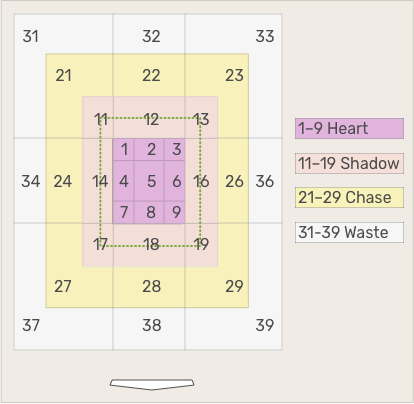
Heart: Entirely within the rulebook’s strike zone, with the outer edge of the heart being more than a full baseball’s width from the edge of the zone. Umpires calling these pitches ‘balls’ are exactly why the ABS challenge system was implemented.
Shadow: This is an area one baseball’s width on either side of the strike zone, with pitches here being borderline offerings that are called strikes roughly 50% of the time. (I’d be curious to see if this has changed with the advent of ABS)
Chase: These pitches are definitively outside the strike zone. Batters swing at them roughly 25 percent of the time.
Waste: This outermost region is completely off the plate. Pitchers almost never target the Waste area and batters almost never swing at pitches in this zone.
Ronald’s results in the heart of the zone are…concerning this year.
| Attack region | 2025 run value | 2026 run value |
| ------------- | -------------: | -------------: |
| Heart         |             +4 |             -7 |
| Shadow        |              0 |            -11 |
| Chase         |            +19 |            +14 |
| Waste         |            +11 |             +9 |
(The positive values in the chase and waste regions do not mean Acuña is crushing bad pitches. Most of that value comes from not swinging; swings and takes are the two components that comprise each zone’s run value score.)
Acuña’s swing value in the Heart fell from +10 last season to -4 this year. He continues to create value when pitchers miss well outside the zone, primarily by taking those pitches. The problem begins when they throw him something he should hit.
His slugging percentage against four-seamers in the Heart is only .205, compared with .571 last year and .674 during his MVP season.
In the heart of the zone, Ronald’s slug against four-seamers is only .205, as compared to .571 last year and .674 during his MVP season.
Don’t blame velocity
Pulling all the fastballs in the zone that he’s seen and binning them by velocity, he has struggled against four-seamers below 94 mph, between 94 and 96, and between 96 and 98 (the sample of 98 and up is too small to draw any meaningful conclusions on, honestly).
Location adds another wrinkle to this. He’s usually poor against elevated four-seamers - that’s the most effective area for the pitch, and a lot of really good hitters aren’t good at hitting them in the upper third of the zone.
But in the middle third and lower third, his performance has cratered from last year to this year:
Middle third = .302/.674 —> .211/.368
Lower third = .588/.882 —> .143/.214
He is struggling with four-seamers throughout the zone, not merely with elevated velocity.
The bat is fast enough
The mechanical aspects of the swing, as measured by Statcast, are in the same basic area as always for Ronald.
His bat speed has gone from 76.4 mph to 75.9 mph this year, a slight decrease but still in the 91st percentile. His swing length is unchanged at 7.6 feet.
But again, his average exit velocity and hard-hit rate are both down.
His popup rate, however, is significantly higher, rising from 5.1% to 8.1%. Mistimed contact can produce that kind of increase, although the number alone cannot prove timing is the cause.
His more-open stance offered one possible explanation early in the season. Acuña opened his feet from approximately 14 degrees to 23 degrees before mostly returning to his previous positioning. Because the four-seam struggles continued after that reversion, the stance change cannot fully explain the season-long problem.
His physical ability to generate bat speed has not disappeared. What has declined is the frequency with which he applies that speed at impact, and we don’t really know for sure why right now.
There is some bad luck, and maybe some progress?
Since Ronald was activated off the injured list from his second hamstring strain on July 27th, he’s hitting just .196/.259/.383. That line includes a .214 BABIP, while his expected results are considerably better: a .250 xBA and .432 xSLG.
Much of the gap between his actual and expected production is concentrated against four-seamers.
Actual: .119 average, .214 slug
Expected: .229 xBA, .396 xSLG
A 61 percent hard-hit rate against four-seamers since returning offers some hope that better results are coming. Even his expected production against the pitch, however, remains inadequate for one of Atlanta’s “aircraft carriers.”
The 111.9 mph groundout against LA is the perfect illustration of this: He’s been unlucky since returning, but that doesn’t erase a season-long four-seam problem that’s been around since before his first hamstring injury of the year.
Why this matters in October
Whether opponents are deliberately targeting this weakness cannot be determined from usage alone. But four-seam usage against Acuña has increased from 29.5 percent to 34.1 percent, and pitchers currently have little reason to change course.
Atlanta doesn’t need the 2023 MVP version of Acuña to come back. They’d take it, obviously, but it’s not required.
What is required is a version of Ronald that can punish four-seamers in the zone, so that postseason opponents can’t repeatedly challenge him with them. If he can get back to even average four-seam production, the ceiling of this Braves lineup changes significantly.
Ronald Acuña Jr. does not need to rebuild his entire offensive game. He still punishes sinkers. He still destroys offspeed pitches. His bat remains fast enough, and his strikeout rate has not spiraled.
The distance between this version of Acuña and the player Atlanta needs in October may be measured in one pitch…and four seams.
Ronald should be benched for a game or two. He needs perspective. Every at bat he’s trying to hit home runs on every swing. His frustration level rises with each strikeout.
Great data deep dive. I assume the Braves' coaches have the same data and conclusions. The question is, how do you correct this and would he even listen if given suggestions for change. (Plays like his being deec'd by Ohtani two nights ago make me wonder).
It's amazing how two proven stars like Acuna and Riley seem to have markedly declined this year. Both have had injuries but I would think the 'rust' of those would have begun to subside by now. I used to think Riley's kryptonite was always the low-and-away sweeper (still is) but it's also the high 4seamer. He just can't make contact. I think even Chipper has come to just shake his head.