


British economist Charles Goodhart was thinking about monetary policy, not teenage pitchers, when he described a problem that we now define using his name.
Goodhart’s Law is, essentially, an indictment of performance measurement: “When a measure becomes a target, it ceases to be a good measure.”
Velocity was once a measurement. For many young pitchers, it has become the target. Too many young pitchers are obsessed with the radar gun’s reading, believing that the delta between 95 and 92 is the magic elixir for getting the D1 college offer or first-round draft attention.
When 95 mph begins to feel like the price of admission, a pitcher sitting at 88 or 92 has every incentive to chase the missing number, even while his body is still developing.
The Atlanta Braves, though, have perhaps become too comfortable not targeting that velocity. Pursuing velocity for velocity’s sake can be bad process, and the Braves understand the danger of asking young pitchers to manufacture it before their bodies are ready. But at the same time, they haven't consistently shown they can develop it safely once those bodies mature.
The Braves have become exceptionally good at making 92 mph work. The uncomfortable question is why they aren’t better at turning it into 95.
Let’s talk about it.
The Braves CAN Build Around 92
Columbus Clingstones pitching coach Mike Steed recently told radio host Bill Shanks that the organization doesn’t push velocity on their young pitchers, explaining that the #1 answer it gives prospects who ask how to throw harder is “grow up.”
To be clear, Steed was not telling them to sit around and wait. He described a development process built around efficient movement, strength, body awareness, pitch shape, location, release height, and deception. Velocity can arrive within that process, but the Braves don’t want it to become the entire process.
And on its face, that makes sense. The Braves still want guys who throw hard. Why wouldn’t they? Velocity shortens a hitter’s reaction time, provides more wiggle room for a missed location, and can make certain secondary pitches even better.
But the distinction for Steed is the intentionality behind velo growth. Velocity can emerge through physical growth, strength and conditioning, and learning how to move more efficiently. The Braves appear to believe that trouble begins when a young pitcher tries to force mechanics or workloads onto a body that isn’t ready for them.
Shanks presented Steed with a great hypothetical (paraphrased):
What would you tell a pitcher who throws 92 or 93 mph and worries that he will never reach 98?
And if you’re someone who’s worried about the health of Atlanta’s pitching prospects, Steed’s answer should be comforting: there are ways to “build stuff” with almost anyone.
And he’s right; there are lots of ways to do that!
The first is fastball movement. Maybe your ideal shape isn’t a four-seamer because it lacks carry, and you need to make a cutter or sinker your primary fastball or mix all three in roughly equal amounts.
Maybe it’s your pitch locations. Are you elevating your four-seamer enough? Is your cutter being thrown into the heart of the zone, or in the shadow?
Maybe it’s your arm slot. Cam Caminiti’s a great example of dropping a pitcher’s arm angle to create outlier pitch shapes.

This works for release height, too. Can you make up for subpar carry on a four-seamer by lowering the release height and creating a flatter Vertical Approach Angle? Or can you find a way to introduce some deception into the delivery?
It might not even be mechanical; it might simply be informational. Where are your misses coming from, and can you adjust the catcher’s target to account for that? Are you overusing one sequence? Are you going to a pitch too often, allowing its effectiveness to ‘decay’ as the hitter sees it multiple times during an at-bat or across the game? And do you know what to throw to ‘buy back’ some of that effectiveness?
The organization’s newer focus on individualized pitching development means it is better equipped to explore those different approaches with each of its prospects.
Understanding and being able to improve all of those facets of a young pitcher are signs of a sophisticated pitching development apparatus.
They’re also workarounds. A 92 mph fastball with excellent shape can absolutely outperform a dead-zone 95 mph fastball, but the same excellent fastball shape at 95 would still be better.
Owen Murphy is the Clearest Cost
Atlanta clearly prioritizes Stuff, and has shown that they’re willing to aggressively pursue impact starters who have it.
Part of the reason the Braves have been so diligent in searching for that impact starter is likely that they haven’t been able to move enough prospects from the “regular season back-end starter” group to the “impact postseason arm” group.
Spencer Schwellenbach, when healthy, is a frontline starter. Spencer Strider, when healthy, has shown he’s capable of being a frontline starter.
But too many of the pitching prospects just now reaching the majors, like JR Ritchie and Owen Murphy, have not yet shown the ability to take that leap.
And with Ritchie, that’s a lofty expectation that was never really placed on him, even as a first-round pick. In his Baseball America pre-draft profile, they both pointed out that the youngster typically pitches in the low 90s and that there was “not much in the way of future physical projection” going forward.
Meanwhile, his final prospect profile before losing his prospect eligibility this season specifically points out that adding velocity could help him “find another gear”.
But that’s not the case for Murphy, who was believed to have more in the tank due to his “natural athleticism,” having been both a “star football player” and a “legitimate prospect as a shortstop” as a prep.
Yet his Triple-A fastball remains about 92 mph this season, four seasons after being drafted. Owen Murphy at 92 has to locate, sequence and maintain his shape. Owen Murphy at 95 could survive the occasional mistake, generate more empty swings and force hitters to begin their decisions earlier. Nothing else about him has to change for his ceiling to move dramatically.
(The caveat here is the time he missed following Tommy John surgery, with Atlanta being right to prioritize health during his return-to-play. That being said, many pitchers naturally return with more velocity after Tommy John and the organization has had several years to develop his body and delivery. His command, pitch shapes and approach have progressed, but the radar reading largely hasn’t.)
Garrett Baumann Complicates The Case
Baumann is, physically, a monster. Standing 6-foot-8 and 240 pounds when drafted in 2023, his draft profile noted his average velo of 91-93 and a max of 96, pointing out that his suboptimal mechanics and having “plenty of arm strength” could eventually translate into a workhorse starter.
Atlanta did help Baumann add some velocity since he was drafted in 2023, as well as polish the rest of the package to create an intriguing starter. His height and release point create a steep approach angle, so the org gave him a sinker to capitalize on that extreme sight picture and he pushed his velo toward an average of 95 mph.
But his fastballs still generated too much upper-level contact despite the modest velo bump, and his merely average secondaries have not consistently given him a way to finish off an at-bat. Following a difficult Triple-A stint where he got hit hard (xwOBA of .346, .306/.380/.653 line), he was moved back to Double-A Columbus last week.
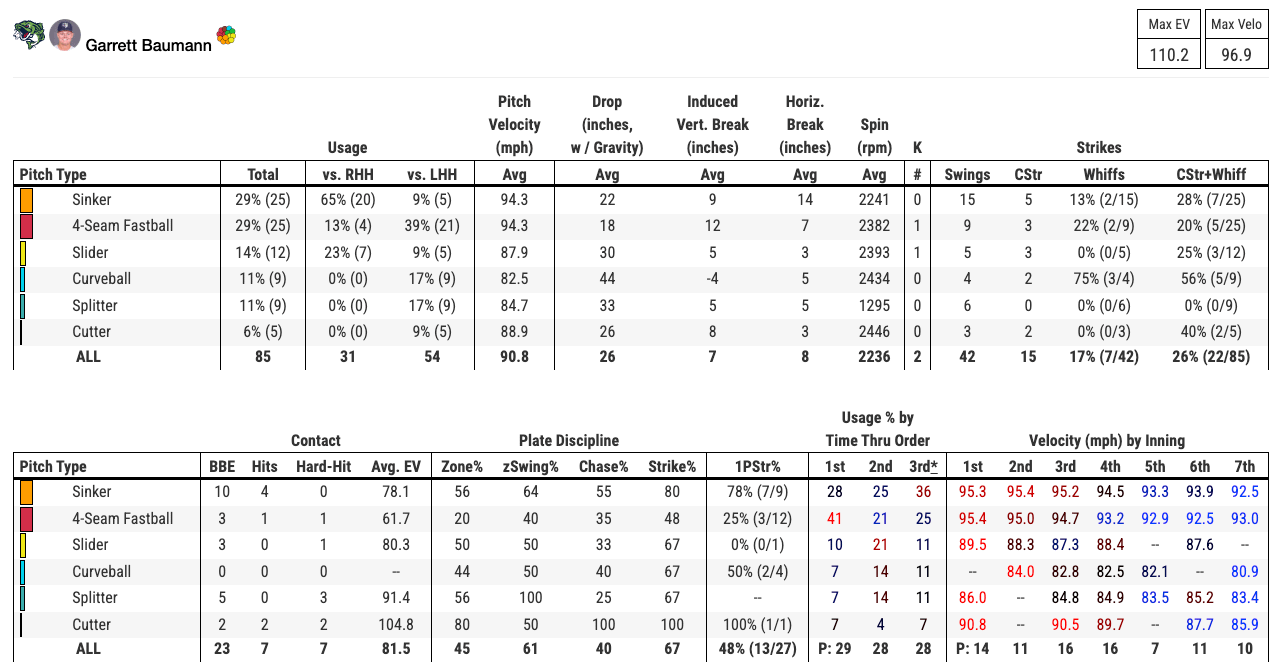
Peak velocity (96.9 mph in that Memphis outing) tells you what an arm is capable of producing. Sustained velocity tells you what kind of pitcher the organization has developed. With Baumann, the system has shown that it can add some velocity and optimize his pitch shapes. It has not yet shown that it can help him preserve that velocity across a starter’s workload or assemble a pitch mix capable of compensating when it fades.
The program is incomplete, lacking the consistent ability to add speed, preserve it across a starter’s workload, and make certain the final pitch mix gets results.
Patience Is Not A Program
It’s only right to acknowledge that there are places where Atlanta’s pitching prospects have been able to make meaningful velocity gains during their time in the system.
Brett Sears, a seventh-round senior sign in the 2024 MLB Draft, was able to acclimate to the grind of a professional season through both physical maturation and finding routines that worked for him, per Steed. That growth allowed him to climb from barely breaking 90 when drafted to comfortably sitting 93. He’s now on the radar as a legitimate prospect, albeit with a ceiling as a back-end or spot starter at best.
Cedric De Grandpré went from a low-90s sinker/slider control artist before his 2024 Tommy John surgery to a Stuff monster, averaging 95 with his multiple fastballs and touching the high 90s with his four-seamer. The previous two-pitch arsenal has ballooned to all three fastballs, a bat-missing curveball (31.3% whiff rate in Triple-A) and a slider, as well as a seldom-used-but-promising changeup. With the additional velo at his disposal, he’s raised his stock from a 13th-round JUCO lottery ticket to a legitimate prospect.
Other pitchers, like Drue Hackenberg and Blake Burkhalter, have been able to return from injury with more physical development and the newfound velocity that come with it.
Individual success stories prove velocity growth can happen inside Atlanta’s system. They do not establish that Atlanta possesses a repeatable process for producing it.
The 2026 Draft: Acquiring Velocity?
The big prep swing in the 2026 draft, in which the Braves saved money with their first two picks (both college outfielders) and then went overslot for three consecutive prep pitchers, may be a tacit acknowledgment by the organization that this deficiency is real.
Of the three Day One arms:
Kaiden McCarthy has reached 99 mph.
Jensen Hirschkorn has reached 95–96, with additional physical projection remaining.
Cole Dennis reached 96 at the Draft Combine and reportedly touched 97 during the spring.
These aren’t pitchers that the Braves must teach to escape the low 90s. They used their draft capital and early underslot savings on pitchers who either already possess or are physically close to possessing the velocity they want.
None of that proves the Braves privately believe they have a velocity-development problem. Draft classes are shaped by availability, bonus demands and opportunity. But after using their first two selections on college bats, Atlanta spent three consecutive picks on high-school pitchers who had already shown mid-to-upper-90s velocity. It is at least fair to wonder whether the organization has decided the safest way to develop premium velocity is to acquire pitchers who already possess it.
The Limits of the Workaround
Atlanta knows how to make 92 play. Bryce Elder’s 91.7 mph fastball has paid off in a 3.73 ERA/3.88 xERA across his last 30 starts, dating back to last August. His 19 quality starts are one ahead of teammate Chris Sale and tied for 5th with Logan Webb, Sonny Gray, and Cam Schlittler.
(Important caveat here: Sale missed most of August 2025 due to injury and has his 18 quality starts in 22 outings compared to Elder’s 30.)
But Atlanta’s pitching pipeline will remain capped until the organization can more consistently make 92 become 95.
If you’re not going to aggressively sign or otherwise acquire flamethrowing aces on the open market, you need to develop them. Atlanta has not shown the consistent ability to build that velocity internally.
Atlanta has proved it can teach 92 mph to survive. Murphy shows the ceiling of that approach, while Baumann shows that touching 97 is not the same as holding it. Perhaps this draft class is merely a collection of the best players available. Or perhaps the Braves have reached a more revealing conclusion: premium velocity is easier to refine than it is to manufacture.
I love the line "Patience is Not a Program".
Great, detailed assessment. It would be nice to see a few guys come up from Gwinnett with real velocity, like Fuentes. But if I were in charge of Braves' pitcher development I would require all pitchers at every level watch every pitch of the seven inning clinic that Pfaadt put on last Friday in Atlanta. 93mph max, mixing FB with Change with Slider, and consistently hitting spots. The result: two meaningless hits is seven innings. Maybe it was a one-off but still a great example for young pitchers.