


There’s something to be said for continuity.
The Atlanta Braves are on just their third different manager since Hall of Famer Bobby Cox retired after the 2010 season. Cox, one of the drivers of The Braves Way, coached new manager Walt Weiss to one of the best seasons of the shortstop’s career in 1998, and Weiss spoke glowingly of the organization and the culture in his introductory press conference.
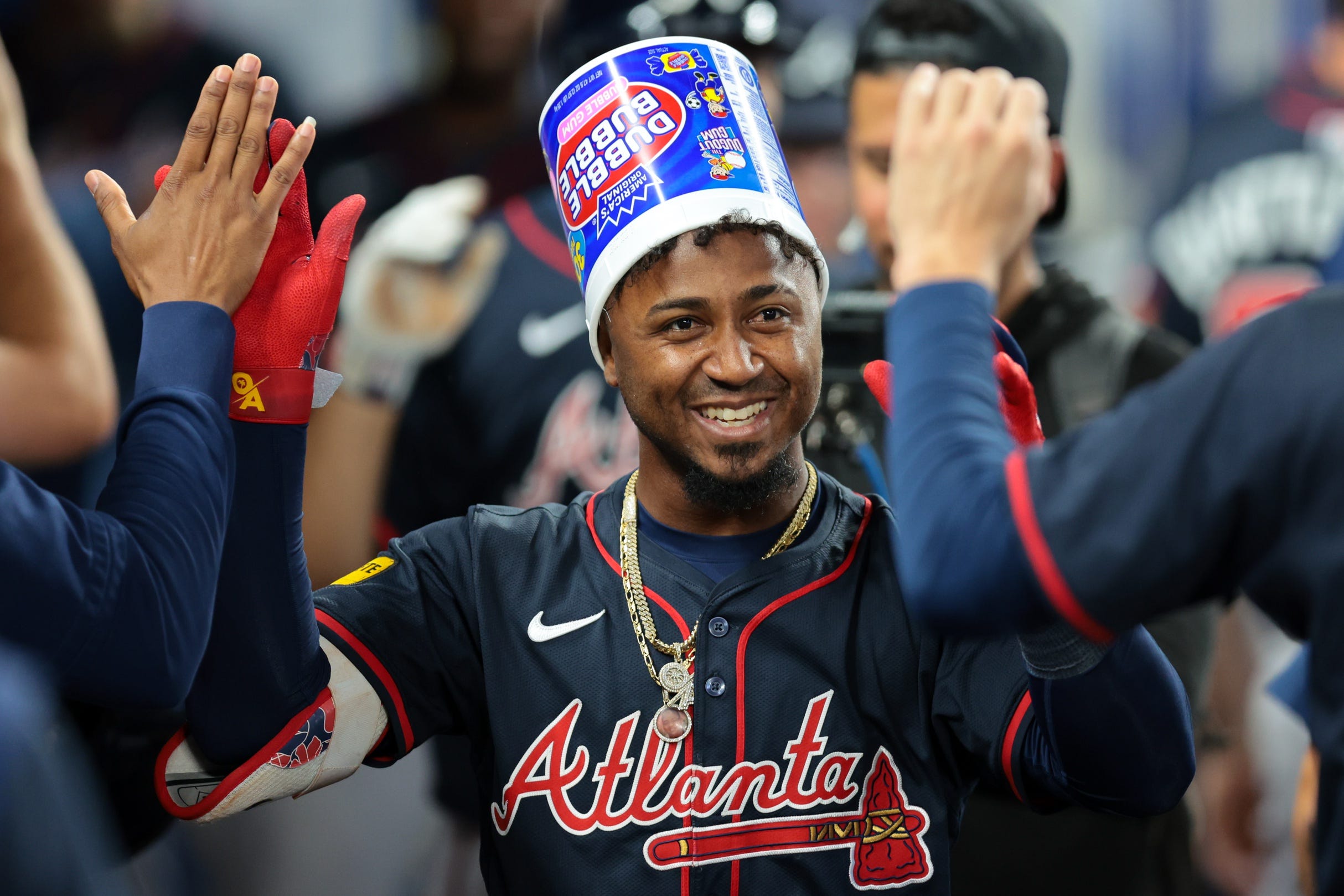
But continuity doesn’t last forever. Atlanta’s longest-tenured player is second baseman Ozzie Albies, who debuted in August of 2017 and has played nearly 1100 games in his nine-year career for the organization, all at second base.
With the soon-to-be-29-year-old Albies on the first of his two club option years, the clock is running out on his contractual control (barring an extension). What does Atlanta do to replace him?
Let’s talk about it.
What are the odds of an extension?
Honestly, not very promising.
Albies is a four-time All-Star and two-time Silver Slugger at second base who has two 30-homer seasons and a career 106 OPS+ and is just now entering his age-29 season. Seems like a profile that’s worth at least discussing an extension for, right?
Unfortunately for Albies, there are both availability and aging curve questions that will essentially shut the door on any substantial negotiations.
The switch-hitter has missed at least one-third of the season in three of the last six campaigns due to injury. The mitigating factor here is that most of those injuries were inflicted on him - a foul ball broke his toe (2024), a hit-by-pitch broke his finger (2022), etc., but the main issue is that it’s happened a lot. Albies has been on the injured list in five of the last six seasons, spending a cumulative 237 days on the shelf.
And partially as a result of the accumulated injuries, Albies has not been the same hitter as earlier in his career. Over the last two seasons, a statistically valid sample of 1,102 plate appearances, Albies has hit just .245/.305/.380 (a 91 OPS+) with a combined 26 home runs and 22 stolen bases.
By contrast, in the first seven seasons of his career, he averaged .273/.325/.479, a 110 OPS+.
Never a hard swinger, Albies has ‘hacked’ his bottom decile swing speed through two means - swinging an incredibly heavy stick and prioritizing pulling the ball in the air. Ozzie’s bat is reportedly 34.5 inches and 32 ounces, larger than Matt Olson’s (34/31.25oz), Austin Riley’s (34/31 oz) and Marcell Ozuna's (34/32 oz).1
And his pulled flyball rate remains elite - he averages 22.8% for his career, several points better than the MLB average of 16.7%, but he’s been gradually increasing it every season and topped out at an absurdly elite 27.2% in 2025.
Which makes his recent production even more disappointing, in hindsight. Despite hitting a well-above-average percentage of batted balls at the optimum launch angles to generate extra base hits and home runs, his ISO of .124 was well below MLB average last season, and his two-season home run rate of 2.4% is a career low.
He’s been changing who he is as a hitter in recent years, upping his walk rate to a career-high 8.2% and whiffing less than ever, but his walk rate is still below MLB’s 8.5% average and he’s still chasing in the mid-30% range.
Another problem with bringing Albies back is the lack of defensive value. Never the same thrower since suffering a shoulder injury as an amateur, Albies has the worst non-first base throwing arm in the game, averaging just 70.6 mph last season from second base. Watch a few games and you’ll see Ozzie’s rainbows turning double plays. His range grades out poorly as well, so it’s unlikely that this is a defensive package that will ever get back to positive value.
Barring a significant improvement in his underlying inputs, he’s likely not bound for a second contract with Atlanta.
So, what can the Braves do here?
Honestly, this is a really good question. There are zero no-doubt middle infield options in the upper minors right now, especially ones that could take over the position for 2027. Barring a complete collapse this upcoming year, Ozzie’s likely back for one more season on his $7M club option.
But the Braves need to eventually decide on either making an external addition to supplement/replace Ozzie or trying to bring someone up internally. There are a few logical names here:
Promote Nacho Alvarez
Now graduated from prospect eligibility, Nacho’s spent most of his professional career playing either shortstop or third base. The team briefly tried to have him play some second base in Gwinnett this last season after he was activated from a spring training wrist injury, but the core muscle injury to Austin Riley scuttled that plan.
Alvarez has a bat that profiles better at second than third, with a career .392 minor league slug and below-average exit velocities so far in the show. If you squint, you can see how Alvarez could be a Tim Hyers-style contact-and-walk profile with more work, though, while his plus range (at third) leads you to think he can play well enough defensively to buy the time needed to catch the bat up there.
That’s a low-ceiling option, though, as Alvarez has never been a strong offensive threat. He’s just 22 years old, but it’s likely the Braves can do better.
Other internal options (after 2027): Cody Miller, Alex Lodise, John Gil, Jim Jarvis
Sign a free agent
Next winter’s free agent class has some notable names at second base, but it’s unknown if the Braves would extend financially on any of these players. Jazz Chisholm Jr., formerly of the Miami Marlins and now with the New York Yankees is the biggest name on the list.
Chisholm, who will be 28 when he enters the free agent market, is a two-time All-Star and 2025 Silver Slugger from the Bahamas that’s one of the flashiest players in the league. A former cover athlete for MLB The Show, Jazz has demonstrated both speed and power, stealing 40 bases in 2024 and following that with a 31-homer, 31-stolen-base campaign in 2025. Getting moved off of shortstop by the Marlins in 2023, he’s played both second and third as well as some above-average centerfield in the last few seasons and would bring some defensive versatility to a Braves team that’s been missing it in the last few years.
Unfortunately, he’d also likely cost a lot, with his current Yankees lilely bidding heavily on the 40/40 candidate.
Other options next winter will include former shortstop Nico Hoerner of the Chicago Cubs, who only moved to second base out of deference to free agent signing Dansby Swanson, as well as former All-Star Jonathan India, veteran slugger Brandon Lowe, QO-accepter Gleyber Torres, and current Braves utilityman Mauricio Dubón.
Mine the trade market
This one’s the most interesting, simply because there are virtually limitless combinations of players to speculate about. To narrow it down, let’s look at players who are either currently blocked or potentially blocked by their team’s expected pursuits.
The first that comes to mind is Kristian Campbell. After trading for Willson Contreras to play first base on Monday, the Boston Red Sox are reportedly trying to lure either Alex Bregman back for another season at third base or free agent Bo Bichette to play second, both moves that would block Campbell from everyday playing time.
The Georgia Tech product signed an extension after just six days of service time last season, guaranteeing him eight years and $60M, but was still optioned down to Triple-A Worcester in mid June amidst an extended slump. Recent reports are that the team is interested in moving him to left field next season, although Boston’s already trying to find playing time for their coterie of high-ceiling outfielders in Roman Anthony, Jarren Duran, Ceddanne Rafaela, Wilyer Abreu, and Masataka Yoshida. Even if one or two of them are traded, Campbell is likely still the odd man out.2
Could the Braves position a deal as them taking on the remainder of Campbell’s $60M to clear up Boston’s financial picture? It’s possible, but it feels a bit early for the Sox to abandon Campbell.
Another potential ‘this-guy-is-blocked-after-a-trade’ option is Zack Gelof of the Athletics. The organization traded for former New York Mets second baseman and outfielder Jeff McNeil on Monday, with the veteran being expected to take over the everyday second base job once he’s recovered from this offseason’s Thoracic Outlet surgery. This one also feels like a bit of a long shot, as Gelof has two more minor league option years, but the Athletics being willing to pay $10M owed to McNeil (New York is covering the remaining $5.75M on 2026’s salary plus the $2M buyout, if the Athletics don’t want to pick up the 2027 club option) tells me they’re not optimistic about the short-term fate of Gelof as a contributor at the major league level.
A 2021 2nd-round pick out of the University of Virginia, Gelof has struggled to a .225/.287/.397 across parts of three seasons in the majors, albeit it in a grand total of 948 plate appearances. He had shoulder surgery late in the 2025 season and was expected to be a full participant in spring training, but now that’s likely just a temporary stop before he reports to minor league camp and Triple-A Las Vegas. If the Braves were to acquire Gelof, he would have four years of control ahead of reaching free agency in 2030.
Other potentially blocked second basemen on the trade block may include Brice Matthews of the Houston Astros (blocked by Jose Altuve at second and Carlos Correa at third), Nolan Gorman of the St. Louis Cardinals (who has already lost his job to super-utility Brendan Donovan and likely won’t get it back after Donovan is traded, thanks to the presence of top prospect and 2024 first-rounder JJ Wetherholt), and Kyren Paris of the Los Angeles Angels, who is battling with several others (including Grissom and 2024 1st-rounder Christian Moore) for LA’s vacant second base job.
In the meantime, let’s hope this is a decision for two years from now, not next winter.
I don’t know why I worded this as “reportedly” - I saw them all in the dugout during batting practice one day and can confirm he swings a tree trunk.
In many ways, this reminds me of the fate of former Braves prospect Vaughn Grissom, who was intended for second base in Boston before being moved to the outfield and first base in Triple-A and then released this winter.