


It’s Atlanta Braves baseball! Let’s break down everything you need to know about this evening’s game one.
Game Info
First Pitch: 4:00 PM ET
Location: UNIQLO Field at Dodger Stadium, Los Angeles CA
TV: Fox/Fox One
Radio: 680 AM/93.7 FM The Fan
Weather: LA is currently in an extreme heat warning, with temperatures at first pitch expected to be 102° with a heat index of 105°. Obviously, the humidity won’t be as bad as in Atlanta, but this is weather that the Braves are accustomed to and the Dodgers are not. Said Walt Weiss before the game, “You’ve got to remember - we’re from Atlanta.”
Atlanta Braves Lineup
DH Drake Baldwin
RF Ronald Acuña Jr.
2B Ozzie Albies
1B Matt Olson
CF Michael Harris II
LF Mauricio Dubón
3B Austin Riley
C Sean Murphy
SS Ha-Seong Kim
Quick thoughts:
Lane Thomas (oblique) returns to the roster just in time, given that he was acquired solely to hit lefties and the Braves are about to face two in a row. Manager Walt Weiss said before the game that they were giving him a rest day, given that he flew in late last night, and he would likely be in the starting lineup on Sunday.
Bench breakdown:
Atlanta’s bench today will have:
Lefty 1B/DH bat: Rowdy Tellez
Weiss explained before the game that they liked Tellez over Dominic Smith for his past experience and production against LA’s pitchers.
Platoon outfielders: Mike Yastrzemski, Lane Thomas
4th outfielder: Brewer Hicklen
Los Angeles Dodgers Lineup
SS Mookie Betts
DH Shohei Ohtani
C Will Smith
1B Freddie Freeman
LF Teoscar Hernández
RF Kyle Tucker
CF Andy Pages
3B Max Muncy
2B Tommy Edman
Quick thoughts:
With a lefty opener, I was curious how aggressively manager Dave Roberts would adjust his lineup to match. The answer is that he didn’t make any changes at all - this is their standard lineup, one through nine, exactly where we predicted they’d be.
Bench breakdown:
Backup catcher: Hunter Feduccia.
Backup infielder/pinch-runner: Hyeseong Kim
Backup outfielder: Josue De Paula
Utilityman/October hero: Kiké Hernandez
Pitching Matchup
Braves Opener: LHP Dylan Dodd (4-1, 2.54)
Quick snapshot
2.54 ERA / 3.10 xERA in 49⅔ innings
27.3% strikeout rate / 7.2% walk rate
60.1% sinker, 35.2% cutter, 4.6% slider. His sinker averages 93.9 mph; the cutter averages 87.1.
Reminder, Dodd’s sinker and cutter are, functionally, a four-seamer and a slider, thanks to his unique pronation and ability to harness seam effects. We wrote about this back in August:

What to watch
The sinker–cutter pairing is the whole opening plan. Opponents hit .161 against Dodd’s sinker and .189 against his cutter. The cutter has generated a 33.6% whiff rate, giving him a way to finish an at-bat after the sinker establishes the inner or outer edge. He has effectively stopped using a four-seamer.
His season splits support the opener choice, but they do not guarantee a platoon advantage. Lefties produced a .622 OPS against Dodd in 86 plate appearances; righties were at .564 in 108. That is encouraging for an opener who might see both Mookie Betts and several of the Dodgers’ left-handed stars. It is also a small enough sample that Atlanta should make its next move based on the actual batting order and Dodd’s command, not the split alone.
The first transition matters more than an arbitrary inning limit. A short Dodd appearance could let Atlanta choose a right-hander for the middle of the order rather than ask one pitcher to get Shohei Ohtani and Freddie Freeman out a second time. Unlike Thursday’s clincher, we don’t have a track record this season of Dodd working as an opener. Dodd recorded one out in Thursday’s clincher against Philadelphia, but has two different three-inning outings this season.
Opposing Starter: LHP Tarik Skubal (12-7, 2.62 ERA)
Quick snapshot
2.72 ERA / 2.94 xERA
30.0% strikeout rate / 4.4% walk rate
38.0% four-seamer, 25.6% changeup, 17.5% sinker, 13.9% slider, 5.0% curveball. His four-seamer and sinker both average about 97 mph; the changeup averages 87.7.
Atlanta’s path against Skubal
Prepare for the changeup even in a left-on-left matchup. Its 46.9% whiff rate and .308 opponent slugging percentage make it his chief putaway pitch. Skubal also uses it against lefties, pairing its arm-side movement with a power sinker. A lineup packed with right-handed bats does not make the changeup disappear, and Matt Olson, Drake Baldwin and Michael Harris II cannot assume they will see only sinkers and sliders.
Left-handed hitters have had more success against him this season, with a sample warning attached. They posted a .706 OPS in 144 plate appearances, compared with a .566 OPS for righties in 476. That is a reason to resist treating Atlanta’s lefties as automatic outs; it is not evidence that the Braves should try to stack the lineup against the platoon.
The sinker is the contact pitch. Hitters batted .270 against it, and its whiff rate was 18.5%, well below the changeup’s. Skubal can still use a 97 mph sinker to get a ground ball or set up the change, so Atlanta’s opening is a hittable pitch in the zone, not a reason to swing at everything firm.
Do not count on free baserunners. A 4.4% walk rate makes an extended patience-only plan difficult. Atlanta needs competitive early-count swings when Skubal offers a strike, while refusing to chase the changeup below the zone. His final regular-season start was seven scoreless innings against San Francisco; Los Angeles removed him after 75 pitches with October in mind.
There is no easy “wait for the postseason version” argument. Across six previous playoff starts, Skubal has a 2.04 ERA with 56 strikeouts in 39⅔ innings. With the Dodgers, he has a 2.61 ERA with 70 strikeouts in 62 innings. His one start against Atlanta this season was seven innings of two-run ball in late April, striking out seven with no walks and five hits. Both those runs came courtesy of an Ozzie Albies first-inning homer.
How he attacks hitters (all graphics courtesy of Thomas Nestico)
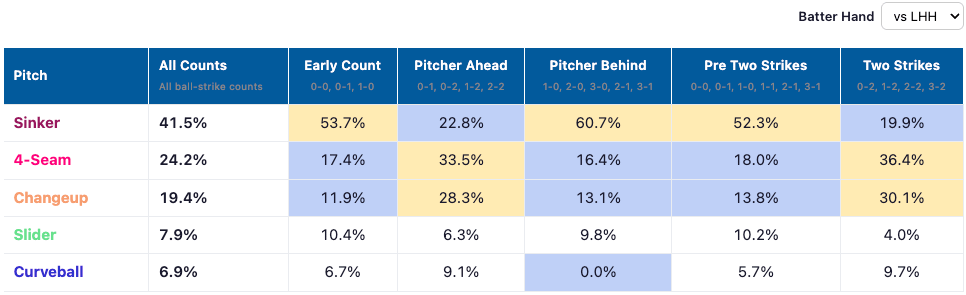
vs LHH: The goal here is to get to the four-seamer/changeup combination - Skubal will throw a lot of sinkers early and when behind, but when he has the advantage, it’s that combo. The slider is an occasional strike stealer early and when he’s behind, while the curveball makes the occasional appearance early and when he’s ahead.
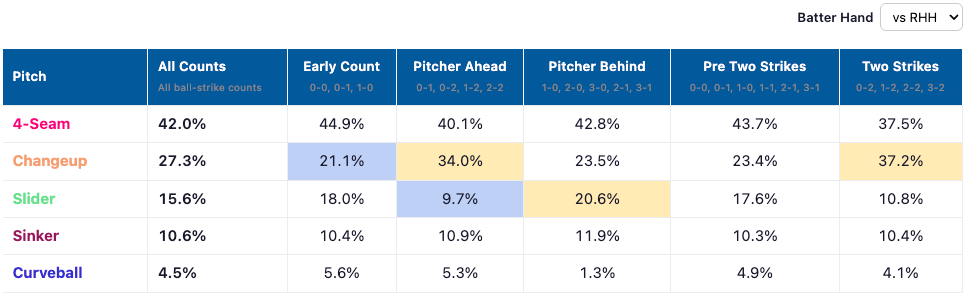
vs RHH: It’s four-seam/changeup/slider to righties, with the changeup getting more run when ahead and the slider more when behind. The sinker’s pretty consistently a 1-in-10 pitch in any situation, while the curveball maintains just the occasional 1-in-20 usage the entire at-bat.
Sequencing:
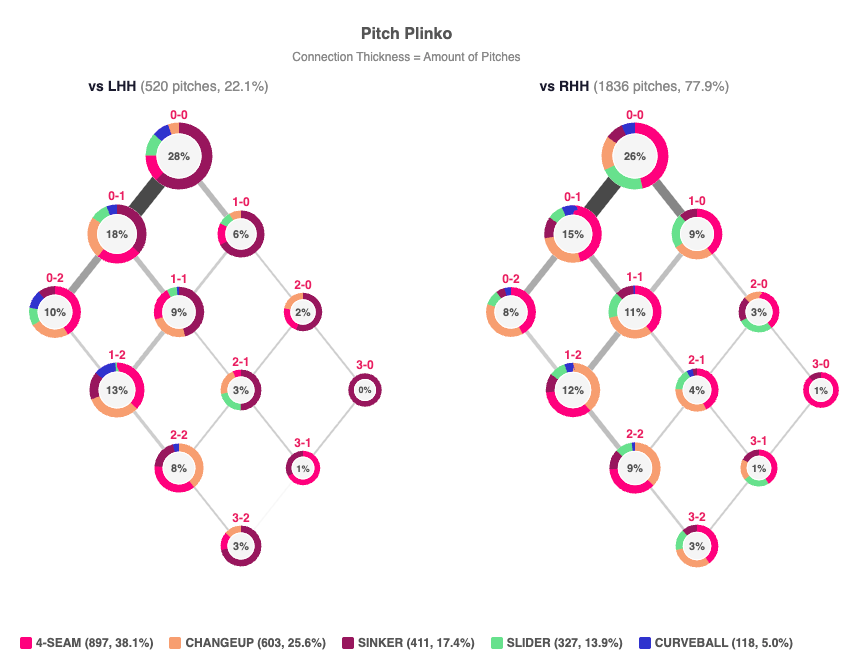
How to read a plinko chart: Each circle represents the usage of a pitcher’s arsenal in a given count (color key is on the bottom of the graphic). The thickness of the connecting lines reflects how often each count occurs, helping show how a pitcher navigates an at-bat.

Are you ready for retirement? Ford Stokes and Zac Blackerby are Braves fans who want to help you make sure you have income for life. Email Zac (zac@activewealth.com) or Ford (ford@activewealth.com) for your free Social Security roadmap today.
Braves Bullpen Status
(Reminder: these are all assumptions based on pitch count and recent usage)
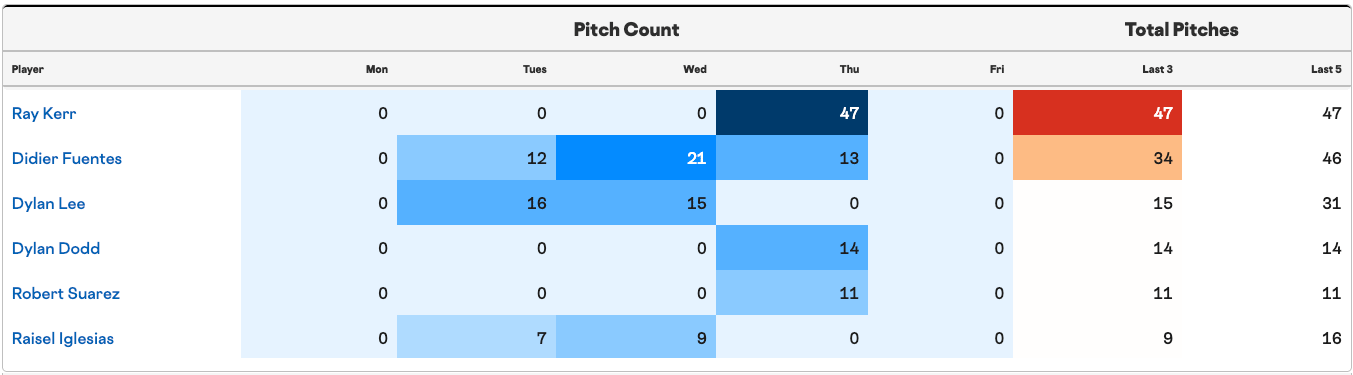
Likely available/potential limitations:
The only reliever that’s explicitly down is likely Ray Kerr. Outside of that, it’s all hands on deck.
Quick takeaway:
The thing to watch for if this ends up being a more traditional bullpen game instead of an opener/bulk arm arrangement is who gets Ohtani and Freeman the 2nd time through the order?
Opponent Bullpen Status
No one’s pitched for LA in the last five days, so there shouldn’t be anyone outright down. Instead, let’s look at the handedness options and their roles this season.
Closer: Tanner Scott (lefty)
Setup: Edwin Díaz, Evan Phillips
Scott worked in the closer role while Díaz was out with injury this season and even after he returned, it was mostly lower-leverage situations.
Middle relief: Alex Vesia (L), Roki Sasaki, Brock Stewart, Kris Bubic (L), Edgardo Henriquez
Henriquez is the big addition here - he’s been on the IL with a back issue, but made this roster and is their best flamethrowing righty in the pen. For a Braves team that’s struggled with velo at times this year, he might play a big role.
Vesia’s their Dylan Lee - a modest 4S/slider guy that’s trusted to handle the toughest lefties, while Bubic’s more of a Brent Suter analog - multiple pitches and can go multiple innings, with uninspiring FB velocity (91.9 mph)
Sasaki worked as the closer last postseason, and has both great stuff and little idea where it’s going. His splitter and forkball are two of the toughest pitches to hit on this roster, when he can manage to both throw a strike to set them up and to throw them remotely close to the zone.
Umpire information
Behind the plate: Roberto Ortiz. UmpScorecards lists 28 plate games for him this season, with 92.9% called-pitch accuracy against 93.7% expected accuracy—a difference of 0.80 percentage points below expectation.
I don’t know much about him, truthfully, which means he lives where most umpires should - roughly average and not standing out in any way, good to bad.
The actionable note is to watch his low-zone calls early: Skubal wants the changeup below the zone, and Dodd’s sinker–cutter combination depends on getting ahead without drifting over the plate.
Final Thought
The Braves are +190 on the moneyline to LA’s -230, and FanDuel has set the over/under at 8.5 runs. The hinge point is Can Atlanta turn a controlled first trip through the Dodgers’ order into a favorable first pitching change?
Dodd has earned this opening look with two effective pitches and success against hitters on both sides. Skubal, meanwhile, gives the Dodgers a starter who rarely walks anyone and can finish righties and lefties with his changeup. Atlanta’s best route is to keep Dodd’s assignment clean, choose the next arm for the lineup actually on the field, and make its limited strikes against Skubal count.
Let’s Talk About It
If you’d rather watch this, here’s the Braves Today live stream from this afternoon, after lineups were announced.
I did not have Dodd on my list of openers, but I kinda like it. And just for kicks… the 4 Dodgers starters lined up to face the Braves are making $123 million this season. That’s more than 3 of the teams still in the playoffs TOTAL payroll and only slightly less than a 4th - the Brewers. And I already know I’m gonna be sick of hearing the national announcers talk about how great the LA farm system is while not 1 of the scheduled SPs was developed in their system. Ok… I’m getting worked up… I hope Braves go out and destroy those a……s!!