


ESPN researcher Paul “Hembo” Hembekides pointed out late last week that Atlanta Braves third baseman Austin Riley has become just the 23rd player in Major League history - and the youngest - to post five consecutive seasons with a declining OPS.
That’s an alarming statistic.
It’s also a slightly misleading one.
Riley’s first two “declines” still produced six-win seasons and OPS marks north of .850.
The more noteworthy story isn’t that his OPS has gone down every year. It’s how it’s gone down. And the real concern isn’t five straight declines in OPS, it’s the shape of those declines.
Let’s talk about it.
The First Two Don’t Count
This ‘declining OPS’ trend of Riley’s technically began in 2022, but there was no reason to be concerned there…and rightfully so.
Riley fully broke out in 2021, his first full-length season as the primary third baseman after spending most of 2019 in left field (out of deference to free agent signee Josh Donaldson) and then playing both infield corners and third during the abbreviated 2020 campaign.
That 2021 season, one where Riley not only finished with his first career Silver Slugger but also was a 7th-place finisher in the NL Most Valuable Player voting, was the massive breakout that Braves fans had been waiting for virtually since Riley was taken with the 41st overall pick in 2015’s MLB Draft. He hit .303/.367/.531 with 33 homers and 107 RBI, but it wasn’t a fluke based on a small sample - his 160 games tied for the National League lead that season. Among primary third basemen, Riley’s .898 OPS was 1st, his home run total was 5th, and his RBI total was 2nd.
Riley was on track to repeat the same trend in 2022 when Atlanta took advantage of an August 1st off day to ink him to a franchise-record1 ten-year, $212M extension that would keep him with the Braves through 2032.
Riley finished 2022 and 2023 in the same ballpark of production as 2021, putting up OPS of .878 and .861. Technically lower than his breakout 2021, but not by enough to care.
At the end of 2023, the book was out on Riley: An elite hitter, one who would always run a slightly higher strikeout rate than the league average of 22.7% and a slightly lower walk rate than the league’s 8.5%, but would be a perennial 30-100 guy with surprising speed and rapidly improving defense at the hot corner.
Then something changed.
Finding the Inflection Point
The ‘declining performance’ Hembo cited was just random statistical fluctuation…until it wasn’t.
The inflection point looks to be 2024.
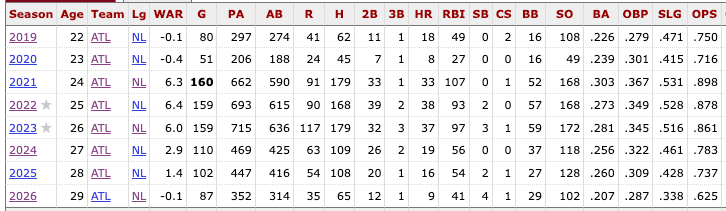
No matter which statistic you choose - OPS, home runs, WAR, or RBI pace - they all point to the same conclusion: Something changed in 2024, even if Riley had played a full campaign. And that “full campaign” note’s important, because for the first time since becoming an everyday player, Riley didn’t get into his usual 160+ games. The third baseman played in only 110 games due to oblique injuries in-season before a broken hand ended his season in mid-August.
2025 saw more injury impacts, with Riley undergoing core muscle surgery after multiple injured list stints for an abdominal injury during the season.
Riley hasn’t looked the same since the injuries hit, and still doesn’t.
The Surgery
Riley’s “core muscle surgery” from last August has been explained as a sports hernia repair, a somewhat misleading name as it’s not actually related to a tissue bulge but rather tears in the lower abdominal muscles.
The underlying injury causes a great deal of pain, both localized, constant pain and activity-triggered intense bursts of pain, which most commonly occur during twisting, turning, and changing direction.
Sounds a lot like being a hitter and playing third base, huh?
Riley first reported the discomfort on July 11th, after making a throw across the diamond, and after a two-week injured-list stint, reportedly re-injured himself while making a diving tag during the Speedway Classic.
“I’ve talked to so many really good players that have had that core muscle surgery, that sports hernia: They say it takes two years to come back from that,” Apple TV sideline reporter Heidi Watney told me recently on the Braves Today podcast. “That the first year, you don’t feel right at the plate because you use so much of your hips and your torque for your swing.”
Watney went on to explain that it takes a “solid, full year” for most players to feel right again. Riley, who had the core surgery in August, hasn’t yet hit that point.
Watney also made another distinction that’s worth keeping in mind as you think about Riley’s struggles over the last few seasons:
“There’s one period of time where you can be back on the field, and there’s another period of time (before) your body feels right again.”
Viewed through that lens, it’s entirely possible Riley has been healthy enough to stay in the lineup without yet being healthy enough to be the hitter the Braves are accustomed to seeing.
Baseball often treats recovery like a light switch. A player is either healthy or injured, active or inactive. The reality is much messier than that. Returning to the lineup usually means a player is healthy enough to compete, but not necessarily healthy enough to perform at his peak.
Is there a connection? It’s certainly plausible, but there’s no way to prove it conclusively.
Statcast’s bat-tracking metrics don’t provide a smoking gun. Riley’s swing speed has remained remarkably consistent, and while his bat tilt has changed slightly over the past few seasons, it’s impossible to know whether that’s intentional, injury-related, or simply natural variation.
The counterpoint here is that before Riley’s mild oblique issue in May of 2024, one that kept him out of the lineup for nearly two weeks, he was hitting just .245/.319/.388 through the season’s first 37 games. He was on pace for 13 homers and 79 RBI, so it was an unusually slow start that he just never had the chance to rebound from thanks to the onset of different issues.
There’s also the compounding mental impacts from a prolonged downturn, as well as the loss of a key part of Riley’s baseball support network to consider.
The Mental Side
“It’s a struggle to try not to let it be a grind mentally.”
Those were Riley’s words to Watney in April before Apple TV carried Braves vs Phillies on April 24th. Riley was hitting .222/.313/.364 heading into that divisional matchup, with only three homers (a 19-homer pace). His 16 RBI gave him a 99 pace for a full season, a lot closer to his career norms, but that’s about all that was going right at the time.
Things have not gotten better since then. Riley’s gone on the record with virtually any Braves media that’s asked him about his lack of production during daily media availability, telling the AJC on May 1st that his slump is “frustrating as hell right now”. He told Marietta Daily Journal’s Grant McAuley last week that his season has been “terrible, awful, everything in between.”
He’s looking for answers, clearly, and is missing his usual support system for it.
Mike Brumley was a former MLB infielder who became a minor league hitting instructor after his MLB career wrapped. He worked for Atlanta from 2018 through 2022, during which he and Riley formed a special relationship rooted in baseball. The third baseman carried an immense amount of admiration for Brumley.
“There are very few people that have been role models in my baseball career. My dad is number one and Mike Brumley is number two.”
Devastatingly, Brumley died in an automobile accident in June of 2024. Riley is now working with Brumley’s son, Logan, but the loss of Mike remains an adjustment Riley has yet to recover from.
“Mike knew my swing better than anybody […] It just seemed like me and Mike always saw eye to eye.” Despite leaving Atlanta after the 2021 season, Brumley continued working with Riley on the mental side of the game, swing mechanics, pitch recognition on sliders down and away, and pitch recognition using distinct pitch tunnels, among other topics.
It’s clear that the offensive inconsistency, combined with the lack of a consistent and trusted voice off the field, has weighed on the slugger this season, with Riley admitting to The Athletic’s Jesús Cano that he loses sleep at times while replaying at-bats in his head. “I want it more than anybody, to figure it out. […] I want to perform for my teammates.”
It appears that Riley’s been pressing to try and find that performance, with his chase rate sitting near career highs at 32.1% entering Sunday’s game. But his in-zone swing rate is also at a career low, at just 66.1%, creating a dichotomy that leads to terrible batted-ball outcomes.
Braves hitting coach Tim Hyers sees the drive to get better, as well as the frustration that’s negatively impacting his approach at the plate and his mechanics. “He’s been searching for some results because he’s wanted to do real well for the team,” Hyers told Canó. “Sometimes that gets him out of his approach, and kind of in swing mode, but I think for the most part, mechanically, (he’s) just underneath some pitches that he usually puts in play.”
Hyers continued, explaining that while Riley’s mechanics are still off a bit, most notably with the hip slide that he’s constantly wrestled with in his career, a lot of the third baseman’s struggles are mental. “When you’re not squaring balls up, your confidence is down a little bit,” Hyers said. “I think he’s chasing pitches out of the strike zone that he normally doesn’t. That doesn’t help him. So it’s kind of twofold when you don’t feel good about your swing, then you probably chase more pitches trying to search for results.”
The Prescription
It’s clear that Riley is trying so hard to become the old Austin Riley that he’s preventing himself from getting there.
And that’s hard to fix.
There’s no magic bullet here - when a proven performer is in a prolonged slump, one that has multiple contributing factors, there’s no one quick fix that rights the entire ship, plugs the holes, and gets the screws in motion.
But given the slugger’s prolonged slump, there is one thing the team can do that hasn’t yet been tried: Give him a reset.
With the upcoming All-Star Break in a week and a half providing all but four Braves four days off, there’s an opportunity to extend that for Riley. Whether that's a few consecutive days off around the All-Star break or simply a lighter workload coming out of it, the team can let Riley take a physical and mental break from the daily grind of the season.
With slugger Ronald Acuña Jr. tentatively due back after next week’s Midsummer Classic, it’s possible that utilityman Mauricio Dubón may be able to return from his daily outfield duties and take over third base for a few days, if the team was worried about the quality of Riley’s temporary replacement.
It’s unconventional, but not unprecedented.
The Chicago Cubs gave former Braves shortstop Dansby Swanson an entire weekend off in early June, on the heels of a .180/.285/.322 start to his season and a 6-for-43 stretch immediately preceding the off days. Manager Craig Counsell said it was part of an “intentional effort to give him a mental and mechanical reset”, per MLB.com.
“I think just at this point, just trying to give him a couple days away from the game,” Counsell told reporters at the time. “Obviously he’s healthy, he could be in there, but [we’re] just trying to get a different look.”
In the near-month since Swanson took the weekend off, he’s hitting .272/.326/.679 with nine homers and 29 RBI, including six hits and five home runs to finish the final two games of a series last week against the San Diego Padres.
Sometimes rest is productive, not punitive.
The goal isn’t to punish Riley for struggling. It’s to give him the best chance to stop struggling.
The Bigger Bet
At some point, every organization has to decide whether it believes the player’s history or his present. Right now, the Braves are choosing history.
And they should.
Austin Riley didn’t accidentally become one of baseball’s best third basemen. He didn’t accidentally post three consecutive seasons of MVP-caliber production. Players with that kind of track record don’t simply forget how to hit at age 29.
That’s what makes this season so frustrating.
The underlying causes are difficult to untangle. There’s the possibility that the core muscle surgery could still be affecting him. There are obvious signs that he’s pressing at the plate. He’s also navigating the loss of one of the most influential baseball mentors of his career while trying to rediscover a swing that once made him one of the sport’s premier power hitters.
None of those explanations completely excuse the results.
But taken together, they do paint a much more believable picture than the idea that Austin Riley suddenly became a below-average baseball player overnight.
The Braves don’t need to decide whether Riley is their third baseman of the future. That decision was made years ago.
They simply have to help him get back to being the player they already know he can be.
The Verdict
Hembo’s statistic deserves attention. It just also deserves context.
The first two “declining” seasons weren’t evidence of deterioration. They were evidence that Austin Riley’s peak was almost impossibly high.
The real story begins in 2024: That’s when the injuries started, and that’s when the production changed.
And if the Braves are right about the player they’ve committed $212 million to, that’s also where the path back begins.
Sometimes the hardest thing to do in baseball is nothing.
In Riley’s case, doing less for a few days may be exactly what allows him to become more again.
Both length and total dollar amount
Excellent, detailed article. I don't doubt Riley's spiral is multifactorial. So Chipper apparently spent some time with Riley in the cage last week. On Saturday he hit his first HR in many weeks TO RIGHT FIELD. Chipper has long championed going uo the middle or to the opposite field. And yet Riley still frequently flies open with his left shoulder and misses a low and away slider by two feet. When you watch guys like Dubon and Freeman, it is clear to even an amateur like myself that they are keeping their lead shoulder in and trying to stroke the ball to the opposite field. Why is that so hard for Riley to remember?
Excellent analysis. Every Braves fan is pulling for Riley to return to an All-Star caliber player. The organization is in a difficult spot. Many of the deals the team has done and issues they’ve tried to address primarily come from having to fill a 5 WAR expectation deficit. Inevitably the organization had to increase their risk tolerance on deals to plug the hole created by Riley’s performance. The situation eventually has to be addressed.