


I hope you had a wonderful Thanksgiving holiday. I spent mine with my family and my sister’s family in the mountains of Kentucky, eating and napping and generally just being unplugged for three or four days.

While I was gone, the Toronto Blue Jays signed one of Atlanta’s coveted arms from the last few seasons, Dylan Cease. The mustachioed starter got $210M across seven years, a post-deferral average of $26M a year. He’s now signed through his age-36 season, a stunning deal for a guy who is sporting a career 3.88 ERA and put up an unsightly 4.55 last year. There was a lot of “holy overpay” talk in the immediate reaction pieces I found upon returning to civilization on Sunday afternoon.
That is, unless you understand what MLB teams are actually looking for from their free agent signings, in which case, this made a ton of sense.
Let’s talk about it.
It’s not the surface stats…except for one
As I mentioned above, Cease has a career 3.88 ERA and in his seven seasons in the league, has only once finished with an ERA below 3.47 - 2022, when he was the runner-up for the American League Cy Young after going 14-8 with a 2.20 ERA and 227 strikeouts in his 184 innings.1
It was an awesome season for a talented player, one that made many across baseball believe he had finally put it together. But with his Chicago White Sox having not yet bottomed out - they finished 2nd in the AL Central that year despite Hall of Fame manager Tony La Russa stepping down in early October with heart issues - he spent one more season in the South Side of Chicago before being traded to the San Diego Padres in March of 2024.
Padres general manager A.J. Preller explained at the time that the allure of acquiring Cease was his ‘power pitcher’ profile, combined with one other important factor: The fact he posts every fifth day. “It’s a power repertoire, but power with durability.”
Cease had just completed his third consecutive season of 32 or more starts at the time, and added two more during his tenure in San Diego. He has never missed a start since debuting in 2019 and has 162 starts over the five full years since the pandemic. In that five-year sample, he’s the only pitcher in baseball to have either 162 total starts or 32 starts (or more) in all five years; only three other pitchers have 32 or more starts in four of the five seasons. Logan Webb of the San Francisco Giants is currently the only other pitcher with an active four-season streak.
That’s the real prize with Cease. Having the ability to write in one-fifth of your rotation in pen is absolutely valuable, and guys with that profile usually get paid over the course of their careers. (It’s also why the Braves will not designate Bryce Elder for assignment, no matter how many internet commenters want them to.)
But seven years at $26M per is a lot to pay for just durability. Yusei Kikuchi has an active three-season streak of 32 or more starts and a career 4.46 ERA, yet got ‘only’ three years and $63M when he signed with the Angels last winter. Sure he’s older, but five million per year older?
There’s another factor at work here.
The Blue Jays are paying for the inputs
Cease has this odd trend of underperforming his inputs almost every single season. He’s perpetually among the league leaders in whiff rate, chase rate and strikeout rate, yet his ERA almost always is worse than both his expected ERA and his Fielding Independent Pitching:
2025: 4.55 ERA, 3.46 xERA, 3.56 FIP
2024: 3.47 ERA, 3.31 xERA, 3.10 FIP
2023: 4.58 ERA, 4.11 xERA, 3.72 FIP
2022: 2.20 ERA, 2.70 xERA, 3.10 FIP
2021: 3.91 ERA, 3.65 xERA, 3.41 FIP
And the one year that he overperformed his inputs, 2022, he was runner-up for the AL Cy Young award.
The Blue Jays are paying for his inputs, not his results. And that’s an important distinction here.
A salary of $26.5M per year is roughly top twelve in the sport for starting pitchers, depending on how you treat Shohei Ohtani’s massively deferred contract to be a two-way player.2 A pitcher with a career 3.88 ERA and 10% walk rate likely wouldn’t be named a top twelve pitcher in the sport, but a career 3.66 xERA/3.67 FIP, 29.2% CSW, and a 3-to-1 strikeout-to-walk ratio is closer to one.
SIDEBAR: Newly re-signed Braves closer Raisel Iglesias is a similar situation, just on a smaller level. He was outright bad in the first half of 2025, putting up a 4.42 ERA with five losses and four blown saves. But not only did he rebound to put up a 3.21 for the season, his FIP & xFIP were also consistently lower through the first half (4.06 FIP/3.47 xFIP) than his actual results and he ended up getting paid the same salary as last year. There were several who predicted he’d need to take a pay cut, but he reportedly had multiple offers at that $16M figure he got to re-sign with Atlanta.
It’s almost like relief pitching is inherently more fungible than starting pitching, huh?
It is also likely that the Blue Jays can help get Cease closer to those inputs than the White Sox or Padres could. His issues seem to be pitching out of the stretch and against lefties, as well as being perpetually let down by his defense and being prone to blow-ups late in outings. Toronto has a fantastic defense, which will help close the ERA/FIP gap, and there are several guys on staff who could teach him a splitter to help negate southpaws.
So, what does this mean for the Braves?
It means that the bargains that several fans are expecting to find this winter may not be there.
Between Cease and Iglesias, we’ve seen that teams are generally willing to overlook bad and/or mediocre surface stats in a platform year or in recent seasons if the peripherals/inputs are there.
Which tells me that there are going to be some surprising contracts this year. Ranger Suarez is going to get paid, mainly because he’s somehow still putting up K/BB ratios of 3.5-to-1 and 4-to-1 with a sub-6% barrel rate despite throwing a 91 mph fastball. His 3.16 xERA was tied with Houston Astros ace Hunter Brown for 15th in all of MLB this year (minimum 200 balls in play). That paycheck was expected, though, with some sites putting him into the top four for starting pitchers this winter.
Several veterans are available after significant underperformances of their xERA or other peripherals, like Steven Matz and Zach Eflin.
Michael Soroka, though, might end up being the most fascinating contract of all. Atlanta’s former Opening Day starter (2020) had a season to forget in 2025, signing with the Washington Nationals as a starter and after putting up a 4.87 ERA, being moved to the Chicago Cubs at the deadline. His xERA was 3.45, a top 35 mark, and despite struggling with walks, he still finished with a 3.28 K/BB ratio and a barrel rate allowed of only 6.7%.
He oddly dropped his slider entirely for 2025, focusing on his four-seamer as the primary fastball and his slurve as the only breaking ball in his arsenal. It leads to a very odd Statcast card, one which I don’t think is doing him any favors from a sequencing/tunneling perspective.
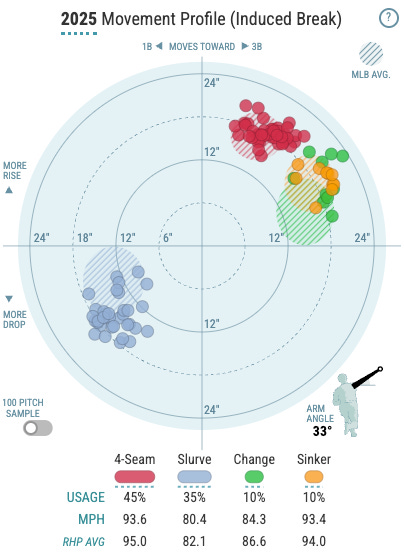
He reserves the sinker almost exclusively for fellow righties at this point in his career, and without the slider (and/or a bridge pitch like, oh say, a cutter), he’s vulnerable from a power perspective to lefties.
Despite all of that, the pieces are there for not only an impact starter, but the fallback of an excellent reliever if it doesn’t work out. Working in the pen late in both 2024 and 2025, he’s put up a 2.58 ERA in a multi-inning role, covering 45.1 innings across 22 outings with 68 strikeouts (35.2% strikeout rate) and only four homers.
While I don’t expect Soroka to be the addition for the Braves rotation this winter - my money’s still on a veteran like Chris Bassitt - the versatility of someone that can both start and relieve, working multiple innings in his appearances, is a Jeremy Hefner specialty.
Believe it or not, that strikeout total was FIFTH in baseball that year, behind Gerrit Cole’s 257 and Corbin Burnes’ 243, although they both took over 200 innings to do it. The highest strikeout rate was Carlos Rodón’s 12.0 K/9, while Cease was 4th at 11.1 K/9.
Does his deferral-adjusted $46M AAV count him as a $23M hitter and $23M pitcher, or is that weighted more towards the offense and he’s a $20M arm?
Welcome back Lindsay.
Yeah, it hurts to "lose" Cease. But i'd rathet keep my draft picks and $500,000 international 2027 bonus money.
I'm hoping for Bassitt and Ha-Seong Kim. Just don't pass the 3rd level and have our first pick pushed back 10 spots.
I thimk the Lottery is this week or next.. Go for a High Floor college player or a High Ceiling prep player. next Summer's Draft
It has been very quiet. I am hopeful that they are exercising caution and being very selective,
My biggest concern is a recent comment that our pitching staff is quite adequate. I believe we ned another very good starter. I would feel more comfortable regarding re-injury. Holmes, for example.
It seems they are possibly omitting the signing of a DH. Management noted they would rely on a non-starter catcher or outfielder to bat as a designated hitter. I totally reject this idea. the Dodgers, Phillies, and Mets all have big sluggers as a DH.
I hope we don't follow the 2025 plan of "WINGING IT." ARE WE BEING TOO FRUGAL/CHEAP?