


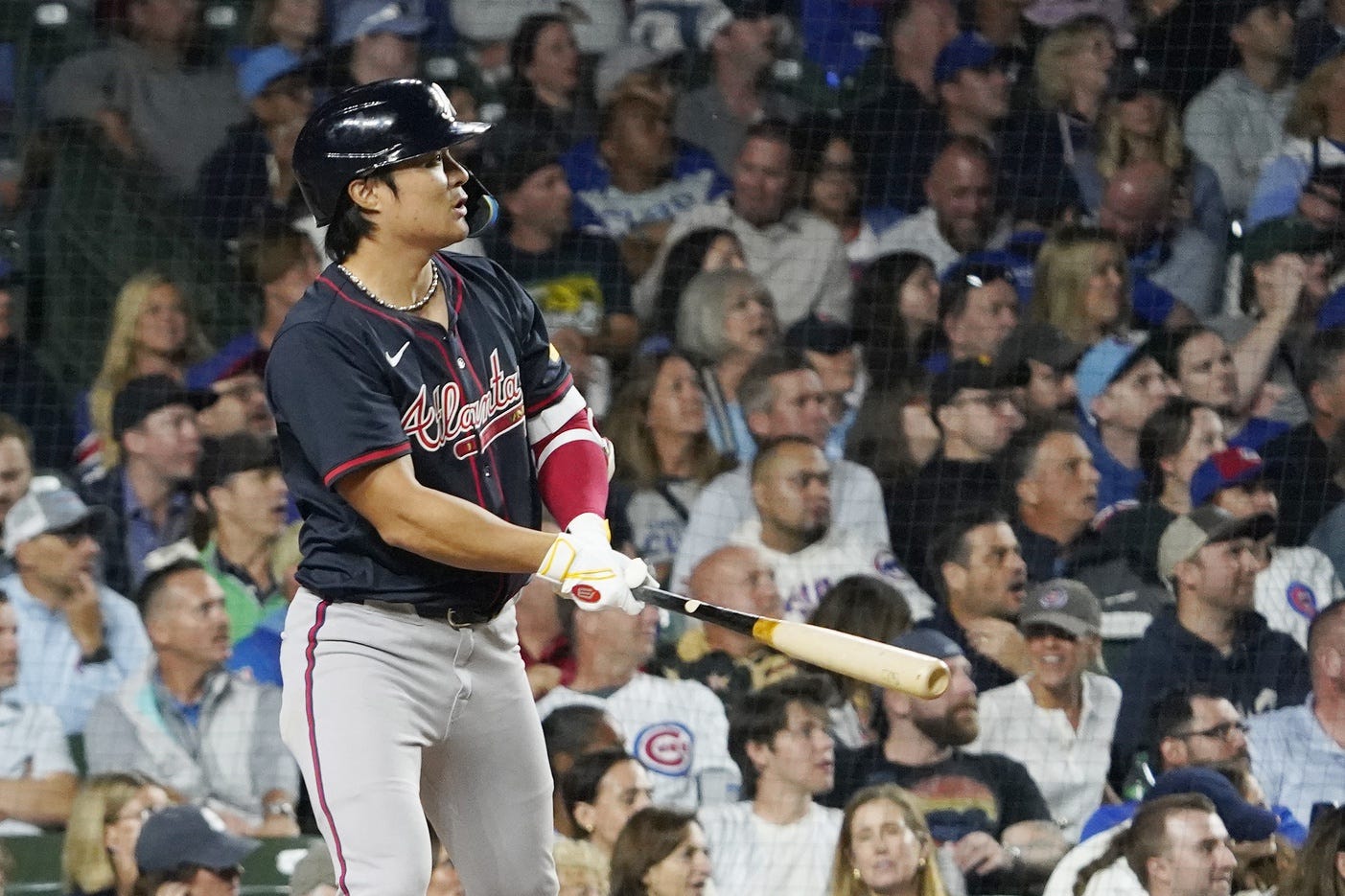
In retrospect, not re-signing Dansby Swanson after the 2022 season proved to be a bigger deal than we thought at the time.
Since the start of the 2023 season, the Atlanta Braves have used eleven different players on the lineup card at shortstop. Outside of a magical first half of the 2023 season from Orlando Arcia (.294/.345/.424, 111 OPS+), none of those players has been even league average at the position.
(For more on the decision to move on from Dansby and what an alternative history might look like for Atlanta, tune in to Tuesday’s episode of Braves Today, debuting at noon eastern on our YouTube channel and wherever you get your podcasts.)
For the 2026 season, the position is virtually set - late-season waiver claim Ha-Seong Kim is back on a $20M salary, and two-time Gold Glove utilityman Mauricio Dubón was acquired via trade to back him up if needed.
But just one problem: Both players are free agents after this season.
Operating on the assumption that baseball is actually played in 20271, who mans the position for Atlanta that season? Let’s talk about it.
You could always re-sign one of them
Part of the reason that Kim is back in the fold on a one-year, $20M deal for 2026 is that he didn’t get the long-term offer he was seeking in free agency. The Scott Boras-repped 30-year-old signed a one-year deal with the Tampa Bay Rays last offseason as he was looking to return from shoulder surgery, but a combination of injury setbacks (back, hamstring) and poor performance (.234/.304/.345, an 83 OPS+) meant that he had to settle for a ‘pillow deal’ with Atlanta.
Now, because Atlanta is who they are, this wasn’t the typical Boras-negotiated pillow deal with high AAVs offset by deferred money and a player opt-out. No, this was a straight one-year deal at $20M for 2026, with no extra contract shenanigans that the Braves normally avoid.
Kim’s discussed his desire for a better season in 2026, including more stolen base attempts. “My strength is being able to steal bases anytime. I stole a lot early in my return, but since my physical condition wasn’t great, I think I got hurt a lot trying to steal,” he told Korean media at Incheon International Airport when returning home after the season. “In Atlanta, it wasn’t like one more stolen base would change the team’s standings, so I told the organization, ‘Rather than stealing bases, I’ll focus on playing every game healthy,’ and they agreed. Next year, I naturally think I should run as much as I used to, and I’ll prepare accordingly.” (emphasis added).
If Kim shows that he’s both fully healthy and back to his 2023 form, one in which he put up a 107 OPS+ while stealing 38 bases in 47 attempts, he’ll easily be one of the most desirable free agents on the market next winter.
Whether or not the Braves can sign him at that point remains to be seen - if he’s making $20M this season and the ‘Atlanta Max’ is only $22M, it’s unlikely that they get a deal done in free agency. Atlanta can tag him with a qualifying offer after the season, in that case, and receive a draft pick as compensation if he were to sign elsewhere.
The obvious path here, clearly, is an early extension. While it’s unlikely that a Scott Boras-repped player signs prior to free agency, it’s not entirely unheard of: Matt Chapman signed a three-year pillow deal with two opt-outs with the San Francisco Giants after the 2023 season and then signed a six-year, $151M extension during his first campaign by the Bay. (Remember, the agent works for the player, not the other way around.) The spectre of a looming lockout and being saddled with a qualifying offer could help push Kim to stick around with Atlanta, especially given that his good friend Jurickson Profar is not only under contract with Atlanta through 2028 but also voluntarily changed from #7 to #17 this winter so that Kim could get his original number back.
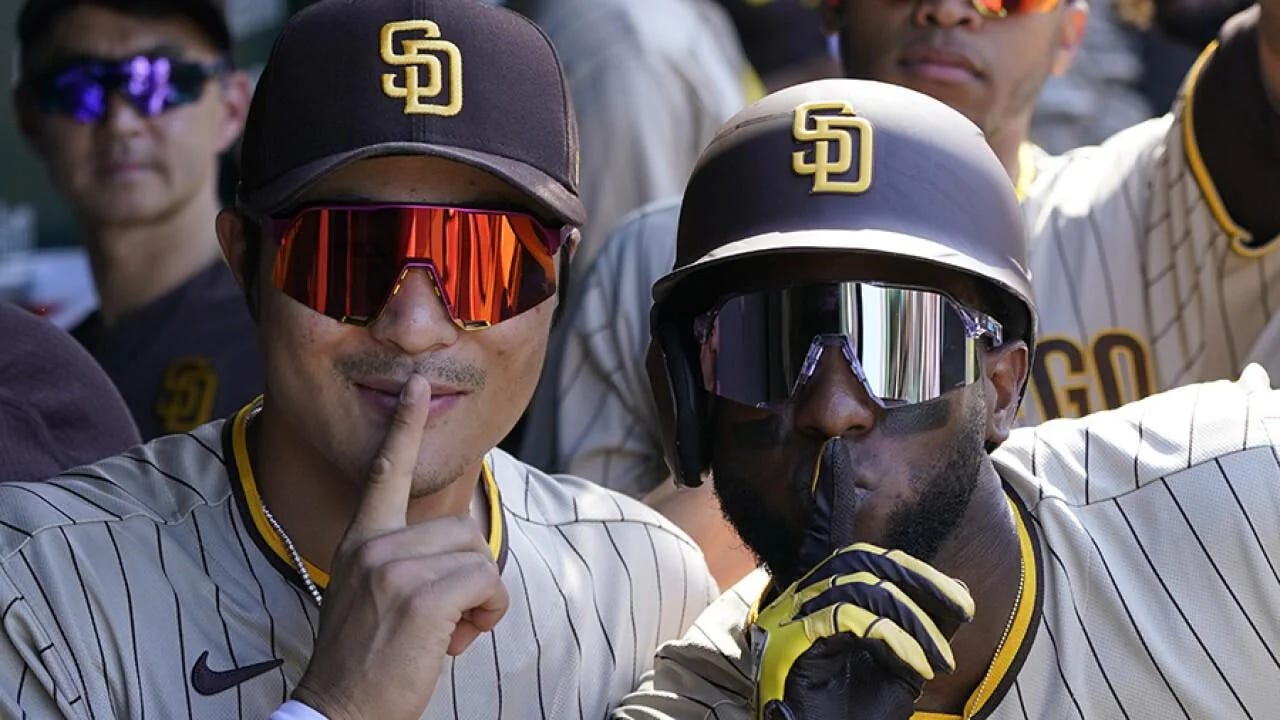
If Kim decides to maximize his earnings on the open market, Atlanta could always pivot to Dubón as the new shortstop. Anthopoulos expressed confidence in his ability to handle the position defensively, telling Braves Today the team’s internal models were okay with that outcome if it came to it this year. “ We feel comfortable with him at shortstop […] Our underlying data on him at shortstop is good and strong.”
My question would be the offense. Since becoming a full-time starter with the Houston Astros in 2023, Dubón’s offense has regressed in three straight seasons, from a 97 OPS+ to an 87 to last season’s 78. The defense has held, but the offense has not.
And as I wrote the day after the trade, Dubón’s strength is not his ability to play shortstop, it’s his ability to play everywhere:
Mauricio Dubón has not only played every defensive position but catcher in the last few seasons; he’s won the American League’s utility Gold Glove in two of the four years of the award’s existence. On Statcast, he grades out as above-average at every defensive position, having put up a +40 Fielding Run Value and +45 Outs Above Average in his career. […] Could allowing Dubón to play four or five days a week, rotating him through different defensive positions while giving the everyday starters either an entire day off or a ‘half-day’ as the designated hitter, help stave off some of the numerous injuries that have decimated Atlanta’s offense in recent seasons?
Bringing him back to be the next starter at shortstop means that the team is once again signing up to eschew load management and potentially grinding down their starters over a 162-game regular season schedule.
But there are other options besides bringing one of these two back.
Could the Braves sign a free agent?
Honestly, it does not look promising.
Just like this winter’s free agent class at the position, next winter’s is also a pretty sparse class. As of now, Kim is the clear jewel of the position, followed by then-32-year-old J.P. Crawford and…Amed Rosario?
Might as well sign Kim during the season, right?
Thankfully, there is another way. We already mentioned signing Dubón to be the everyday shortstop, but he’s not the only player who could be moved to shortstop and expected to thrive defensively.
Chicago Cubs second baseman Nico Hoerner only moved to the keystone out of deference to free agent signing Dansby Swanson, but graded out at +10 Fielding Run Value and +13 OAA the last time he manned the position on an everyday basis in 2022. He has a career +73 OAA in the middle infield and has shown the speed (82nd percentile 28.6 ft/sec) to maintain the range. While his arm strength could be the limiting factor, with Hoerner’s 2025 season mark of an average 75.5 mph coming in as a 7th percentile mark, he’s consistently shown throwing velocities of four to seven mph higher in the sporadic innings he’s covered at shortstop since the Swanson signing.
Philadelphia Phillies utilityman Edmundo Sosa is another shortstop conversion candidate - he’s played nearly 1400 innings at short in his seven-year MLB career and holds a +18 OAA mark. What helps is that he also has a career .258 average and 99 OPS+, including a 109 OPS+ last season.
There are a few trade candidates to be had
Given the sparse free agency market, it’s possible the Braves need to go identify and get a shortstop for 2027 via trade. Most of these acquisitions would fit into one of two buckets: acquiring a young player who is headed for a free agency payday or getting an ‘overpaid’ veteran in a salary dump-type situation.
And some of the names will be familiar because they’re the same names we discussed early this offseason, when we were waiting to see if Kim would pick up his player option to return to Atlanta.
Young pre-FA names: Jeremy Peña, CJ Abrams, Zach Neto
Peña reportedly cut off extension negotiations last summer when the Houston Astros seemingly capped out at five years and $105M, an amount that would have bought out just three free-agent years and sent him back to free agency at 32. He then switched his representation to Scott Boras, so he’s likely heading to the open market after 2027. Would the Astros follow the same pattern as they did last winter with Kyle Tucker, trading him prior to his final year of team control in order to get more compensation than just the qualifying offer?2
Abrams and Neto are in similar positions - promising young players on teams that don’t portend to be competitive during their remaining team control. Do either get moved? While it’s questionable if Abrams will move in the division, Alex Anthopoulos has made several deals with his former lieutenant and current Los Angeles Angels GM Perry Minasian. If Neto does get moved by LA, you’d have to imagine that Atlanta would have as good a chance at anyone at landing the Campbell University product. He wouldn’t exactly be cheap, as he’s not scheduled to head to free agency until 2030 (barring the next CBA changing that timeframe), but he’d immediately be the best shortstop available next winter were he to be made available.
Pricey veterans: Corey Seager, Trevor Story, Ezequiel Tovar3
I wrote about these options back in early November as we waited for Kim to make his decision and without re-hashing the entire newsletter again, Story and Seager would be short and long-term salary dumps, respectively, while Tovar would be Atlanta buying low on a potential franchise cornerstone that’s dealt with injuries and underperformance in the short-term.
I’ve got one more idea, though, which is so crazy it just might work:
Matt McLain of the Cincinnati Reds
One more season of underperformance by the UCLA product, who moved from shortstop to second base out of deference to budding superstar Elly De La Cruz, could potentially see the notoriously frugal Reds looking to move on from the versatile speedster as he gets into the heart of his arbitration years. In just 503 career MLB innings at shortstop, McLain has +2 OAA at shortstop and a +7 Fielding Run Value overall.
The issue here is twofold: He missed the entire 2024 season due to a shoulder injury and his bat still hasn’t returned, coming in at -16 Batting Run Value last season after hitting .220/.300/.343. The speed’s still there - a 93rd percentile sprint speed of 29.2 ft/sec and 18 stolen bases last year - and so if Atlanta feels like the bat can come back, the acquisition makes a lot of sense.
The problem here is that if the bat comes back next season, McLain’s likely not made available via trade next winter. Does Atlanta need to reach out to Cincinnati President of Baseball Operations Nick Krall this winter or early next year? It’s likely, but I’m fine with that. Maybe there’s a path here to move one of Atlanta’s excess starters and a pitching prospect or two to get the deal done, although Cincinnati’s main offensive weakness has been and continues to be their outfield, an area where Atlanta’s not exactly deep in prospect capital.
What about a prospect promotion?
It’s unlikely. Atlanta’s main shortstop options - international free agent John Gil and 2025 college draftees Alex Lodise (Florida State, Rd2) and Cody Miller (East Tennessee State, Rd3) will likely start 2025 in High-A. While the Braves have been aggressive with their prospects4, that’s usually been confined to pitching prospects, not hitters. It’s increasingly unlikely that any of that trio is ready to be the starting shortstop on Opening Day 2027, and Atlanta would want a veteran shortstop on the roster as a fallback either way - a World Series-contending team can’t afford to put every single egg in a rookie’s basket.
Yes, this is early
I understand that talking about the 2027 season feels a bit premature - I mean, we haven’t even played the 2026 season yet and we don’t know what the CBA we’ll be playing under will look like…but this is how front offices think. Alex Anthopoulos wants to build the most competitive roster he can for 2026, sure, but that desire needs to (and will) be balanced with extending Atlanta’s competitive window as long as possible.
Not having a shortstop to speak of on the roster in 2027 makes it pretty difficult to compete for the division, nevermind championships. I’m sure Atlanta will figure something out, either through free agency or a trade, and I can’t wait to see what it is.
There’s no way the owners would risk nuking the entire 2027 season with a lockout just to get a salary cap, right? RIGHT?
Hopefully, the qualifying offer system doesn’t even exist that offseason after the next CBA eliminates the anti-player provision.
Which stretches the definition of “veteran”, but work with me here
Sometimes to a fault - more on that coming soon
Gil Is Gonna Be That Guy
Gil is going to be da man.
Yes, I know—it’s a big ask to have him truly ready by 2027. I get it. Everything under the sun would have to break just right for that timeline to work. But even acknowledging that, the upside here is impossible not to get excited about.
Even if Gil’s hit tool ends up being the slowest part of his development, he’s still going to be electric to watch. He is so fast—game-changing fast. The kind of speed that turns routine grounders into infield hits and puts constant pressure on the defense. Dribblers, rushed throws, chaos. That’s his game. His power is coming along.
And with the new first base coach helping him refine his baserunning and learn how to steal efficiently—think along the lines of how the Mets’ resident speedster Soto maximizes his legs—LOL--Gil could become an absolute weapon on the bases.
I can easily picture Gil as a long-term 9-hole hitter for the Braves: a second leadoff man who flips the lineup over, wreaks havoc, and sets the table year after year. And hey, maybe it’s only for a year or two before a better bat at shortstop pushes him out—that’s a good problem to have.
Either way, if Gil sticks at short, Braves fans are going to love him.