


Atlanta Braves fans have spent months arguing about who is and isn’t “clutch” on this season’s roster. The problem is that most of the evidence they’re using has very little to do with clutch hitting.
A bases-loaded single in the fifth inning of a ten-run game counts as a hit with runners in scoring position. So does a game-tying single in the ninth inning.
Those aren’t the same thing.
Getting a hit with runners in scoring position is important, but RISP statistics don’t actually measure a player’s ability to perform in the biggest moments. They measure his ability to convert opportunities with runners on second or third base.
High-leverage statistics, meanwhile, are designed to measure performance when the outcome of the game hangs most heavily in the balance.
Sometimes those situations overlap. Often they don’t.
So before we decide which Braves hitters have been clutch this season, we need to answer a more fundamental question:
What exactly are we measuring? Let’s talk about it.
RISP Merchant vs Clutch Hitter
Let’s define some terms.
Not for runners in scoring position - we all know by now that it’s when there’s a runner on either second or third base (or both).
No, let’s talk about leverage.
FanGraphs has defined leverage based on how any particular situation changes a game’s win expectancy for the two teams. There’s more math than that, with the Leverage Index incorporating probabilities of both each potential outcome and the average potential swing in win expectancy, but you get the idea here. Average is an LI of 1.0.
The three buckets come out to this:
High Leverage: 2.0+
Medium Leverage: 0.85-2.0
Low Leverage: 0-0.85
A side note here is that the frequency of these events isn’t an even distribution - roughly 60% of all game situations are low leverage, while only about 10% are truly high leverage. The frequency with which each player faces a high-leverage situation also isn’t evenly distributed - backend relievers and pinch hitters face them the most, with lineup regulars and starting pitchers seeing them less often.
Someone who is good with runners in scoring position can rack up huge stats without paying attention to the inning or score - you can have an at-bat with RISP despite the game being solidly in hand, but it doesn’t necessarily mean you were good when it mattered.
At the same time, a clutch hitter, by definition, performs when the outcome is still up in the air: Late innings, tie games, extra innings, game-changing moments. It’s clearly more important because of the impact of that performance - it’s guaranteed to matter, by definition, where RISP at-bats are implied to be important but aren’t guaranteed to be.
So with that being said, let’s look at the four different buckets a player can be binned into, using wRC+ to sort them.
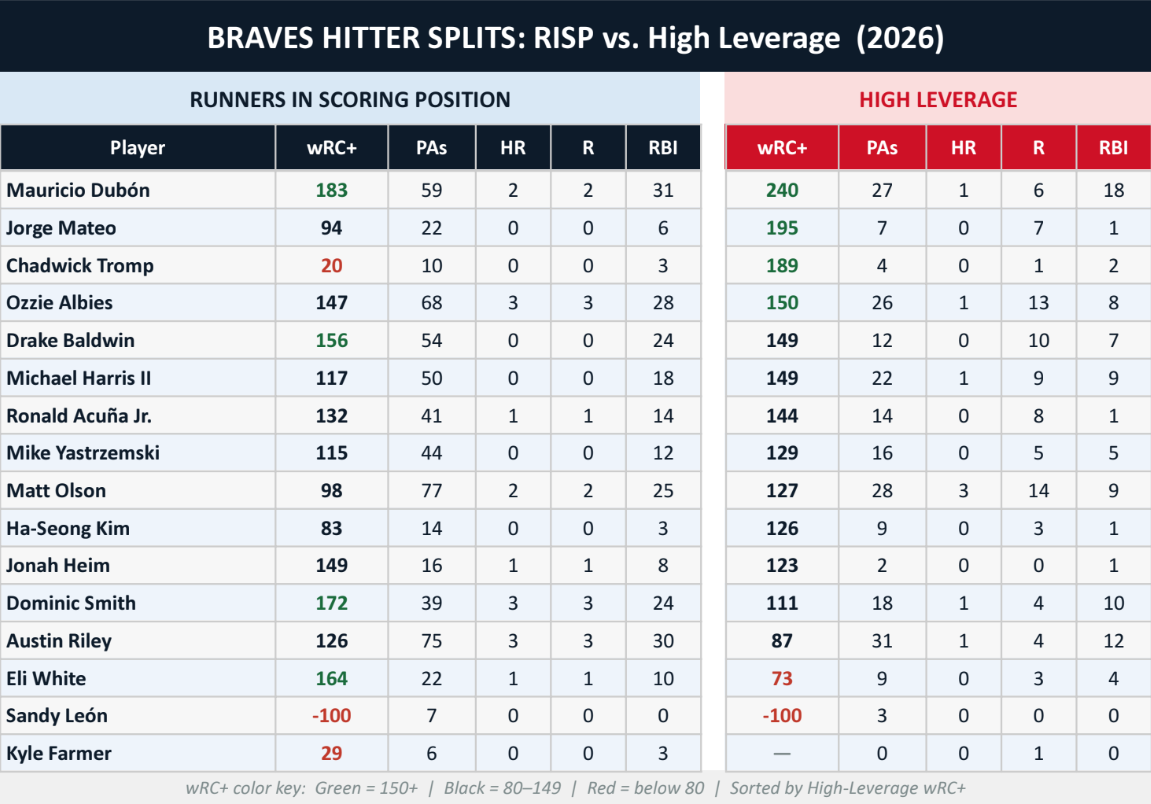
Bucket 1: The Real Clutch Hitters
These are the guys delivering regardless of game context, as they’ve excelled in both high-leverage and with runners in scoring position.
The poster child for this on Atlanta’s roster is Mauricio Dubón, who has discussed shortening his swing and aiming to put the ball in play the opposite way. The utilityman has succeeded more often than not, putting up an 183 wRC+ with 31 RBI in 59 PAs with RISP and a 240 wRC+ with 18 RBI in his 27 high-leverage PAs.
Other Braves who have excelled in both situations include Drake Baldwin (156 wRC+ w/ RISP, 149 wRC+ in high leverage) and Ozzie Albies (147 wRC+/150 wRC+), and Ronald Acuña Jr. (132 wRC+/144 wRC+).
There are a few who are better than average in both, but with a significant discrepancy between the two scores. Dom Smith is a great example here: he has a 172 wRC+w/ RISP, but ‘only’ an 111 wRC+ in high leverage, while Mike Yastrzemski is the opposite, putting up a 115 wRC+ with RISP but a 129 wRC+ in high leverage.
Bucket 2: The RISP Merchants
Good with RISP, but not actually good in clutch moments. The guys whose RBI totals make them look clutch even though the leverage numbers disagree.
The two guys here are both fan favorites, although one of them has fallen out of favor with his recent struggles. Austin Riley has a 126 wRC+ with runners in scoring position, having driven in 30 with three home runs in his 75 PAs. But when the game’s been on the line, 31 PAs classified as high leverage, he has only an 87 wRC+. Riley’s clearly being aggressive at the plate in an attempt to come through when the team needs it, with an on-base of only .290 and a 6.5% walk rate, but his .259 average and .697 OPS showcase his struggles.
The other is Eli White, although he’s suffering from a much smaller sample size. His 164 wRC+ in 22 PAs with runners in scoring position creates the illusion that he’s been a clutch hitter, but he’s put up only a 73 wRC+ in high-leverage moments. The problem, however, is he’s only had nine high-leverage PAs, as he’s usually a pinch-hit candidate in those situations.
Bucket 3: The Firefighters
These are probably the most misunderstood hitters on a roster.
Fans naturally remember RBI opportunities because they’re easy to spot. Runner on second, base hit, run scores. But high-leverage situations aren’t always accompanied by runners in scoring position. A tie game in the eighth inning with nobody on is often more important than a bases-loaded at-bat in a blowout.
That’s what makes this group so fascinating. These hitters may not always capitalize on traditional RBI opportunities, but when the outcome of the game hangs in the balance, they tend to find a way to contribute.
Matt Olson’s the poster child of this here. ‘Oly’ is pretty much a league-average hitter in any given RISP situation, putting up a 98 wRC+ in his 77 chances with two homers and 25 RBI.
But when the game has reached its most consequential moments, Olson has generally been one of Atlanta’s more dependable hitters.
His 127 wRC+ in high-leverage situations was driven by three homers, nine RBI, and a robust .600 slugging percentage. That distinction matters because Olson’s season has sometimes felt frustrating. His overall numbers are solid, but stretches of inconsistency and missed opportunities with runners aboard have made him an occasional target of criticism.
The leverage data tells a slightly different story. Olson hasn’t been a dominant RISP performer, but he has delivered some of his biggest swings when the win expectancy implications were at their highest.
Olson is the most prominent example because of his role in the lineup, but he’s not the only one.
The pattern appears for Jorge Mateo, as well, although the similarities to Olson mostly begin and end with this particular bucket. He has a 94 wRC+ in 22 RISP plate appearances but a 195 wRC+ in his seven high-leverage PAs.
Mateo is an even better example of why these buckets exist in the first place.
If you only looked at his RISP production, you’d conclude that he’s been mostly ordinary. But because high-leverage situations are measuring something different, he lands in a completely different category. His sample size is tiny, which means the numbers should be treated carefully, but it’s a good illustration of how a player’s reputation can change depending on which situations you’re emphasizing.
Despite the terrible start to the season he’s having, Ha-Seong Kim is also in this bucket (albeit with a tiny sample size). His 14 RISP plate appearances have resulted in an 83 wRC+, but in his nine high-leverage PAs, he’s produced a 126 wRC+.
Taken together, this group highlights why leverage matters. If you only looked at RISP production, you'd miss some of the hitters who have done their best work when the game was most likely to swing one way or the other (and also, Ha-Seong Kim).
Bucket 4: The Strugglers
This is self-explanatory, right? These guys aren’t good in either situation.
The thing here is that when you’re off to a franchise-best 45-21 start, you don’t have very many players where this is an issue.
And for all of them that are, it’s an extremely small sample size. Sandy León has a -100 wRC+ in both situations, but it totals just 10 combined PAs. Kyle Farmer has a 29 wRC+ with RISP, but hasn’t gotten a high-leverage plate appearance.
What This Means For Atlanta
Let’s zoom out a bit.
The Braves have either been exceptionally lucky or Alex Anthopoulos has built this year’s roster very well, as they haven’t had to rely on anyone who genuinely struggles to produce in either situation.
I’m leaning towards crediting Anthopoulos here, as several of the new roster additions like Mauricio Dubón and Jorge Mateo are the best on the team at the moment at producing in clutch situations. Overperformance in key situations like that can help paper over issues elsewhere on the roster, like Drake Baldwin being on the injured list or Ronald Acuña Jr.’s slow start to the season from a power perspective.
But at the same time, it throws out some warning signs. One of the arguments I’ve seen in support of struggling third baseman Austin Riley is that he’s still “a clutch hitter”, with his RISP stats being cited as evidence. The problem is, we’ve established that he’s not performing in clutch moments, just with runners in scoring position.
One last time:
A hit with runners in scoring position isn’t automatically clutch.
A clutch hit doesn’t always happen with runners in scoring position.
The two overlap more often than not, which is why fans tend to use them interchangeably. But they’re measuring different things. One measures your ability to capitalize on opportunities. The other measures your ability to perform when the game is hanging in the balance.
For Atlanta, the good news is that there aren’t many glaring holes in either category.
The Braves have hitters who excel in both situations, hitters who are better with RISP than in true leverage spots, and hitters who seem to save some of their best work for the moments that matter most. That’s part of what happens when you build one of the deepest lineups in baseball.
It also serves as a reminder to be careful about the narratives we create.
A player can rack up RBI and still struggle in high-leverage situations. Another can have middling RISP numbers while consistently delivering when the game is on the line. Both can feel “clutch” depending on which moments fans remember.
The next time the Braves load the bases in the third inning or bring the tying run to the plate in the ninth, remember that those situations aren’t created equal.
Neither are the hitters stepping into the batter’s box.
"That’s part of what happens when you build one of the deepest lineups in baseball"...and actually USE all the pieces. Walt USES ALL 26 GUYS; or he and AA release them. EVERYONE (well, almost) gets REGULAR ABs so someone like Lindsay can create more than "sample size" to either calm fan howlings down, or justify a move with an individual player. You're the fan psychiatrist, Lindsay!!
Lindsay, this is very, very interesting. No question there is a difference between RISP and Clutch in high leverage situations.
My question is: Given the small sample size of AB's in High Leverage situations, how much of this is real and how much of this (may be) small sample noise in either direction - good or bad?