


The Atlanta Braves have felt a little cursed over the last two seasons. The jokes about selling the franchise’s soul for the 2021 World Series are starting to feel less like jokes and more like reality with every new setback.
We have already seen injuries pile up with Ha-Seong Kim, Spencer Schwellenbach, and Hurston Waldrep, along with AJ Smith-Shawver’s elbow issue carrying over into this year. On top of that, Jurickson Profar has likely played his last game in a Braves uniform, and possibly in the big leagues altogether. All before Opening Day.
A lot of the depth Alex Anthopoulos added this offseason is already being tested.
One of the biggest talking points across Braves Country right now is the starting rotation. With the current injuries, the Opening Day group is lining up to be Chris Sale, Spencer Strider, Reynaldo López, Grant Holmes, and Bryce Elder. That is clearly not the rotation most of us expected to see just a couple of months ago.
Anthopoulos made it clear he was open to adding a starter, but only if it was a true impact arm who could help in October. As of now, that move has not materialized.
Let’s talk about why.
Who would they have added?
Instead of going through every possible name the Braves could have pursued, I want to focus on three pitchers that kept coming up among fans: Sonny Gray, Chris Bassitt, and Lucas Giolito.
Sonny Gray has felt connected to Atlanta for years. It makes sense given his Tennessee roots and Vanderbilt background. Over a 13-year career, he owns a 3.58 ERA and 1.20 WHIP across 339 appearances (330 starts). He is a three-time All-Star and has finished top ten in Cy Young voting three times. He will be entering his age 36 season in 2026.
Chris Bassitt is heading into his age 37 season and has put together a solid career as well with a 3.64 ERA and 1.25 WHIP across 232 appearances (218 starts). While he only has one All-Star appearance, he has also finished in the top ten in Cy Young voting three times.
Lucas Giolito is a bit younger, turning 32 in July. The former first-rounder has pitched nine seasons in the big leagues, the majority being with the White Sox. He owns a career 4.30 ERA and 1.26 WHIP across 206 appearances (204 starts). He has also made one All-Star appearance and finished top ten in Cy Young voting twice.
On the surface, all three of these pitchers have solid career numbers. If you dropped those stat lines into the current Braves rotation, most fans would take it without hesitation. The issue here is that you are paying for what a player did in the past, not for what they will be moving forward.
When you look at the last two seasons, the trends are not as encouraging:

Gray has still been effective, but there are signs of decline in contact quality and stuff. Bassitt has been steady but unspectacular, and in some areas has taken a step back. Giolito has struggled more noticeably, especially in limiting hard contact. Clearly, Father Time is starting to creep in for all three. They can still provide value and give a team quality innings, but the real question is whether that value justifies the cost for Atlanta.
Using the 2024 and 2025 seasons as a baseline, the production from these pitchers is not drastically different from what the Braves have already gotten from Reynaldo López and Grant Holmes.

There is some context needed here, especially given López's absence for most of 2025, but the overall point still stands. The production gap is not nearly as wide as it may seem at first glance.
Giolito is likely the cheapest option at this point, as he has yet to sign with a team. If the Braves brought him in strictly for depth and innings on an extremely cheap or minor-league deal, it would not be a bad move. The question is what role he would actually fill. If the organization already has arms capable of similar or better production, there is little reason to block those opportunities.
In Bassitt’s case, the situation is a bit clearer. He signed a one-year, $18.5 million deal with Baltimore after a solid but unspectacular season. One-year deals are usually low risk, but committing that level of money to a pitcher who has performed similarly or even worse than internal options over the last two years does not make much sense. That is not the type of impact arm Anthopoulos was talking about, and money that can be allocated elsewhere.
Gray is the best of the group, and that is not really up for debate; I know this. The argument is about cost versus return. What would it take to acquire him, and would that upgrade be meaningful enough to justify it? He is still a very good pitcher and would help any rotation. He projects as a strong number three starter for Boston this season. The issue is the acquisition cost.
Boston gave up Richard Fitts and prospect Brandon Clarke to land Gray, with St. Louis covering $20 million of his salary. If you are Atlanta, that probably means parting with two pitching prospects like Owen Murphy, Garrett Baumann, Luke Sinnard, or Lucas Braun. You are essentially giving up years of cost-controlled pitching talent for a short-term upgrade that may not move the needle as much as you would hope.
For me, that is where the line is. Prospects are always a divisive topic; some fans believe every prospect will turn into a star, while others assume most will not pan out. The truth is usually somewhere in the middle. What we can say with confidence is that the Braves have earned trust when it comes to developing pitchers.
Over the last several years, this organization has consistently produced arms that can contribute at the major league level. Max Fried, Spencer Strider, Spencer Schwellenbach, and even what they got out of Kyle Wright, Ian Anderson, and Mike Soroka are proof of that. Even guys who were not top-tier prospects have come up and provided meaningful innings.
And that pipeline is still very much intact.
AJ Smith-Shawver and Hurston Waldrep both look ready to factor into the rotation once healthy. Strider and Schwellenbach are already established pieces. JR Ritchie, Didier Fuentes, and Cam Caminiti are showing up on top prospect lists, while Owen Murphy continues to work his way back from Tommy John surgery and should soon join them. Beyond that, there is even more depth with names like Luke Sinnard, Garrett Baumann, Lucas Braun, Briggs McKenzie, and others who could emerge.
When you compare the minor league performance of guys like Schwellenbach, Smith-Shawver, and Waldrep before their debuts to where Ritchie, Fuentes, and Murphy are now, the results are encouraging.
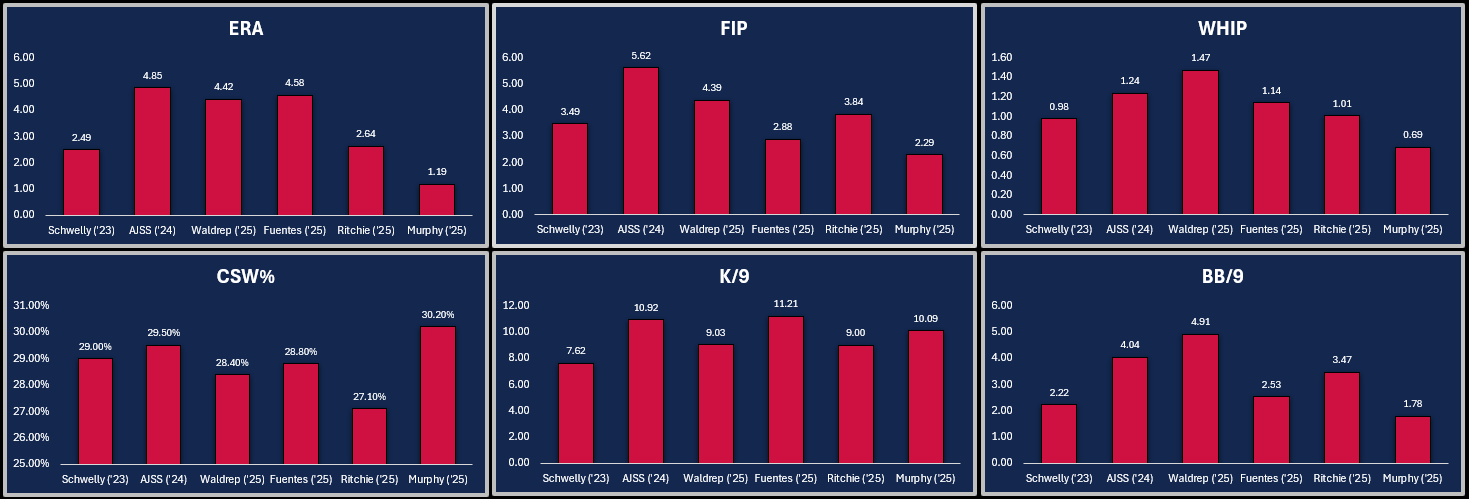
There will always be some variation. Fuentes is still just 20 years old, and Murphy has not yet pitched above High-A, but the underlying performance is right in line with what the Braves have promoted in the past.
This organization has shown a willingness to be aggressive when pitchers are ready. There is a real chance that one or more of these arms contribute this season and provide production that is comparable to what the veteran fans wanted to bring in.
Instead of using prospect capital to make a marginal upgrade, the Braves have the option to let those prospects become the upgrade. That is a bet I am more comfortable in making than giving up on them. Now, if a true top-of-the-rotation arm becomes available, that is a different conversation. That is the type of move you push your chips in for. But for smaller upgrades, it just does not feel worth it.
At the end of the day, it comes down to this: Is the upgrade to Gray worth giving up multiple years of control over two quality prospects? Is paying close to $20 million for Bassitt a better use of resources than sticking in-house? Does bringing in Giolito really move the needle enough to justify taking innings away from someone already in the system?
I do not think it does.
For this Braves team, the smarter path is to stay the course. Trust the development system that has consistently produced quality pitching. Give opportunities to the arms already in the organization, such as Didier Fuentes and JR Ritchie, until Schwellenbach and Waldrep are healthy. Let the season play out and reassess if needed. This is the type of pathway that turns the notion of “We have no starter depth” to “How are Hurston Waldrep and AJ Smith-Shawver on the outside looking in at the rotation when they would be number threes on most teams?”
It may not be the flashiest approach, but it is one that has worked for Atlanta before, and there is a good chance it will work again.
The conclusions in this article are right on target. Acquiring pitchers in the FA market or by trading prospects carries too much risk given the frequency of pitching injuries in today’s MLB. The days of a stable 5 man starting rotation being the foundation of a successful season are gone. A deep, flexible staff, including bullpen and minor leaguers, are the key to success in today’s game. Good starting pitching still matters a lot, but look around the league… what rotation is staffed by proven starters with minimal history of injuries? Red Sox and Cubs come the closest, but it’s not the ‘90’s anymore. The Braves have the right approach - use top draft picks on pitchers and focus on development and build a deep staff.
Taylor, I’m with you on this. Just read some of the Red Sox articles and you can see how concerned those that cover them are with the Sonny Gray acquisition. Not worth the cost, IMO. Really excited to see what happens this year!