


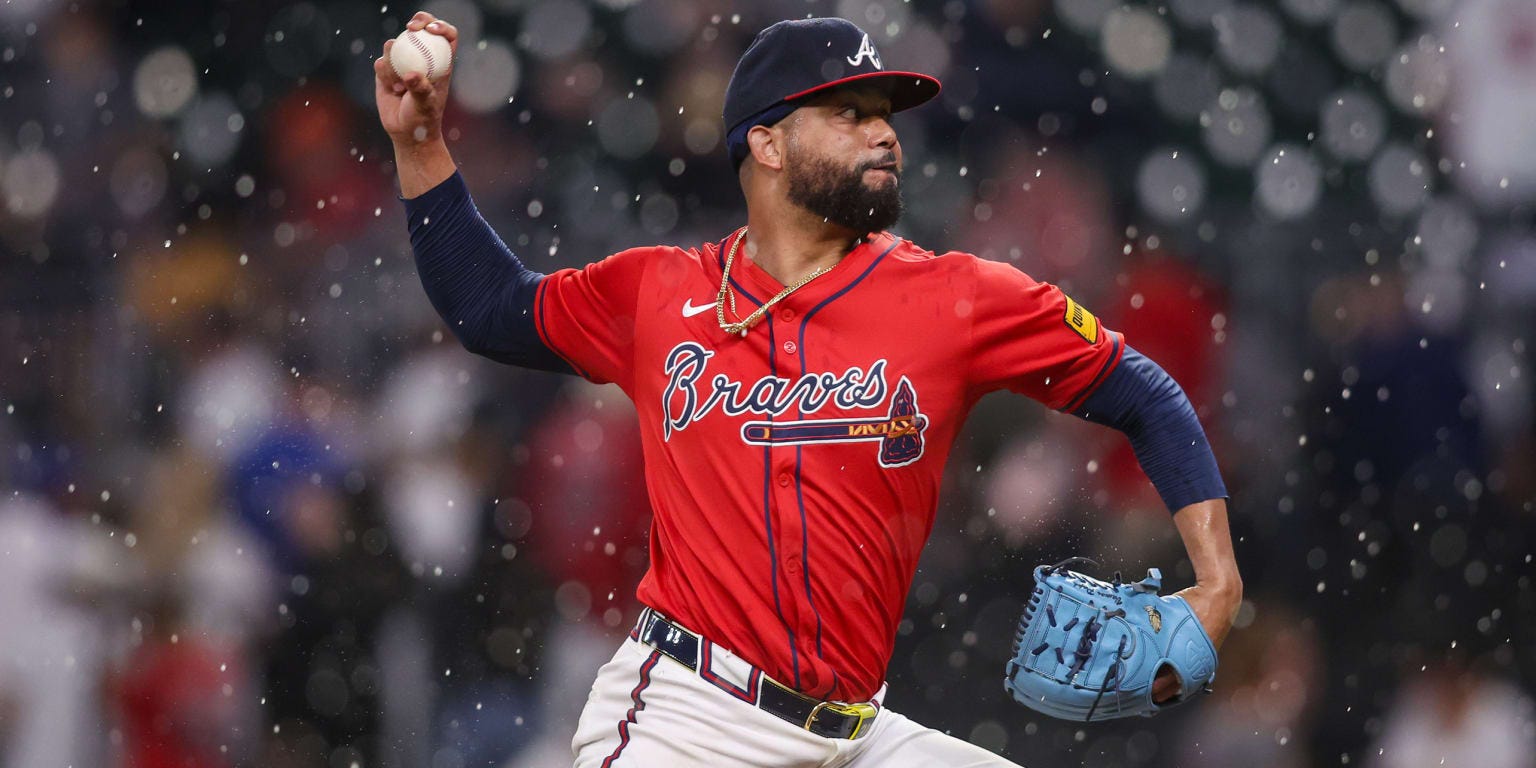
The common calculus for the back of Atlanta’s bullpen is that the Braves have a two-headed, changeup-driven monster for the late innings in returner Raisel Iglesias and free agent signing Robert Suarez. Those two will be backstopped by lefty Dylan Lee, who has quietly been one of the best relievers in baseball until he dealt with some bad homer luck late last season.
But who will serve as the fourth back-end leverage reliever has been an open question. Joe Jiménez, who has had two knee surgeries since last pitching in 2024, is someone that the Braves have admitted they are “not counting on” for high-leverage innings. While I’m convinced Grant Holmes would be successful in the late innings of a close ballgame, he’s still in consideration for the final rotation spot, barring a blockbuster signing or trade. Lefty Aaron Bummer is being paid like a high-leverage reliever, making $9.5M in the final year of his extension signed last winter, but he’s lost almost 3.5 mph on his fastballs in the last three seasons and his whiff rate has collapsed accordingly.1
As much as I’ve openly advocated for the Braves to eschew signing a “bulk innings” starter in favor of another leverage arm, the answer may already be on Atlanta’s roster. Let’s talk about Joel Payamps.
What happened in 2025?
Payamps majorly struggled, that’s what. The 31-year-old entered his third season with Milwaukee rocking a neat 153 ERA+, fueled by his 26.1% strikeout rate. The warning signs were there, however - in 2024, his majority red Statcast card showed several steps back in his inputs, including significantly increased hard-hit and barrel rates.
While he did not significantly change his pitch mix, leading with a sweeper-ish slider and backing it with a four-seamer and sinker, he did lose half a mph in his fastball velocity and saw his already-minimal changeup usage drop to virtually nothing.
Truthfully, there is not much to explain why his ERA spiked from his 2023-2024 average of 2.78 to a 7.23 with Milwaukee last season except for two things: The small sample size nature of his season (just 23.2 innings) and the exceptionally bad luck he received on balls in play - opposing hitters put up an absurd .361 average against him in Milwaukee.
The performance estimators confirm that a lot of the poor surface stats come back to bad luck - his Fielding Independent Pitching for last season was 4.32 for his Milwaukee tenure and his Expected ERA for the entirety of the season was 4.08. Sure, his strikeout rate dropped to 20.5%, but that can also partially be fueled by the significant bad luck in BABIP.
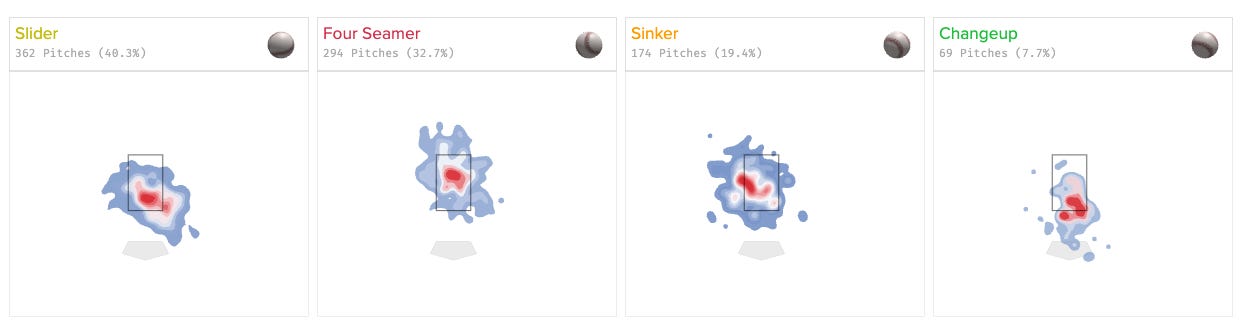
Despite his walk rate finishing at an identical 7.7% in both seasons, indicating that his overall level of control was still there, his command largely evaporated.
‘Control’ is the ability to throw a ball generally inside the strike zone. ‘Command’ is the ability to place the ball where you want it inside (or outside) the strike zone - it’s more precise than just “can throw strikes”.
Here’s the Statcast heat maps for his primary pitches in 2024:
And here’s the Statcast heat maps for those same pitches in 2025:
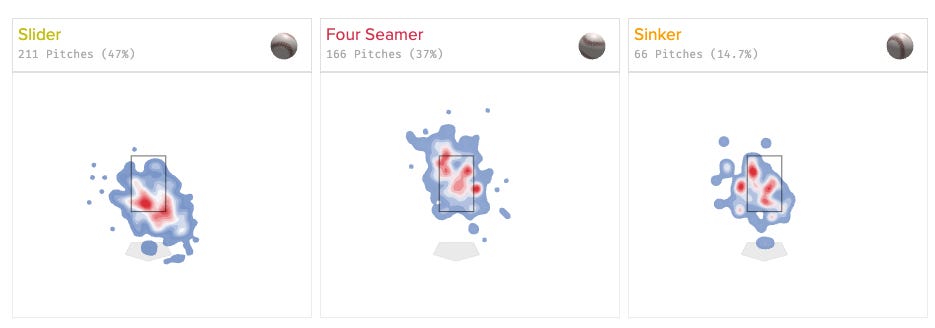
While there are fewer overall pitches of each type for 2025, naturally leading to less defined ‘hot spots’ on the map, you can still see how he had more variability with their locations. Too many sinkers were left up in the zone, for instance, a function of his adjustment to attempt to throw it more inside to righties. These locations caused the overall fastball whiff rate to continue to slide, from 28.2% in 2023 to 26.5% in 2024, down to 15.7% last year.
His slider locations were also a challenge, with the added movement (+2 inches vertical drop, +3 inches horizontal) taking the ball out of his preferred glove-side locations. This had the side effect of actually increasing his whiff rate, from the mid-29% range up to 34.1%, but not enough to offset the collapse in the ability of his fastballs to miss bats.
How do the Braves fix it?
I think Payamps has made the first adjustment already: he stopped throwing his changeup. He didn’t use the pitch once after May 1st, and with good reason - it doesn’t interact well with his arsenal. Throwing a changeup off of his four-seam fastball isn’t very deceptive, as the change typically landed in the bottom the zone against lefties owing to its significant increase in arm-side run versus the four-seamer. His 4S fastball up and away, followed by that changeup, means the cambio ends up being not only very recognizable out of the hand, but hittable if it doesn’t drop enough to miss the zone completely (and it normally didn’t).
I wouldn’t be shocked if Payamps experiments with some other changeup variation this winter, maybe a Vulcan or even a split-finger.
The second adjustment I’d make is to pair the slider more with the sinker. He starts the slider in on a righty and tries to land it away, which would allow the sinker to start in roughly the same location but run in on the hitter’s hands, making for a difficult-to-cover horizontal sight picture.
That’s not what Payamps did, though, with his pitch usage versus righties last year coming in at 50% slider, 33% four-seamer, and 17% sinker. I’m assuming he wasn’t comfortable with the ability to land his sinker.
To be successful, though, the sinker usage likely needs to increase considerably from last year’s 14.7%, but that’s fine - the four-seamer isn’t good enough on its own (.359/.590 BA/SLG, .246/.428 xBA/xSLG) to be the primary fastball. Payamps also experimented with a cutter late in the year, throwing two in his 24 pitches on September 7th against the Pirates. I’m fine with sinker and cutter usage eating into the four-seamer’s share against righties, if for no other reason than to keep pitches out of the heart of the plate in those situations.
What’s the ceiling here?
Honestly, with some common-sense changes and an offseason to make them stick, I could see Payamps taking over as the 4th leverage arm in the bullpen, pairing with Dylan Lee to cover the 7th and 8th if Suarez or Iglesias need a day off. He’s done it before. The stuff is still good in a vacuum, with a Stuff+ score of 103 and a Pitching+ score (which combines Stuff+ with locations) of 105, it’s just being used incorrectly.
And if Atlanta can both figure out Payamps and get Joe Jimenez back from injury? That could be the best bullpen in baseball.
Bummer went from 94.5 mph in 2022 to just under 91 mph last season on his sinker, while the four-seamer cratered from 94.6 to 91.6 across the same span. The whiff rate, correspondingly, has dropped from 32.5% (an 89th percentile mark) to 22.9% (28th percentile)
I still don't understand how we still have Bummer and not Kinley (era under 1.00as a Brave).
We talk about lost velocity all the time. But nobody explains it. Is it age or is it just wear and tear on the arm ?
I've noticed that a lot of college arms the Braves draft immediately lose velocity when they begin theit pro career. Going all the way back to 2021 1st rounder Shuster.
He never threw as hard as he did at Wake Forest.