


The Atlanta Braves are roughly two weeks away from the first reporting date for spring training. While only pitchers and catchers are required to be in North Port by February 9th, many of the team’s position players come in at the same time to get a head start on the season’s preparations.
The 2026 group is largely set at this point; President of Baseball Operations Alex Anthopoulos did a lot of work late last year, making a trade for Mauricio Dubón and signing several players to modest free agent deals to round out one of the deepest rosters he’s assembled while running the Braves.
But there’s room in both the payroll and on the 26-man roster for one more addition, if so inclined. Do the Braves add a bat or an arm into the mix? Let’s talk about it.
Answer the question of “why”
It’s important to remember that when a front office seeks to improve a roster this late in the offseason, it typically wants a specific reason. Adding a player just to make an addition or in response to someone else’s move isn’t a strategy but a reaction, and often a bad one.
Again, there has to be a reason for making that addition.
The good thing is that when trying to decide between adding a bat or adding an arm to the 2026 Atlanta Braves, it’s easy to understand the case for both scenarios.
The case to add a pitcher
Adding an arm comes down to finding certainty, as much as you can do that with an MLB pitcher in a velocity and spin-rate-obsessed league. Almost every single starter in Atlanta’s rotation for next season has a workload or injury question that goes beyond ‘they were hurt last year, so can they stay healthy this year?’
That uncertainty shows up in different ways across every projected member of the rotation.
Chris Sale: Even in his Cy Young season of 2024, he missed the final two weeks because of a balky back that ultimately sidelined him for Atlanta’s Wild Card round. The last time he made 30 starts in a season was 2017, when the then-28-year-old was the runner-up for the American League Cy Young award. Can the now 36-year-old make it through an entire MLB regular season with something left in the gas tank for October?
Spencer Schwellenbach: Atlanta’s budding ace has pitched just 234.1 major league innings across the last two seasons, owing to a mid-season callup in 2024 and his broken elbow in 2025. Factoring in his minor league starts as well, he has exactly one season where he’s exceeded 115 innings, putting up 169 in 2024.
Spencer Strider: Atlanta’s strikeout master has only once qualified for the ERA title in his major league career. He put up 186.2 innings after making 32 starts in 2023, but the aforementioned elbow injury and then a hamstring strain last season mean he’s pitched just 134.1 combined innings across the last two seasons.
Reynaldo López: The converted reliever hit the wall in 2024, pitching 135.2 innings before going down with a shoulder issue that ultimately required surgery after just one start last season. His workload potential for 2026 is unknown; while he reportedly feels better than he has in multiple years, how many effective innings can he put up after essentially an entire year off?
Hurston Waldrep: Last season was the longest of the youngster’s career, with the righty throwing 148 innings between Gwinnett and Atlanta. Per a source, he told the team he was “pretty gassed” towards the end of the season and likely would not have been as effective were the team to make postseason play.
Grant Holmes: In his first season as a full-time starter since his Double-A days of 2017, Holmes pitched 115 innings before going down with a partial UCL tear that he (apparently) has successfully rehabbed without surgery. But whether the healed UCL will be able to stand up to a full season of starting remains to be seen, and it’s expected that Holmes will begin the year in a ‘utility’ role in the bullpen.
Bryce Elder: I talked to a minor league pitching coordinator once who told me there was no such thing as a healthy pitcher, just one that hadn’t been hurt yet. Elder’s been a workhorse during his time in Atlanta, never appearing on the injured list and pitching at least 150 combined minor and major league innings every season of the last four. This could very well be the year where the wrath of the baseball gods finally catches up to him.
Adding one more starting pitcher to this group means an increased likelihood that the postseason-caliber starters do not get run down over the course of the regular season and are fresh and effective for October. While this also creates problems - there are already too many out-of-options starting pitchers and the bullpen can only hold so many - this just might work itself out in spring if someone is injured or ineffective.
The case to add a bat
Now that we have confirmation from MLB.com’s Mark Bowman that catcher Sean Murphy will be out until May as he rehabs from his September hip injury, something I warned you about soon after the injury happened, there’s a clear need for a lefty-mashing bat on the bench.
Even in Murphy’s disappointing 2025, one in which he hit .199 with a 97 wRC+, the veteran catcher crushed left-handed pitching to the tune of a 123 wRC+ and a .271 ISO, by far the team’s best ISO against lefties on last year’s roster. Murphy hit seven home runs in just 96 ABs against LHP last year.
A viable plan for the now-vacated designated hitter spot would have been using Murphy against lefties and outfielder Mike Yastrzemski (126 wRC+ vs RHP) against righties this year. But with Murphy sidelined until sometime in May, finding another bat to fill that role would be useful.
Without Murphy, the role of short-side platoon bat falls to Eli White, who wasn’t bad against lefties last year but also wasn’t anything better than league average, coming in at an even 100 wRC+. Mauricio Dubón’s 111 wRC+ and the ability to play every outfield spot naturally had him penciled in for that short-side role with Yastrzemski, but the injury to shortstop Ha-Seong Kim pushed Dubón into everyday playing time.1
Atlanta’s bench is projected to consist of a backup catcher (likely Chadwick Tromp or Sandy León), a backup shortstop (Jorge Mateo), and outfielder Eli White. There’s room to add a lefty-hitting specialist there, if the team chooses.
What a pitching addition would mean
There are plenty of starters available, from veteran workhorses who can protect your postseason guys like Chris Bassitt to possible postseason starters (if he can recapture his old magic) like Justin Verlander to intriguing projects like Lucas Giolito and qualifying offer players Zac Gallen and Framber Valdez.
Anthopoulos has previously discussed an “impact” starter and we’re not going to rehash the options - that’s been done.
But adding an arm has downstream effects on the roster.
The Braves are currently looking at five starting pitcher options for the final rotation spot behind the expected starting foursome of Sale, Schwellenbach, Strider, and López. Only Hurston Waldrep, the least experienced of the group, has minor league options remaining. If Bryce Elder, for instance, were given the final spot, that would mean that Grant Holmes, Joey Wentz, and Jose Suárez would all need to either settle into bullpen roles or be moved.
Adding a starter via trade or free agency just adds to the roster crunch in the bullpen - Atlanta can’t reasonably add four guys to the bullpen, as there’s already six names out there - four players locked into spots and two more penciled in.2 I’m fine sacrificing a Suárez or Wentz to add a veteran starter - the Braves already lost Suárez once to waivers before reclaiming him this week - but losing both and/or Elder might be a trade-off that requires immediate performance from Atlanta’s top-level pitching prospects.
Would a bat be the better choice here?
Adding a position player to hit lefties would likely mean sacrificing a bit of flexibility - most of the available options remaining on the free agent market don’t bring a lot of defensive and/or positional utility and would be here solely to hit southpaws on occasion.
Here are the remaining free agents who were best against left-handed pitching last season (minimum of 50 PAs):
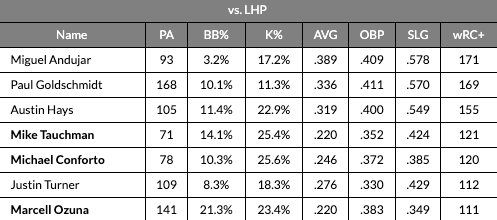
Adding one of these bats feels like it’s a fine idea under ideal conditions, but Atlanta hasn’t been there since 2023. Were a positionally inflexible bat to take up the final spot on the bench, it leaves the team with one fewer option the next time an injury were to strike. Having an extra first baseman on the bench does Atlanta no good if a centerfielder or second baseman goes down.
That’s not to say that one of these additions can’t happen, but it is a trade-off worth discussing.
Standing pat is an option, too
And to be clear, the Braves aren’t forced to add anyone right now. Maintaining the limited payroll space remaining and seeing what happens during spring training, both on the injury and the free agency/trade front, is an option for Atlanta too.
Because here’s the thing about adding a bat or an arm: One move doesn’t fix anything, it just changes where the risk lives.
Paying for an arm means the Braves are leaning into 2024’s gameplan, where the league’s best pitching staff carried an injury-decimated position player group to a Wild Card berth on the season’s final day. It also means hoping that more position player injuries don’t come up, eating away the team’s long-desired depth without a financial cushion to replace it.
But paying for that final hitter, one that can hopefully form a platoon super-bat with Mike Yastrzemski, means the risk is squarely on the pitching staff. If one or two starters go down, especially towards the top of the rotation, the Braves need to worry about how to configure a rotation in October and if they can even get there.
Something I’ve long felt that fans3 and even some commentators don’t adequately understand is that a decision is either right or wrong based on the information you have when you make it. Add a starter, and the risk is that the lineup has to stay healthy. Add a bat, and the risk shifts squarely onto the rotation. That’s the choice in front of the Braves.
I don’t envy Alex Anthopoulos right now. Whatever he chooses, the real verdict won’t come in February — it’ll come in October, when we find out where the risk actually lived.
Kim is also projected to return in mid-May at the earliest, although I tend to think it’ll be closer to the All-Star Break based on both the team’s habit of under-shooting these recovery timelines (see Murphy’s timeframe from last fall) and Kim’s struggles in hitting last year’s return date after his 2024 shoulder surgery.
Joel Payamps and Aaron Bummer.
Present company excluded; y’all know ball
Excellent article. I vote for a pitcher - Bassit being my choice. With an extra proven arm, Weiss can go more slowly with the starters coming back from injuries - and Sale, a 37 y/o power pitcher - we need him for the entire season.
Young Latin pitchers from Augusta are worth mentioning for future rotations.
Rayven Antonio, 6'1" from.Colombia and Jeremy Reyes 6'1" from Venezuela. Reyesgot a $250,000 signimg bonus and can throw in the upper 90s.
Antonio only got $10,000. But last year he started striking out 1 per inning to go with all those groundouts he's known for.
Davis Polo missed all of '25 but has exceptional Lucas Braun-type control.
He pitched for Augusta in '24.