


Despite having stocked the Atlanta Braves’ cupboard pretty full this winter, President of Baseball Operations Alex Anthopoulos isn’t calling it quits on the offseason just yet.
When asked about adding a starting pitcher prior to the Winter Meetings, Anthopoulos was pretty clear that the team was still at work on that front. “We’d still like to do it. […] We’ve gone down the road on some of those conversations. Obviously, we haven’t gotten anything done, but we have had conversations [and] we’re not ruling it out.”
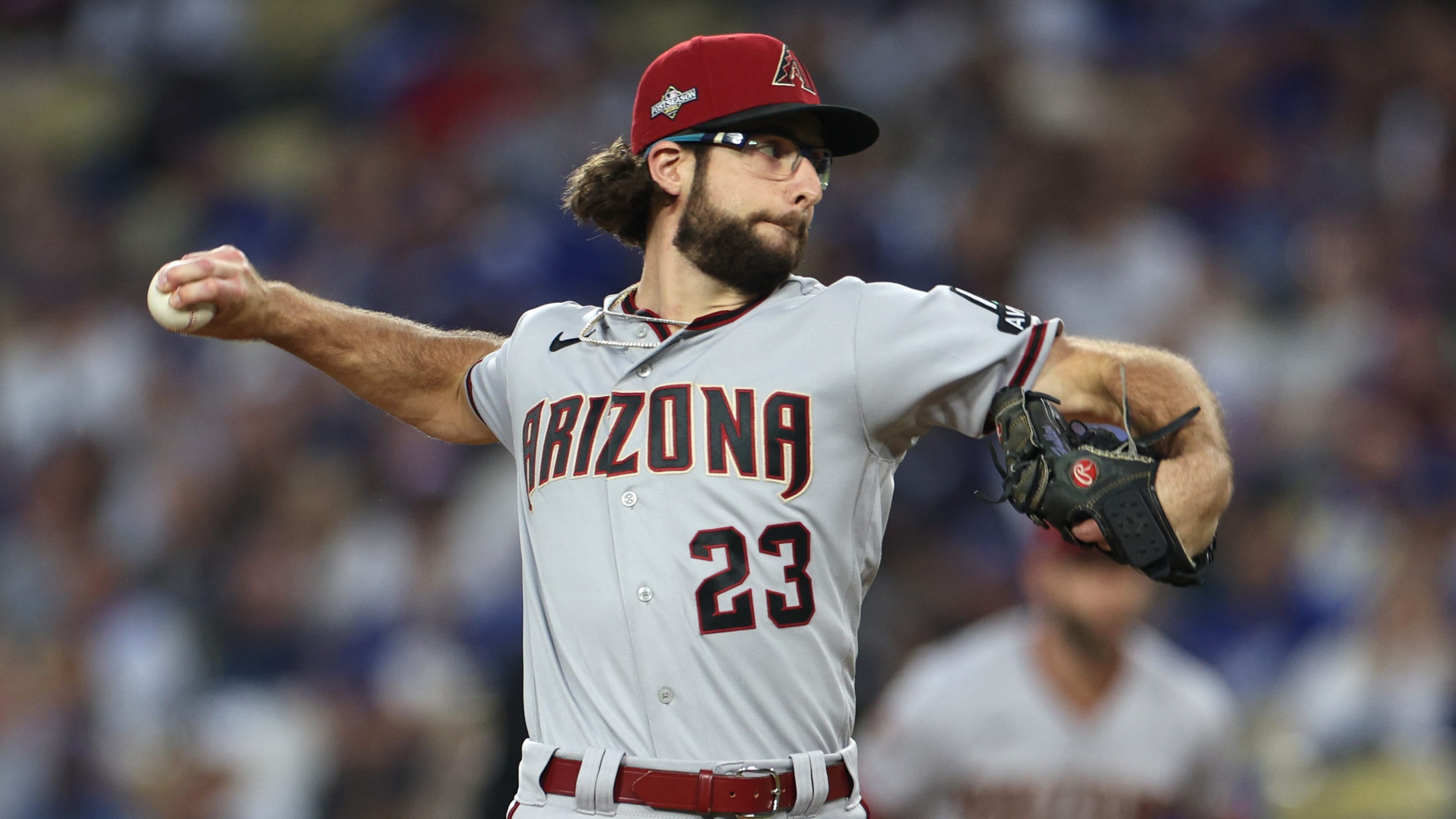
One of the more popular names bandied about for Atlanta, with chatter intensifying after Anthopoulos confirmed they’d be willing to sacrifice the #26 overall pick to sign a player that rejected a Qualifying Offer, is former Arizona Diamondbacks ace Zac Gallen. The righty’s a former All-Star Game starter (2023) who has finished the season with Cy Young votes on three separate occasions and holds a career 3.58 ERA…but he also struggled to a 4.83 last year with career-worst homer and strikeout rates.
What happened last year, and is this an opportunity for Atlanta to get a playoff-caliber starter at a discount? Let’s talk about it.
It’s really been two years of deteoriation
Gallen’s 2023 season was the capstone on a two-year run of dominance for the righty, being named to his first All-Star Game and earning two consecutive top-five Cy Young finishes. Across the two seasons, Gallen pitched to a 3.04 ERA/3.16 FIP with 412 strikeouts. Despite being better in 2022, with an MLB-leading 5.9 H/9 and an NL-leading 0.913 WHIP in that campaign, it was 2023’s 210 innings and complete game shutout1 that got him the most attention, culminating in an 3rd-place Cy Young finish.
But since that 2023 season, Gallen hasn’t been the same pitcher. Over the last two years, sure he’s posted, making 61 starts across 340 innings, but with a 4.31 ERA/4.01 FIP. Over time, the peripherals have collapsed, leaving Gallen susceptible in a few areas.
His homer rate spiked in 2025 to 3.8%, a career high and 6/10ths of a percent worse than the MLB average. Most notably, his once-dominant knuckle curve was the victim here, with 2025’s nine homers on the breaker being more than the previous three seasons combined.
He also walked more batters than usual, posting a walk rate above 8% after two seasons at a well-below-average 6% rate. His performance against lefties also collapsed, with 2025 seeing southpaws hit a collective .256/.326/.422, a career-high .748 OPS.
What happened here, and is it fixable?
It comes down to the breaking ball
As I mentioned above, Gallen’s bread-and-butter pitch has been his knuckle curve. Unlike a traditional curveball, a knuckle curve is thrown harder, with a fastball’s arm action. Gallen’s comes in at 81.1 mph, relying on a spiked finger to create late downward break.
SIDEBAR: This is called a ‘knuckle curve’ because you’re holding the baseball with a curled index finger, similar to how a pitcher would hold all of their fingers on a knuckleball, but ‘spike curveball’ is probably a more appropriate name. Calling it a knuckle curve gives the impression that it’s thrown with minimal spin, similar to a knuckleball, when in reality, you want that downward spin to help create the late movement.
And as I mentioned above, his knuckle curve was obliterated in 2025. Opposing hitters put it in play at a .219 clip, not terrible but still at the highest rate of his career, and had a slug of .438 on the pitch. Of the 101 batted ball events (BBE) on the breaker, 39 were hits, and 20 of those were for extra bases.
Given that there’s nothing extraordinarily different about the knuckle curve itself in 2025 - the velocity (81.1), usage (23.5%), and whiff rates (38.9%) are all roughly about the same - the poor performance is likely due to locations and random variance in outcomes.
In 2024, at similar velocity (81.0), usage (27.7%), and whiff rates (39.2%), 108 BBEs on the knuckle curve turned into two homers and nine total extra base hits, a .148 average and .230 slug.
Sometimes, you just get some bad luck that will normalize with a large enough sample. That bad luck can take the form of both locations (81 pitches across the middle of the zone) and the results on those pitches - in 2025, a .391 average and .913 slug. Past Gallen seasons have seen a lower percentage of knuckle curves left up, roughly half a percent less (when calculated as a portion of his total pitches), and results more from a .118-.250 batting average and .118-.333 slug.
Similar to the results from Raisel Iglesias’ slider, it’s likely this regresses back towards the mean next season.
What other concerns are there with Gallen?
His walk rate was elevated, yes, but I think this was more coincidental last year. Gallen’s walk rate started off extremely high, sitting at over 10% for the month of March, before coming down to a below-average 7.6% in June and bottoming out at 4% in July. It slowly started to tick back up over the rest of the campaign, rising to 8.1% in September…which was still lower than the MLB average of 8.5% last year.
Quick, guess which month was Gallen’s best last year? Trick question, it was August, where Gallen put up a 2.57 ERA across six starts and 35 innings. Of Gallen’s six starts, five of them were quality starts, including six scoreless innings on the road in Los Angeles against the Dodgers on August 29th.
But in July, Gallen’s 9.9 K/9 was his best mark of the season. In his first two starts of the month, he struck out 19 in 13 innings with one run allowed (on a solo homer) and one walk before struggling in his starts around the All-Star Break.
On his performance against lefties, which I mentioned above, there’s no clear explanation for his struggles. He didn’t notably change his pitch mix year-over-year, slightly increasing cutter usage from 5% to 7%. This could very well be random variance as well, given that opponent performance by handedness has been within 14 points of OPS across Gallen’s entire career (and his FIP is literally one point apart, 3.65 versus LHH and 3.66 versus RHP).
Should the Braves be afraid to jump into the Gallen market?
Provided Atlanta is confident that a lot of his issues stem from random variance or a correctable issue, we likely shouldn’t be worried about Zac Gallen’s performance continuing to regress if he signs with the Braves in free agency.
That being said, the current version of Gallen doesn’t fit with what the Braves like to do. He sports a Stuff+ that’s been under 100 for the last three seasons, coming in at 98, 92, and 93. He’s missing fewer bats than ever, with a swinging strike rate that’s below 10% for the first time since he became a full-time starter in 2021. Atlanta prefers strikeouts from their pitchers, leading all of baseball in that mark in 2024 and running it back with largely that same staff in 2025.
While Gallen’s fastball velocity has held consistent at roughly 93 mph and his recent injuries have mostly been limited to some mild hamstring strains, the expected price means the deal doesn’t make a ton of sense for the Braves.
Per Jon Becker’s aggregated spending projection, Gallen’s predicted for a two-year, $52M deal, an Average Annual Value of $26M a year. He also declined a Qualifying Offer from the Diamondbacks, so signing Gallen would cost the Braves the #26 pick and its estimated $3.5M bonus pool amount.
At the end of the day, I think the Braves could be comfortable with one or the other, but not both. While a lot of Gallen’s profile lends to believe in his poor variance regressing to towards the mean next season, it’s both an expensive contract for the next two seasons and a large price to pay in prospect capital.
Signing a QO player to a short-term deal doesn’t make sense from a talent accumulation perspective, quite frankly. The nature of the contract means the team doesn’t have the player very long, but also has one fewer opportunity to develop a prospect to replace them, given the sacrifice of the draft pick. It’s taking two gambles in one transaction, betting that the player not only lives up to the contract but that you’ll be able to replace them without the benefit of that draft pick.
Rather than paying Gallen $26M a year for two years and sacrificing a draft pick, why not pay Tatsuya Imai $22M for more years and keep the draft pick? If the Braves insist on going short-term with a starter, why not pay Lucas Giolito an estimated $45.5M over two years ($22.75M AAV) and save the draft pick?
Gallen may very well rebound next season. But Atlanta making two gambles on that happening doesn’t make a ton of sense.
1-0 versus the Chicago Cubs in Wrigley Field on September 8th, allowing three hits (all singles) and one walk against nine strikeouts.
Interesting discussion. The old saying seems appropriate: “A bird in the hand is worth two in the bush”. Or in today’s MLB: “A controllable SP in the organization is worth 2 in FA”. Or “a dozen on the waiver wire” as we found out last year. For consideration and looping back to your prior discussion: Bryce Elder in 2025: 28 starts with a 4.55 FIP. Zac Gallon in 2025: 33 starts with a 4.50 FIP. The cost per WAR difference is stunning. Braves have a system that seems to be stocked with developing and promising arms…Use them!. The track record is strong: Strider, Schwellenbach, AJSS, Waldrup, Next Up.
Good analysis - I hope AA or someone on his staff takes note.