


I was about 550 words into a newsletter about what needed to go right for the 2026 Atlanta Braves to return to the postseason when the Ha-Seong Kim news broke. If you missed the team’s announcement on Sunday, Atlanta’s starting shortstop tore a tendon in his right middle finger after he slipped and fell on an icy sidewalk back home in Korea. He had surgery on Sunday in Atlanta and is supposed to be out for the next four to five months.
While I planned to discuss other things that needed to go right, like Michael Harris II and Ozzie Albies not being among the worst qualified hitters in baseball and Austin Riley returning to perennial MVP-candidate form, avoiding the massively inconvenient injuries the Braves have dealt with in the last two seasons was agenda item #1.
About that.
With Kim out for a not-insignificant portion of the season, let’s talk about Atlanta’s options for shortstop and potential moves they could make to reinforce a position that’s been a perennial weakness for three seasons.
When might Kim be back?
Per Gabe Burns of the AJC, the team’s initial four to five-month timeframe is all-inclusive.
“The four-to-five-month expected absence encompasses everything before Kim’s return to major-league games. In other words, it represents his entire process, including restarting baseball activity and going on a rehab assignment, before rejoining the team. So Kim’s earliest projected return would be around mid-May.”
It is important to consider two factors, though - that Kim hasn’t had clean returns from injury before, as well as anything that wipes away a player’s spring training ramp-up typically requires longer to return to play.
Kim had shoulder surgery late in the 2024 campaign, missing the season’s final six weeks and San Diego’s postseason run. At the time, he was given a return-to-play projection of late April, but didn’t debut for the Tampa Bay Rays until early July because of a back issue and a hamstring strain. He then played just 24 games before going on the injured list again with a recurrence of that same back issue.
The injuries forced him to change his plans for the rest of the season after being claimed off waivers by the Atlanta Braves. As Kim told Korean media after the season, he intentionally did not attempt to steal bases in order to stay healthy, citing Atlanta’s place in the standings and expected absence from postseason play. "In Atlanta, it wasn't like my stealing one more base would change the team's standings, so I told the team, 'I'd rather play healthy than steal,' and the team agreed."
The other issue here is that Kim will be missing spring training, meaning that all of the normal season preparation activities for a position player - taking groundballs to get defensive reads back, facing pitchers in live at-bats, conditioning to play an entire game - all of that is delayed.
That’s a long-winded way of saying that while a four to five month timeframe would project out to Kim being back by mid-May to early June, it is very likely and even more realistic that he doesn’t make it back until closer to the All-Star Break.
Where do the Braves go from here?
There are options to either trade or sign another shortstop option, but most of them aren’t good.
Just sign someone
On the signing side, this winter’s free agent class is mostly down to just Isiah Kiner-Falefa and Jorge Mateo. Kiner-Falefa’s a 30-year-old veteran that’s played all over the infield and has 73 early-career games behind the plate, as well. While a lifetime .262/.311/.349 MLB line (82 OPS+) isn’t anything special, experience at six different defensive positions could be useful as the team’s temporary utilityman while Dubón mans shortstop on an everyday basis.
Mateo, meanwhile, is even less accomplished offensively (.221/.266/.363, 77 OPS+) but offers one thing that IKF doesn’t - speed. Mateo’s been consistently logged as one of the fastest players in all of baseball and has 106 career stolen bases, being considered one of the league’s better baserunners during his eight year career.
The last time he was an everyday starter at shortstop, coming in 2022 prior to the promotion of uber-prospect Gunnar Henderson, he also graded out as one of the league’s best defenders at +11 Fielding Run Value/+10 OAA, a 95th percentile mark.
Both players have strengths that the Braves could tap into, but both are flawed players who were allowed to head to free agency for a reason.
A trade might be more likely.
The usual caveats apply here
Just like the other times we’ve discussed trading for a shortstop this winter, finding someone on the trade market is easier said than done.

And the obvious explanation for this is that if there really was an obvious trade candidate available for just some prospects, the Braves would have already done it. Instead, Atlanta paid $20M to a Scott Boras-repped player coming off of major surgery that played exactly one month in Atlanta in Ha-Seong Kim. But let’s look anyway, just deeper.
We’ll still throw out the obvious names and general reasoning behind why a trade might ultimately happen, but let’s not stop there.
Taking on a contract:
Trevor Story, Boston Red Sox
Ezequiel Tovar, Colorado Rockies
Young player that eventually needs to get paid:
Jeremy Pena, Houston Astros
Zach Neto, Los Angeles Angels
CJ Abrams, Washington Nationals
Brendan Donovan, St.Louis Cardinals1
But here are some other candidates, often a bit under the radar, that might work.
Jordan Lawlar, Arizona Diamondbacks
Now that 2B Ketel Marte is not being traded and 3B Nolan Arenado was acquired via trade, the Diamondbacks have an incredibly locked-in infield. Leaves Lawlar without a defensive home, right? Not so fast, my friend. Steve Gilbert of MLB.com reports that Lawlar will be spending time in centerfield, along with utilityman Blaze Alexander, as Arizona looks for an upgrade on Alek Thomas and his career 76 OPS+. Still, with the organization still hurting for both starting pitching in 2026 and depth going forward, it’s worth a phone call.
Alex Freeland or Hyeseong Kim, Los Angeles Dodgers
Admittedly, I don’t see LA moving one of their top infield backups when they have one of the oldest position player groups in baseball, but Atlanta would be remiss if they didn’t ask. Freeland spent time at both second and third last season and was almost entirely a shortstop in the minors, while Kim’s first season stateside saw him hit .280/.314/.385, a 95 OPS+, while spending time at short, second, and in centerfield.
It makes sense that LA would want to keep both, as 35-year-old third baseman Max Muncy is on the final year of his deal and both 33-year-old Mookie Betts and 30-year-old Tommy Edman have had injuries during their time in LA’s middle infield. LA’s only high-level prospect in the infield is Single-A’s Emil Morales, who is still a few seasons away, making these two depth pieces important to MLB’s oldest team.
Luisangel Acuña, New York Mets
This one’s a long shot, given the fact that it would be an intra-division trade, but the Braves would be negligent if they didn’t check in with Mets president David Stearns. Ronald’s little brother is both out of options and on the outside looking in for a bench spot, meaning that New York may appreciate the opportunity to get anything of value for someone they may end up designating for assignment at the end of spring anyway. He’s only a .248/.299/.341 hitter (82 OPS+) in his major league career, although that’s a grand total of 233 plate appearances across two seasons so there may be more in the tank. He’s played all three infield positions and centerfield in his brief time in the majors, putting up +2 OAA at shortstop in just 126 innings. Similar to Mateo, he’s also one of the faster players in baseball with an average sprint speed of 29.6 ft/sec, a 97th-percentile mark.
The off-the-field aspect of acquiring Ronald’s little brother ahead of what is expected to be a tough negotiation with Acuña, as the former MVP looks for a contract extension, can’t be ignored either. Reportedly, Ronald and his brother have always wanted to play on the same team and adding Luisangel may help Ronald accept the “hometown discount” that will be required for the Braves to extend the veteran after his club option years end after 2028.
Trei Cruz, Detroit Tigers
Cruz was a 3rd-round pick by Detroit in the 2020 draft, one that has been pretty lucrative for the Tigers already. First overall pick Spencer Torkelson, 2nd rounder Dillon Dingler, and 4th & 5th round infielders Gage Workman and Colr Keith have all already made the majors and have produced a combined 7.4 bWAR.
While Cruz was protected from December’s Rule 5 draft by the Tigers, it’s also hard to see how he projects into Detroit’s future infield. The Tigers boast some of the most impressive infield prospects in the game, from top-end talent in shortstops Kevin McGonigle and Bryce Ranier to high-level depth in Jace Jung, Hao-Yu Lee, and Trey Sweeney.
It’s possible Cruz ends up being disposable for Detroit in that scenario. And if that happens, Atlanta could swoop in with an offer.
Braves Today Discord member Ronald Anderson was the first to make this call-out, cutting through the post-Kim injury panic in our Discord with a call to acquire Cruz for cheap. His proposed package was sending fellow 27-year-old Brett Sears, who is a back-end pitching prospect in Atlanta’s system without good enough stuff to break into the majors, back to Detroit as compensation.
Per Prospect Savant, Cruz’s plate approach is one of the best in Triple-A, with the switch-hitter putting up a 19.9% walk rate last year to go with his .284/.423/458 line in Triple-A Toledo.
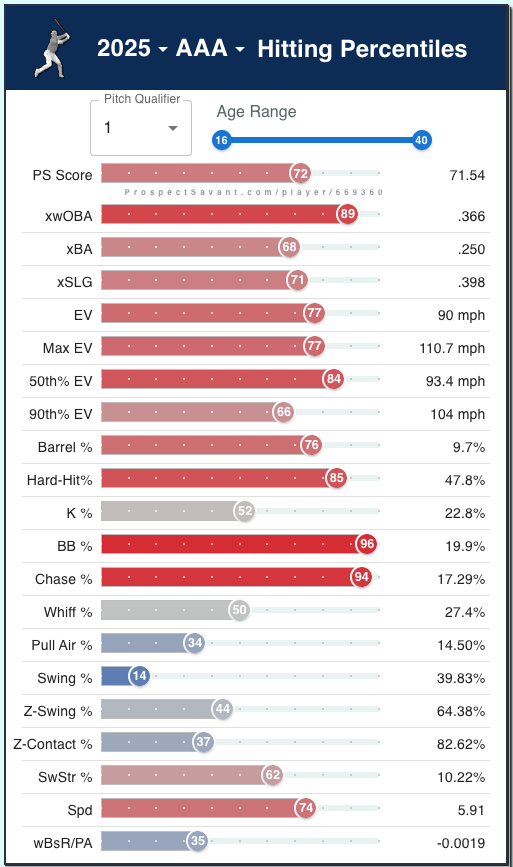
While he seems extraordinarily passive in Toledo (14th percentile swing rate of 39.83%) and will need to be more aggressive at pitches in the zone in Atlanta (64.38% zone swing rate), he’s excelled at making quality contact against righties (average exit velocity of 91.6 mph against RHP last year) and would be a good complement to the lefty-crushing Dubón. If he acclimates to the majors quickly, it’s worth the loss of a fringe at best major league prospect in Sears, a soft-tossing, crossfiring righty that projects to be a “solid upper-minors organizational starter” without the ‘stuff’ needed to make any sort of impact in the majors, per Baseball America.
It’s likely that Atlanta would need to add one more piece to Sears to make the deal happen, if Detroit’s open to the possibility, but they might have already sent Atlanta’s next backup infielder to the Braves.
Promote Jarvis?
The very end of July, the Braves finally ended the Rafael Montero mistake by sending the reliever to the Tigers after he put up a 5.50 ERA and walked 21 in his 34.1 innings.
The compensation was Jim Jarvis, a former University of Alabama standout that was Detroit’s 11th-round pick in 2023. Jarvis struggled to perform with the Tigers, hitting just .242 in Double-A Erie prior to the trade. On the injured list thanks to a freak HBP-caused facial injury at the time of the trade, the Braves discussed some swing changes with Jarvis to help with his extreme ground-ball rate, which came in just shy of 50% last season.
Early indications are that the changes might have worked. In Arizona, Jarvis hit .259/.324/.426 with two homers in just 66 plate appearances, the same number of home runs that he hit in 310 plate appearances in Erie.
While it feels like Atlanta may want Jarvis to play every day in Gwinnett, it’s possible they give him an opportunity in spring training to play his way onto the Opening Day roster as an infield backup for a roster that doesn’t really have one at the moment. Jarvis has played everywhere on the dirt but first base and was lauded by Baseball America as a “rock-solid shortstop defender” who is reliable, albeit not flashy.
While it’s not a high-ceiling option - Jarvis might not ever get to an average bat and his power potential remains below average, even with the changes - it’s another option that would allow Atlanta to survive until Kim returns around the All-Star Break.
Can Alex Anthopoulos pull another rabbit out of his hat, or is shortstop destined to be a weakness for yet another season in 2026?
BONUS: We ran out of space in the newsletter - darn you Substack’s “email length limit” - to get into two other scenarios I fleshed out more in depth on Monday’s podcast episode: a platoon of Dubón and Brendan Donovan at shortstop or a package trade with the Milwaukee Brewers for both starter Freddy Peralta and a shortstop in either Caleb Durbin or Joey Ortiz. Check out the show below, with timestamps of 26:39 for Donovan and 31:21 for Peralta and Durbin/Ortiz.
The Donovan mention requires some explanation, as he’s not a shortstop. Donovan hits righties (career .293 BA, 130 wRC+) even better than Dubón hits lefties (career .283 BA, 111 wRC+), but isn’t as good a defender overall and isn’t really proven at shortstop. What I proposed on Monday’s podcast episode is a scenario where the Braves treated 2026’s shortstop similarly to 2023’s left field - starting Donovan as the Kevin Pillar analogue here and swapping to Dubón in the late innings. Donovan could kick over to second base in place of Ozzie Albies or get the rest of the game off. A move like this would also have the side benefit of giving you a high-level Ozzie replacement were he to struggle or get hurt in 2026.
I would think at some point Luke Waddell could get in the mix. A SS by trade can also play 2B/3B.
He is an OBP machine and could be optioned back to AAA upon Kim-s return to play daily in.Gwinnett
There are better options but I certainly like him better than Jim Jarvis as an.internal.option
What are your thoughts on Nico Hoerner being an option? He was a good SS for Chicago before Dansby arrived and can be a stop-gap at the position while potentially replacing Ozzie at 2B (any deal for Hoerner would have to come with a contract extension worked out).