


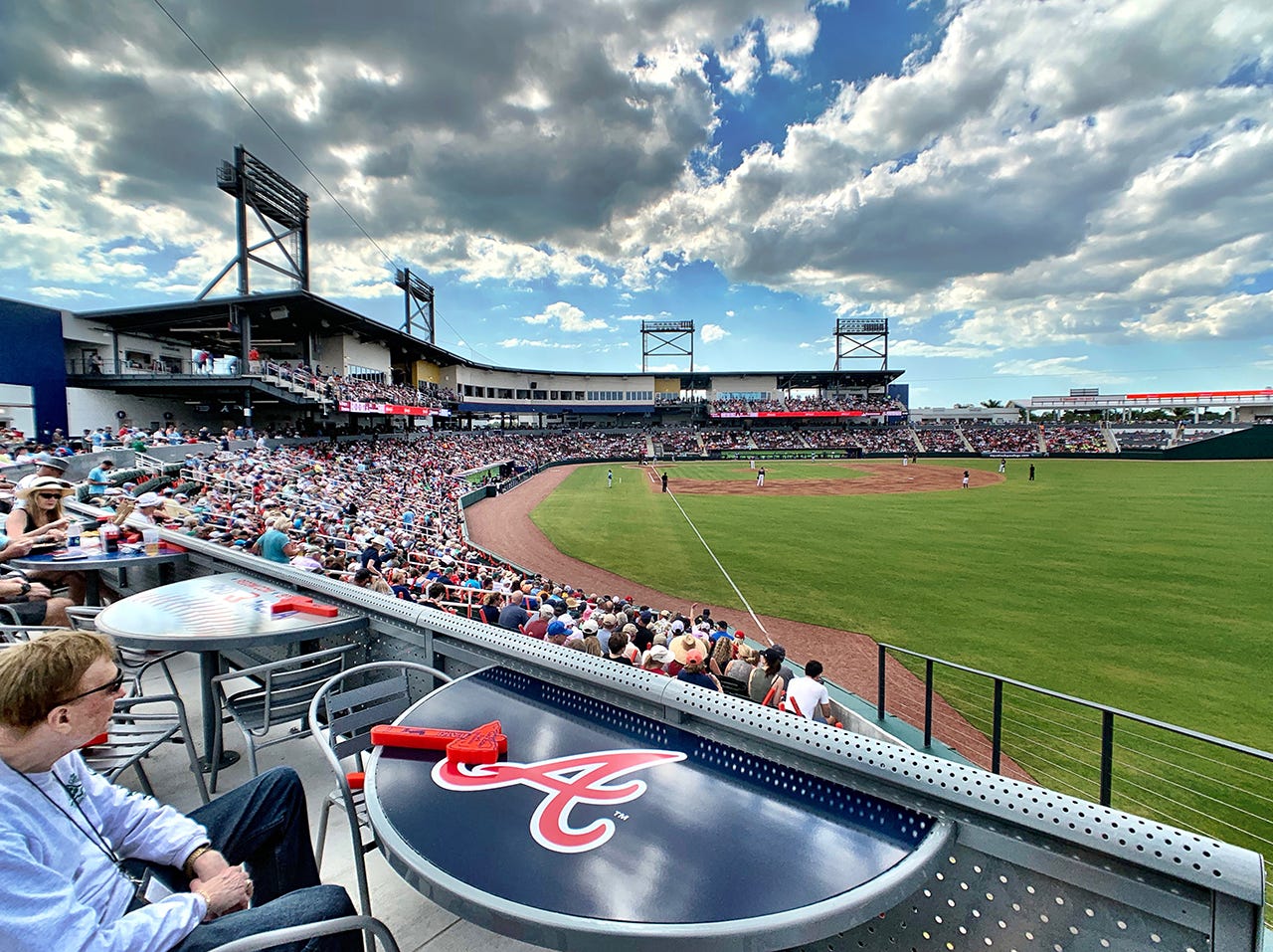
The Atlanta Braves are heading to spring training.
On Wednesday afternoon, the team released their list of non-roster invitees - players on minor league deals looking to force their way onto the Opening Day roster. In total, 64 players will report to North Port next week, chasing just 26 major league jobs.
But not everybody is actually a roster candidate. Let’s break down where each player realistically stands and what we can learn from who is - or isn’t - included on this year’s invite list.
Let’s talk about it.
Tier 1: Players Who Could Force a Real Roster Decision
Atlanta’s roster is mostly set as they head to North Port, but these are the players that can make spring training uncomfortable for the front office. These are the guys who can put real pressure on the 40-man roster, forcing the front office to make decisions rather than default to incumbents.
Among the pitchers, let’s talk about veterans Martín Pérez and James Karinchak.
Pérez was a late addition, signing a minor league deal just last week. A former All-Star who won a World Series championship with the Texas Rangers in 2023, the 34-year-old lefty is trying to get back into the majors after injuries held him to just 56 innings with the Chicago White Sox last year.
The soft-tosser is a ‘kitchen sink’ lefty, throwing all three fastballs, a changeup, and both a curveball and a slider. While he barely broke 90 mph with his heaters last season, some of that can be chalked up to injuries - Pérez was averaging 93 somewhat recently before groin, forearm, and shoulder issues took much of the last two seasons from him. ZiPS is somewhat of a believer that he can get back to being a serviceable #5 starter, projecting him for a 4.46 ERA/4.45 FIP next season.
Karinchak has been more accomplished than Pérez at times in his career, twice putting up ERAs rather close to 2.00 as part of Cleveland’s bullpen. But he’s also been beset by injuries, mostly a recurring shoulder issue that took a majority of the last two major league seasons from the righty. If the stuff looks like pre-2023 Karinchak, this becomes a leverage conversation fast.

Karinchak’s primary competition among NRIs is reliever Ian Hamilton, formerly of the Yankees. The 30-year-old has a pretty limited arsenal, consisting of a sinker and a slider, supplemented by the occasional four-seam fastball. While he still has a good velocity base, averaging 94.9 on his heaters last year (down from 96.1 in 2024), his lack of fallback options makes him the underdog to earn a job in a Jeremy Hefner-coached bullpen.
Both relievers need some dominant performances to climb that hill in front of them, but it’s easy to see a winding path to the MLB roster for either man.
For position players, there are just as many options in the first tier as there are pitchers. Utilitymen Luke Williams and Aaron Schunk are likely the most logical candidates for Atlanta’s final bench spot, with Williams holding the advantage over the Atlanta native Schunk thanks to Luke’s familiarity with the MLB roster (and his dominant relief pitching).
Schunk, who attended the Lovett School and the University of Georgia before being drafted by Colorado in 2019’s 2nd-round, signed a minor league deal last December.
At catcher, veterans Chadwick Tromp and Sandy León are ostensibly battling for the backup job behind reigning Rookie of the Year Drake Baldwin. They’re both known quantities, having spent time on Atlanta’s MLB roster last season. Neither man projects as anything more than the prototypical defense-first veteran, although León does have familiarity with Baldwin, whom he mentored in Triple-A Gwinnett in 2024.
One of these two will make the Opening Day roster, barring a surprise catcher signing during spring.
Tier 2: Depth With a Path (But It Requires Help)
These are the guys that could theoretically make the roster, but they need an injury, a bad spring from someone else, or possibly both to get a 26-man roster spot.
Among pitchers, starters Carlos Carrasco and Elieser Hernández are here to compete, but are ticketed for Gwinnett to start the season. Carrasco can provide veteran innings and immediate depth if healthy, but he hasn’t had a FIP or ERA below 4.93 since 2022.1
Hernández is a swingman with experience both in the majors and Korea’s KBO, but without the same margin for error as Carrasco or Pérez. He’s more of a project than a 2025 option.
Relievers Javy Guerra and Tayler Scott are interesting arms, but an overcrowded MLB bullpen likely sends both to Gwinnett..
On the position player side, outfielders José Azócar and Ben Gamel have intriguing tools but face a numbers game in front of them. Azócar’s speed and defense are useful, but he’s likely reliant on an injury to backup outfielder Eli White to earn a spot in Atlanta on Opening Day. Gamel can provide professional at-bats if needed, but nothing in his skill set or profile differentiates him from other options. It’s hard for a jack-of-all-trades that’s limited to the outfield to earn one of the team’s final bench spots without a standout tool that can translate to a specific role.
Among the position players, Luke Waddell is the infield version of Gamel - adequate at several different roles, but not the top option for any of them.
These guys aren’t camp filler, but they’re reactive depth instead of proactive solutions.
Tier 3: Developmental or Evaluation Invites
These are the future starters that Atlanta wants to get eyes on in camp, as well as guys that could benefit from exposure to the major league veterans prior to continuing their development in the minors this season.
In the infield, shortstops John Gil and Alex Lodise immediately come to mind here. Both are ticketed for the lower minors, but Gil’s batted ball profile and Lodise’s swing decisions can use some tweaking. This duo will spend time learning from Atlanta’s veteran position players before heading to minor league camp before heading to minor league camp towards the end of Grapefruit League action.
For the pitchers, JR Ritchie, Owen Murphy, and Garrett Baumann all fit this description. Each player could be a factor down the road, but they’re not expected to break camp with the team or even be a debut candidate until late in the season at best.
Jim Jarvis and Tristin English are upper-minor infielders who aren’t expected to earn bench spots, but have development remaining and a potential role on the club as a depth infielder should injuries decimate the roster this season.
Among outfielders, Brewer Hicklen and DaShawn Keirsey Jr. fit this same mold. The duo has combined for 125 plate appearances in the majors, mostly from Keirsey, but will play a similar role to J.P. Martinez and Carlos Rodriguez as Gwinnett outfield depth in case injuries strike in the bigs.
If one of these guys breaks camp, something probably went very wrong elsewhere on the roster.
Tier 4: Emergency-Only Depth
Honestly, you hope to never need this tier. Most of these players are camp filler, here to cover late innings on a spring road game or fill in for a backup who gets hurt and has to leave a game early. Jair Camargo is catching depth you want in the system…just not on the big league roster. His primary value is catching bullpens and live ABs during spring training, allowing veterans who aren’t scheduled to play to get extra side work. Austin Pope will be someone’s catch partner and will be sent on the bus to Tampa (Yankees), Sarasota (Baltimore), and Ft. Myers (Boston & Minnesota) to cover innings.
Who wasn’t invited is really interesting
There are a few names that I was expecting to see on this list that were omitted.
Blake Burkhalter, who spent half the 2025 season in Gwinnett, is a former starter who is now confirmed to be exclusively a reliever. Going unprotected and unselected in last winter’s Rule 5 draft, the Braves have made the decision to leave him in the Gwinnett bullpen and let him pare down his arsenal in relief.
Infielder Jordan Groshans is a former first-round pick from 2018 who signed a minor league deal last week with Atlanta, but did not receive a camp invite. The right-handed hitter came up as a shortstop but largely abandoned the position in 2023, playing 17 games for Miami at third base and continuing in the minors at the three non-shortstop infield positions.
Other prospects that could have been invited include David McCabe, who put up a perfectly cromulent season as an OBP-focused corner infielder last season and finished in Gwinnett, as well as starter Lucas Braun. The righthander out of Cal State-Northridge has a history of stacking innings in the minors, throwing 293.1 across the last two seasons (including over 200 in the upper minors), but won’t have a chance to throw in major league camp.
What this list actually tells us
Non-roster invite lists are rarely about surprises. They’re about priorities.
Atlanta didn’t bring 24 additional players to North Port hoping for chaos. They brought them to answer very specific questions. Can Pérez or Karinchak be trusted with MLB innings? Can a utility infielder force a real bench decision? Which upper-minors prospects are ready to be challenged by proximity, not promotion?
Most of the invitees fall into clearly defined buckets: a small handful who can create real roster tension, a larger group of depth options waiting for attrition, and an even larger group here to be evaluated rather than activated. That’s not a lack of ambition. It’s roster discipline.
The omissions matter just as much as the invites. Leaving Burkhalter, Groshans, and others in minor league camp suggests Atlanta already knows what it wants from them, and that spring training reps against major league competition are not part of that plan right now. Development, not exposure, is the priority.
Spring training will always produce a standout or two. Someone will force a tougher decision than expected. But the broad outline is already drawn. This isn’t an open competition so much as a stress test of the margins.
And if one of these names ends up playing a meaningful role for the Braves in April, it probably means the plan changed. Or something went wrong.
Either way, that’s what spring training is really for.
That 2022 season was with now Braves pitching coach Jeremy Hefner, though, so maybe there’s something there.
I totally understand each manager is different. What one manager does (or doesn’t do) doesn’t necessarily mean anything about future choices.
One thing Cox and Snitker have done in the past is bring players over from the minor league side — even without a spring invite — and let them play if they see something on the back fields they want another look at.
I wouldn’t be surprised if some of the non-roster guys get a look in big-league camp after a week or so. I could be wrong, but it’s happened before.
These are the kinds of articles I find myself reading over and over. Amazing job as always — thank you.
Good overview. I hope to see s few 'pleasant surprise' outbreaks from some young players but, in reality, your review shows how depleted the Braves' minor league system has become and how dependent on complete (= miraculous) recovery of the SP's for this team to be successful. I would think McGuirk and AA should be feeling some real apprehension.