


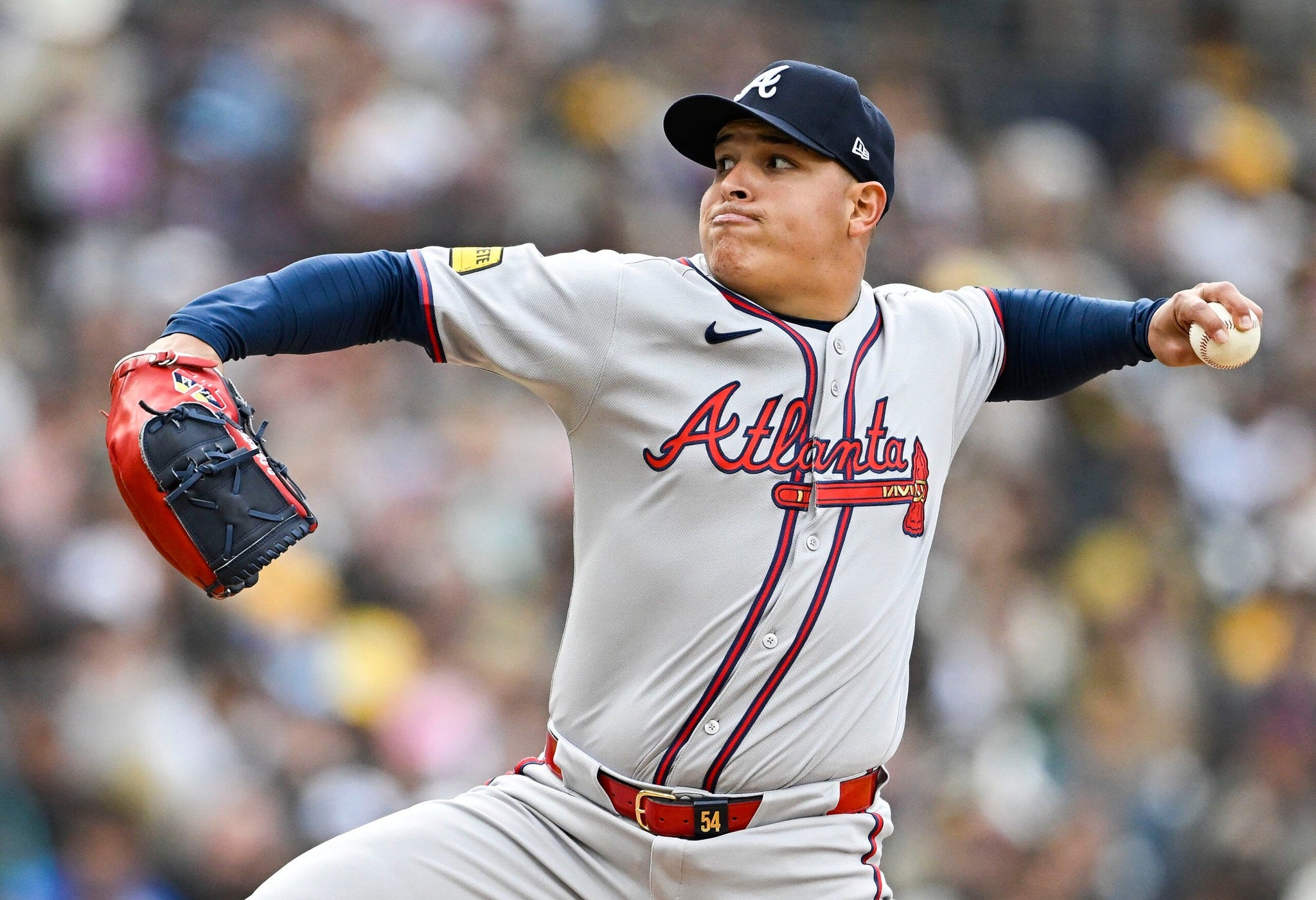
It’s funny where inspiration for a story comes from.
On Sunday night, I asked Atlanta Braves President of Baseball Operations Alex Anthopoulos about why the Braves aren’t more aggressive with using starting pitching prospects in the bullpen.
It’s long been a pet peeve of mine - the bullpen would be a great way for them to acclimate to facing major league hitters, and Max Fried has discussed how it helped him learn to attack big leaguers and trust his stuff. Why don’t the Braves do it more?
Turns out, AA agrees with me on it being a great idea and would also like to see the organization do it more, it’s just hard for a pitching prospect to get enough bullpen innings in any given week or month for it to be useful. They’d rather see that same prospect make scheduled starts every single week in Triple-A and be guaranteed a 100-pitch workload over short outings here and there as the MLB schedule and game situations dictate.1
But in the course of answering my question, Anthopoulos said something else that piqued my interest. Let’s talk about the “Swiss Army Knife” pitcher and Atlanta’s embrace of them.
Get you a man that can do both
Anthopoulos talked on Sunday night about being impressed with what Grant Holmes did once he moved into the rotation as a full-time starter in 2025. Holmes struck out 123 in his 115 innings, finishing with a 3.99 ERA before a partial UCL tear ultimately ended his season. He overperformed his peripherals, sure - a 4.40 FIP/4.52 xERA, a 10.1% barrel rate, and an 11% walk rate - but for having not been a starter since 2019, it was impressive work.
But as valuable as that production was from someone making league minimum, I’m much more impressed with his 2024 season. Just like New York’s hottest club, he did some of everything in his 68.1 innings: seven starts, 13 multi-inning appearances, and he finished seven games. He finished with a 3.56 ERA/3.20 FIP/3.46 xERA and 70 strikeouts to 15 walks, a 19.5% K-BB ratio.
It was actually more valuable by fWAR (1.2) than his 2025 campaign, one that delivered 115 innings of 3.99 ERA/.4.40 FIP/4.52 xERA ball and came out to just 0.9 fWAR.2
And it went so well in 2024 that the Braves are set to potentially run it back three different ways this season.
Let’s talk about swingmen
To be clear, every team has someone like this - they get the ball in a blowout, or if a starter takes a line drive off the thigh and has to come out early. They might even start if, say, Spencer Strider strains a hamstring during pregame warmups.
But the Braves are set to not only embrace it next season, but to take it to the extreme.
Assuming no other additions this winter (which is absolutely NOT a guarantee - Anthopoulos said yesterday he was looking for “impact” from their potential addition), Atlanta’s final starter is likely either Bryce Elder or youngster Hurston Waldrep. For the sake of this article, let’s assume Elder finally starts throwing the cutter I’ve been asking him to throw for the last two seasons and parleys that newfound weapon into the final rotation spot, meaning Waldrep starts the season in Gwinnett to preserve as much depth as possible.

That means your rotation is this:
Chris Sale
Spencer Strider
Spencer Schwellenbach
Reynaldo López
Bryce Elder
And the trio of Grant Holmes, Joey Wentz, and José Suarez are all in the bullpen.
And that’s right up Jeremy Hefner’s alley.
Let’s talk about the 2024 Mets
I know, 2025 is his most recent season, but their pitching injuries last year were so absurd that it’s hard to judge him by what they did this season. Let’s look at a season where almost everything went right for the Mets, up until a NLCS trip where they were obliterated by a fully armed and operational Los Angeles Dodgers Death Star.
The Mets used just 35 pitchers that season, with only twelve different starters despite injuries to Kodai Senga and Paul Blackburn.
But one of the most impressive arms outside of the usual suspects (closer Edwin Díaz, starters Sean Manaea and Luis Severino) was swingman José Buttó. He covered 74 innings for New York in only 30 games, making seven starts and not only finishing five contests, but picking up three saves in the process.
Hefner identified his potential early in spring training, telling The Athletic’s Tim Britton, “he’s really turned into a monster on the mound and an aggressive, come-at-you, want-to-get-you-out type of guy” early in Grapefruit League action.
Armed with two fastballs (four-seamer and sinker) and two sliders (sweeper and gyro) backed by a running changeup, coming at batters is exactly what he did. Buttó sported a career-high first pitch strike percentage of 61.0% and once he was ahead in the count, he mostly stayed out of the zone. He threw balls over the plate just 36.9% of the time, instead forcing batters to cover the edge and outside. It led to a career-high 32% whiff rate despite roughly pedestrian stuff - nothing in Buttó’s arsenal graded out as even average from a Stuff+ perspective except his 94.2 mph four-seamer.
How does that translate to Atlanta?
We already know what Grant Holmes can do as a “utility pitcher”, but let’s talk about Wentz and Suárez.
Joey Wentz, the team’s first-round pick in 2016, returned to the Braves when he was waived by the Minnesota Twins, which came exactly a month after they claimed him off waivers from the Pittsburgh Pirates.
Atlanta promptly threw the reliever back into the rotation for the first time since 2023, sending him out thirteen times. Despite a pedestrian 4.92 ERA, the underlying numbers were much better (3.43 FIP, 4.25 xERA) thanks to Atlanta’s push of his seldom-used slider into a prominent role in the arsenal.3
On the season, Wentz pitched in 39 games, starting 13 and finishing nine others. While with the Braves, he struck out 23% of opposing hitters. He twice pitched into the seventh inning for the Braves, both times allowing just one run while striking out five.
Suárez didn’t get a lot of run at the major league level for the Braves last year, pitching just 19.1 innings across multiple stints, but he came up late in the year from Gwinnett for an impressive spot start - seven+ innings against Washington in game one of a doubleheader on the road, allowing just two runs on six hits with two walks and nine strikeouts. He threw 99 pitches (65 for strikes) and finished with 21 whiffs and a 36% CSW.
He sports a five-pitch package, as well, throwing both a four-seamer and a sinker and using a changeup and two breaking pitches, a slider and the occasional curveball. He’s a kitchen sink against fellow lefties, throwing everything, while righties see predominantly four-seam/changeup with the occasional slider as a tendency breaker.
He took the ball twenty times total between Atlanta and Gwinnett, giving the organization 81 total innings and working in every role from starter (12 total) to multi-inning reliever and even finishing an extra-inning win in Philadelphia in early April.
Put them together and what have you got?
A versatile bullpen, that’s what.
Assuming no further additions, which feels really unlikely when you consider that Anthopoulos said that they are not planning on the injured Joe Jiménez “being someone we can count on for the eighth inning”, the bullpen is set up to have a lot of flexibility and versatility. Let’s go through the options as they stand on Tuesday morning:
Closer: Raisel Iglesias - this one’s easy. Assuming no small sample size slider shenanigans again, I expect him to be a lot closer to the 2024 form that he found down the stretch last year.
Setup: Dylan Lee (L), Joel Payamps (R) - this is where I’d expect an addition, as Payamps had good stuff (103 Stuff+) and adjusted stats (4.32 FIP) but terrible results (8.20 ERA). Being able to add someone right-handed with closer experience right here (Pete Fairbanks? Kyle Finnegan?) would do a lot to lengthen the pen.
Middle relief: Dylan Dodd (L), Aaron Bummer (L) - I’m not totally thrilled with the value-to-results on Bummer and his $9.5M salary for 2026, but he’s been elite at generating groundballs and if he regains some of the lost fastball velocity (career-low 90.8 sinker/91.6 four-seamer), he could get back to his dominant funky lefty self. Dodd, despite being a recently converted starter, is typically deployed for single innings but has the capability to turn over a lineup if needed.
Utility Pitchers: Grant Holmes, Joey Wentz (L), José Suarez (L) - Anthopoulos pointed out at the end of Sunday’s conversation that this trio was “too talented” to expose to waivers, so look for them to either make the bullpen or be packaged in a minor trade at the end of camp. I’d stack rank them as Holmes, Wentz, Suarez, although those last two are interchangeable.
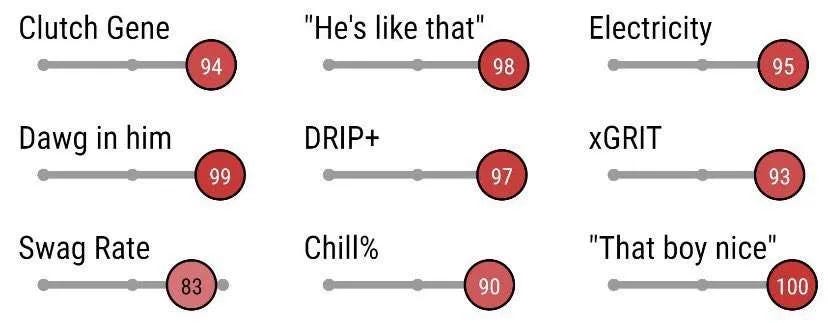
When looking at the highest and best use of each guy, I think Holmes can absolutely function as a setup man if the team needed him to do that, with his edge in “xGRIT” and “Dawg in him” counteracting any sort of Stuff+ edge he’s sacrificing to Suarez or Wentz.
I’d probably use Suarez as the main multi-inning guy, owing to his wide arsenal, with Wentz having the most experience as a starter in the majors and being able to step into a spot start if Holmes were unavailable or otherwise needed in the back end.
The way that Jeremy Hefner uses this bullpen in 2026 will be fascinating.
(Programming note: We’ve got a draft lottery recap piece coming Wednesday morning, but since the Braves have no open 40-man spots available, they won’t be able to participate in the Rule 5 draft on Wednesday afternoon, barring some sort of roster move today. I’m still debating on whether I should write up and publish my shopping list of who I’d take - let me know if you’d still like to read that and I can drop a second piece on Wednesday morning.)
BONUS: Adding more ‘Swiss Army knives’
The Braves are potentially going to sign another reliever, depending on both the availability of Jiménez and their ability to move Bummer’s salary in a trade. What if they went for broke and decided to build the whole plane out of utility pitchers?
Here’s a non-comprehensive list of some of the most qualified swingmen on the free agent market this winter:
Nick Martinez (Reds): While the traditional results (4.45 ERA) weren’t amazing, Martinez had good expected stats (3.97 xERA) while providing a starter’s workload with 165.2 innings over 40 appearances (26 starts). He throws six pitches, including all three fastballs, and excelled at preventing hard contact (90th percentile Hard-Hit rate of 34.5%, 74th percentile barrel rate of 6.9%). It’s a below-average arsenal from a Stuff+ perspective, but that’s why you throw all three fastballs, folks.
Michael Soroka (Nationals/Cubs): Former Braves Opening Day starter “Maple Maddux” has been attempting to reestablish himself as a major league starter after three Achilles surgeries, but his loss could be your bullpen’s gain. He excelled as a reliever late in the 2024 season for the White Sox after returning from a biceps strain and parlayed that into a deal with the Nationals to start for them last year. After underperforming in the rotation again, he was dealt to the Cubs at the deadline and immediately shoved out of the pen yet again before being felled by a shoulder strain. This is probably his last chance to make it as a starter in MLB, but the fallback of a 4S/slurve reliever is alluring.
UPDATE: Soroka signed with the Diamondbacks on a one-year, $7.5M deal on Monday morning.
Brad Keller (Cubs): While he’s expected to be a straight rotation conversion, like Holmes4 was in 2025, there’s still something here to the idea of using him as a swingman. As we’ve discussed in the context of Reynaldo López before, relievers moving back to starting are typically capped at around 110 to 130 innings in their first season. I could see a team that is expecting some arms back from injury around midseason and/or some prospects to force their way into the picture signing him as a starter and then transitioning him to the pen in the back half of the schedule. His 633.2 rotation innings from 2018-2022 were 30th in all of baseball during that span, so it feels like it’s simply a matter of stacking workload and getting him reacclimated to the demands of taking the ball every fifth day.
The exact quote was “In the minor leagues, you stick to these guys in the rotation from a development standpoint, right? Even though you ultimately might believe that they’re relievers, you want them to get as many reps as they can, as many innings as they can have, bullpens, side work, go deep into the games. You have a guy in the minors who’s a one-inning reliever, you might have a 10-pitch inning and not really get to work on things.”
Tremendous value for a salary of $740,000, as well as FAR better than any of us could do.
This was called a cutter at the time, but Wentz later clarified in clubhouse media that it’s technically his slider that he’s throwing more. You don’t understand how much it pains me to make this distinction.
Grant or Clay, take your pick.
I thought by now there would be more Andrew Miller 2016 Indians/Guardians type guys in MLB; highly skilled pitchers you can use for 2-3 innings in the middle innings if/when the game is still on the line.
If the rational for guys with great stuff not starting is they do not have either the stamina or pitch variety to survive the second time through the order, there still can be a valuable place for them for 2-3 innings in the middle, especially since starters only go 5 or 6 innings now.
I THINK the Braves now pick 9th, 26th , and 49th. Its 6:34pm Tuesday after the Lottery.
I read somewhere the Braves could have fallen to 15th !!!!
So now i'm not so mad they fell to 9th.