


The thing they don’t tell you about being a member of the media is all of the random emails you’ll get.
I’m on multiple mailing lists, including several that have nothing to do with baseball - I, for some reason, keep getting emails about Gibson Guitars and about traffic stats for the state of Alabama, where I live.
But I’m also on a mailing list from a prominent sportsbook, and they sent out preliminary MLB award odds on Tuesday.
It’s a relevant email for Braves Today, as the Atlanta Braves have pretty consistently been in the mix for postseason awards in the last few seasons. They have a recent MVP selection, with Ronald Acuña Jr. taking the award in 2023, as well as a Cy Young (Chris Sale) in 2024 and multiple Silver Sluggers and Gold Gloves in the last few seasons.
They’re also very prolific in the Rookie of the Year voting. The Braves have won three of the last eight in the National League, the most by any team during that span. Drake Baldwin took the most recent in 2025, following the legacy set by Michael Harris II (2022) and Ronald Acuña Jr. (2018). Atlanta’s also had several finalists for the award, including runner-up Spencer Strider in 2022, runner-up Michael Soroka in 2019, and vote-getter Ian Anderson in 2020.
Unfortunately, this season is the first in a while where the Braves don’t have anyone listed as a Rookie of the Year candidate on the opening boards, and it’s an interesting glimpse into Atlanta’s roster construction heading into 2026. Let’s talk about it.
There’s not much runway here
Something that I’ve been discussing for a few years now is how hard it is for a contending team to break a rookie into their lineup, and this upcoming season (at least, before the inevitable injuries change things) is a perfect example of that.
Look at Atlanta’s offseason - they added a veteran outfield bat to be a platoon/fourth outfielder, as well as signing two veteran relievers to fortify the back end of their bullpen. They also brought in a shortstop, traded for a veteran utilityman, and set up a position battle for the 26th spot on the roster between two late-20s infielders in Vidal Bruján and Brett Wisely.
This is clearly a team built to contend in 2026 - they were one of the ten oldest teams in baseball last season and replaced several young injury replacements with veterans for next year, likely pushing that average age up.1 Despite the injuries, Atlanta never went full ‘youth movement’ - per Baseball Reference, the Braves gave just five players their debut last season, with all but reigning Rookie of the Year Drake Baldwin being late-season injury replacements in the pitching staff. Those four promoted arms, Nathan Wiles, Rolddy Muñoz, Didier Fuentes, and Hayden Harris, combined for just 20.1 innings.
By contrast, only two teams, the New York Yankees and Philadelphia Phillies, had fewer debutants than Atlanta last year, four each. Coincidentally, those two usually rank among the oldest teams in baseball thanks to the long-term contracts for their superstars. Philadelphia was the only team with an average age greater than 30 for both its hitters and pitchers, led by the 2nd-oldest position player group in MLB. The Yankees, for the sake of comparison, had the 6th-oldest pitching staff and a relatively young collection of bats at ‘only’ 9th-oldest.
And there’s an obvious explanation for contenders relying less on prospects and youth: When a team is positioned for a deep playoff run, it’s harder to accept below-average production from a prospect that’s acclimating to the majors. Braves legend and MLB Hall of Famer Tom Glavine frequently talks about this, pointing out how he and fellow Hall of Famer John Smoltz learned on the job with Atlanta. In 1988, the duo combined to go 9-24, each having ERAs over 4.50, before settling into everyday rotation spots and winning a combined 26 games the very next season.
The difference here is that the 1988 Atlanta Braves went 54-106, finishing in 6th-place in the NL West. They weren’t expected to be competitive that season, although those low expectations didn’t save manager Chuck Tanner’s job, as he was fired after a 12-27 start.
The 2026 Atlanta Braves expect to not only be solidly in the playoffs, but they also intend to compete for the NL East title and push for the World Series.
And the available playing time reflects those lofty goals.
There are relatively few position battles
As we sit here on December 31st, there’s maybe…three position battles projected for spring training: The 5th starter, the 13th position player spot on the bench, and the 4th high-leverage reliever spot.
And none of those battles have prospects that will factor into them. Recently graduated Hurston Waldrep is a fringe candidate for the final rotation spot, but with both Grant Holmes and Bryce Elder out of options, the optionable Waldrep is likely destined for starting the season in Triple-A Gwinnett to preserve the team’s depth for the grueling regular season. Veteran reliever Joel Payamps has the inside track on the 4th high-leverage spot, pending a positive medical result from setup man Joe Jiménez. And that final bench spot is likely down to Vidal Bruján and Brett Wisely, as also-graduated Nacho Alvarez, like Waldrep, is optionable and likely starts the season in Gwinnett.
So, when you look at the ROTY board for the National League…yeah, it makes sense that there’s no Braves on there.
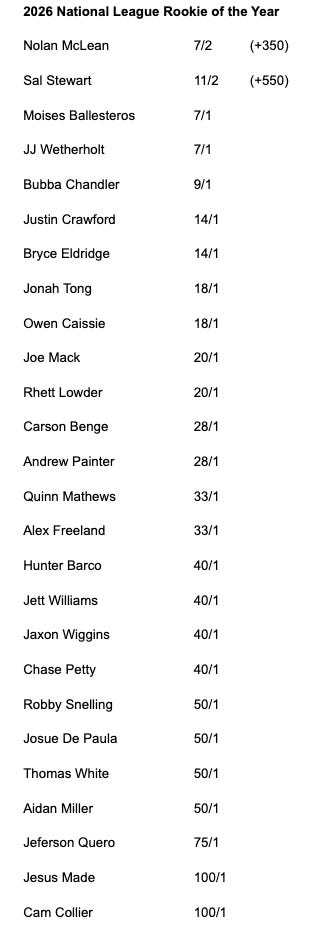
Most of the high-minors prospects in this pitching-heavy farm system don’t have a path to playing time without multiple injuries ahead of them. But if anyone were to debut midseason and push for the Rookie of the Year, who would it be?
Spoiler: They’re all arms
Atlanta’s upper-level position player depth is virtually nil, with no significant offensive prospects to speak of. Gwinnett’s roster only lists twelve position players, five of them being catchers, with at least five of them joining the organization this winter.
So let’s look at the pitchers. Since it’s virtually impossible for a reliever to win Rookie of the Year - the last time a bullpen arm finished in the top three in a non-shortened season2 was Dellin Betances’ third-place finish in 2014 - we’re likely talking about a starter here. There are several that could be called on to reinforce the major league rotation if injuries strike.

J.R. Ritchie
Atlanta’s top upper-minors prospect, Ritchie pitched in three levels of the system last year, finishing 2025 with eleven starts in Gwinnett. He had a 2.64 ERA for the season, pitching to a more-than-respectable 3.02 in Gwinnett with just over one strikeout per inning and a 1.089 WHIP.
In Gwinnett, Ritchie threw six distinct pitches, leading with a 93.4 mph sinker and butressing with four different ancillary options all thrown between 12% & 15% of the time - a curveball at 81.5, a slider at 82.4, a changeup at 86, and a four-seamer at 93.5. He rounds out the package with a high-80s cutter, thrown around 8% of the time. Against lefties, he leads with changeup/sinker/curveball, scrapping the slider, while righties rarely see a cutter or a changeup but see twice as many sliders as any other breaking pitch.
But again, despite the Jeremy Hefner-favored wide arsenal, the lack of available playing time stands in Ritchie’s way. Atlanta has at least three candidates in Elder, Holmes, and Waldrep for that final rotation spot, with out-of-options relievers Joey Wentz and José Suarez relegated to the pen but with recent starting experience as well. Additionally, Ritchie’s not on the 40-man roster, necessitating an additional transaction (and potentially losing someone else) to make him promotable.
Barring a surprise early-season promotion and some Cade Horton-like protection, Ritchie’s not likely to win the award.
Didier Fuentes
That sound you hear is MLB.com’s Mark Bowman laughing, but hear me out.
Fuentes has exceptional stuff, with the FanGraphs Stuff+ model giving all four of his pitches grades of at least 105 or better…he just doesn’t really know where it’s going. As a 20-year-old, the flamethrower walked six batters in thirteen innings in the bigs. It’s important to point out, however, that his minor league walk numbers were much more respectable, at 16 walks in 57 innings and 238 batters faced (2.53 BB/9).
As I mentioned above, the stuff’s excellent, with Fuentes’ 95-mph four-seamer backed by a low-80s sweeper, a high-70s curveball, and a high-80s splitter with exceptional late break. He clearly wasn’t ready for his debut last season, but with another offseason to work and the sheer quality of his stuff, I don’t think you can count out a hot run out of the youngster if he gets the call and hits the ground running.
Other candidates
Those are really the top two options for a ROTY campaign for Atlanta next year, but I’ll throw out some dark horses in Blake Burkhalter and Luke Sinnard. Burkhalter’s role is a bit more questionable, as I don’t know if he’ll stick as a starter long-term, but he’s got the mentality to attack big leaguers from day one. Sinnard’s successfully returned from Tommy John surgery to flash above-average stuff last year, impressing with his five-pitch arsenal this season in the Arizona Fall League and making the circuit’s “Fall Stars” Game.
READ MORE: Luke Sinnard’s Fall Stars Nod is the Capstone On a Resurgent Season

The Braves are notorious for fast-tracking prospects that they feel are more advanced than their current level would dictate, and so there’s a possibility he makes the majors sooner rather than later if his three fastball + slider and splitter combo continues to flash early in the minor league season.
The caveat here is that being old isn’t necessarily bad - the Dodgers were the oldest and have won two consecutive World Series titles - it’s moreso not being young that we’re looking at here.
Devin Williams won it in 2020 with 27.0 innings over two infielders, Alec Bohm and Jake Cronenworth
Happy New Year to all the Braves Today family.
January 15 is approaching. I'm very optimistic. They've shown much more interest in the Latin pitching market. This year's headliner is a Dominican shortstop, and a Cuban pitcher.
And they've started drafting lefthanders and hitters.
The farm system needs power hitting outfielders. more than anything for the Draft.
I still think Owen Murphy will be in the Rotation by '27.