


It feels like the 2026 Atlanta Braves roster is nearly complete.
To date, the team’s signed a shortstop in Ha-Seong Kim, a platoon outfielder in Mike Yastrzemski, brought back their closer in Raisel Iglesias, supplemented that signing with another closer in Robert Suarez, and traded for one of the league’s best utilitymen in Mauricio Dubón.
Atlanta’s cash payroll at the moment comes out to about $261M for 2026, more than $47M higher than last year. Looking at the Competitive Balance Tax payroll figure, which is calculated on annual contract figures rather than actual yearly cash, Atlanta’s solidly over the first tax threshold of $244M at a projected $255.741M.
In recent seasons, the team has limited itself to staying under the third CBT tier, which this year begins at $284M. Per President of Baseball Operations Alex Anthopoulos, the escalating penalties of breaking that third tier, which include draft pick implications, are a bridge too far for the team. “If you have these teams that are well over, you’re losing draft position and things like that. There’s a real opportunity cost there. The opportunity cost [for us] is dollars. It’s not, in my view, the same as moving back in the draft and things like that.”
So, if the third tier is $284M but the team’s only projected for just under $256M of spending right now, what are the plans for that available $28M? We likely won’t know until spring training. Let’s talk about it.
They always save money for the deadline
Atlanta is typically one of the more aggressive teams at adding reinforcements at the trade deadline, albeit with role players rather than superstars on expiring deals.
Here’s a look at Atlanta’s trade deadline adds in the last few competitive seasons:
2024: OF Jorge Soler, RHP Luke Jackson = $4.5M
2023: LHP Brad Hand, INF Nicky Lopez, RHP Pierce Johnson = $3.7M
2022: RHPs Raisel Iglesias & Jake Odorizzi, OF Robbie Grossman, INF Ehire Adrianza = $12.034M
2021: OFs Jorge Soler, Adam Duvall, Joc Pederson, Eddie Rosario, RHP Richard Rodríguez, C Stephen Vogt = $9.884M
On the high end, it’s more than $10M in spending, but recently the Braves have spent $5M or so. It’s important to point out that both in 2023 and 2024, Anthopoulos alluded to deals they attempted and failed to get done, so it’s likely that they would have spent closer to that standard $10M had they found a ‘dance partner’.
So, let’s subtract $10M and assume Atlanta’s left with about $18M at the most for this winter. What are they going to spend it on?
They’re trying to get a starter
Reports from Ken Rosental of The Athletic are that the Braves are one of five teams interested in Milwaukee Brewers starter Freddy Peralta, which makes a ton of sense: His 2026 salary is only $8M and even if he hits all the reachable escalators (for a Cy Young win, All-Star, and Gold Glove), he’d max out at just $8.725M.1
You see how this makes sense, right? Adding an “impact starter”, as Anthopoulos has termed it, for only $8M would give Atlanta one of the best rotations in all of baseball while keeping them both under the CBT tier and with their ‘contingency fund’ available for the trade deadline.
If you want more info on who Peralta is as a pitcher, what his addition would do to the rotation (and bullpen), and what a potential deal might require to get done, we broke it all down on Tuesday’s episode of the Braves Today podcast.
If Atlanta is unable to trade for Peralta or one of the other cost-controlled starters on the market, like Miami’s Edward Cabrera, Washington’s MacKenzie Gore, or Minnesota’s Joe Ryan, it’s a lot harder to fit someone who is an “impact starter” into this available payroll space.
Here’s a list of every free agent starting pitcher that signed for $18M or less this winter:
Dustin May (Boston to St. Louis) = $12.5M
Cody Ponce (KBO to Toronto) = $11M
Adrian Houser (Tampa Bay to San Fran) = $11M
Brad Keller (Chicago Cubs to Philly) = $11M
Tyler Mahle (Texas to San Fran) = $10M
Zach Eflin (re-signed with Baltimore) = $10M
Steven Matz (Boston to Tampa Bay) = $7.5M
Drew Anderson (KBO to Detroit) = $7M
None of those pitchers is pushing down any of Atlanta’s top four options in the Opening Day rotation.
That’s not saying a starter is impossible to acquire this winter; it’ll just require a trade win. Alex Anthopoulos will need to either get the other team to keep some money owed to a player like Pablo Lopez ($21.5M) or shed an excess salary like Aaron Bummer ($9.5M) in the deal.2
But when the team does finally make another financial move, there’s likely to be something that spurs them to act.
Waiting on medical reports
The two biggest outstanding questions around player availability are not starting pitchers, believe it or not; AA told us last month that “on paper, right now we’re in pretty good shape” thanks to the outstanding medical reports they’ve received on Grant Holmes (UCL), Reynaldo López (shoulder surgery), and Spencer Schwellenbach (broken elbow).
No, the only significant injury concerns we’re aware of at the moment belong to catcher Sean Murphy and reliever Joe Jiménez.
Confirming our reporting from September, Anthopoulos admitted to MLB Network Radio last month that Sean Murphy’s return to play date after his hip surgery might extend into the regular season. The plan is to re-evaluate Murphy soon before spring training, which begins earlier this season in deference to players' World Baseball Classic obligations.
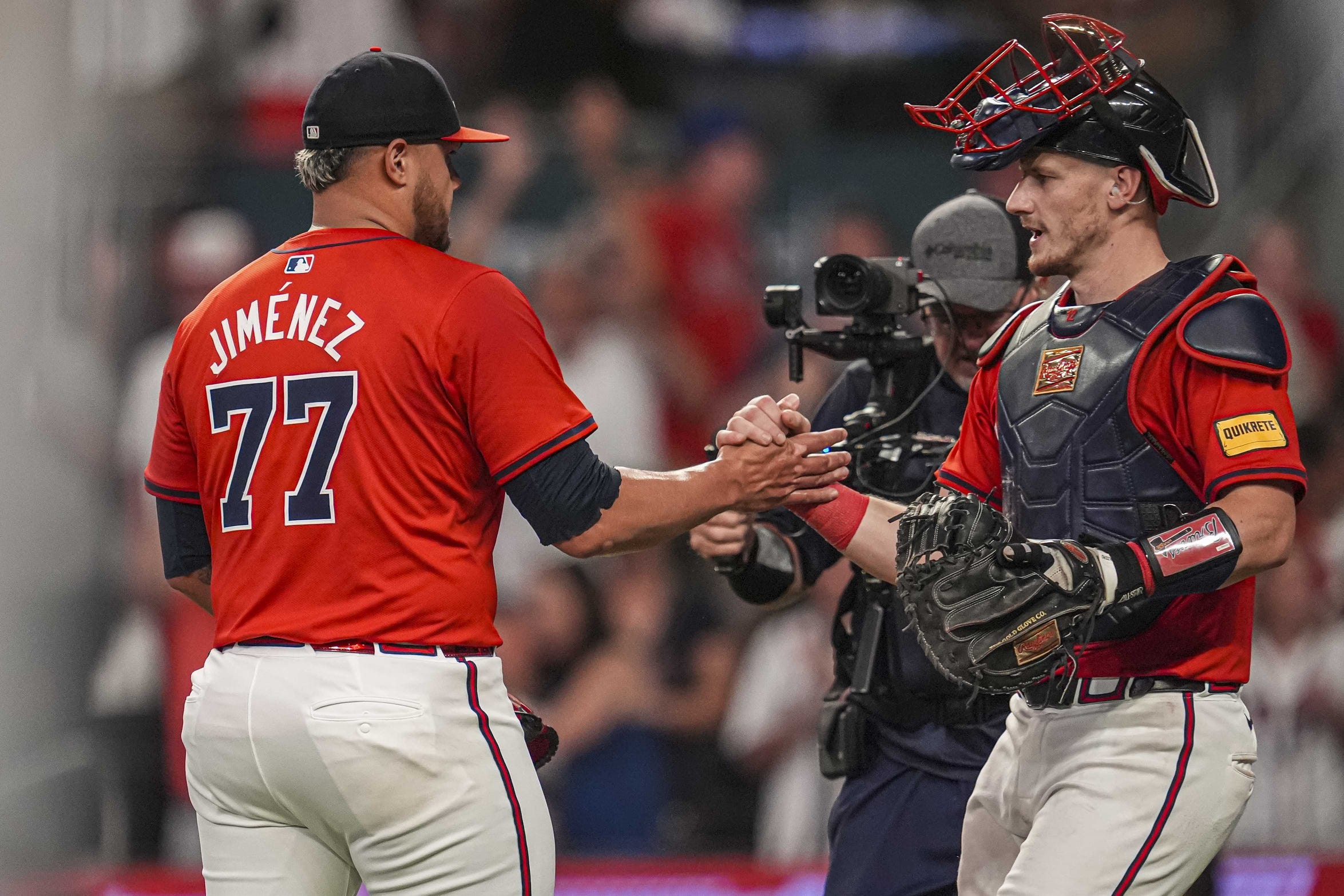
Anthopoulos has been more direct on Jiménez, who missed all of 2025 after tearing cartilage in his knee late in the 2024 season and then re-aggravating the injury last year. Jiménez has had a second surgery, one AA termed a ‘clean-up’ procedure, and will also be re-evaluated once pitchers and catchers begin reporting to North Port early in February. But until that happens, Jimenez is “not someone we’re counting on” to take leverage innings for the club in 2026, per Anthopoulos.
And that’s where I think the money might go. It feels increasingly likely that the team is looking to see if they can make any no-brainer adds (like a playoff-caliber starter for only $8M in Freddy Peralta) and if that doesn’t work out, sitting tight until they find out about the status of Jiménez and Murphy for Opening Day.
If they’re both available, then the Braves roll right into North Port and get to work. But if one or both will be out for an extended absence, Atlanta has work to do.
Another signing is likely needed
If Drake Baldwin is the starter for a few weeks of the regular season while Murphy’s on the mend, I don’t think there’s any significant impact on the 2026 roster. Baldwin can play five or so days a week for a month without any sort of negative impacts from overuse.
But if Murphy’s absence stretches to the five or six week mark, that’s where I think the team may begin to get antsy with their roster. Behind Baldwin, Atlanta’s current catcher depth chart consists entirely of non-40-man guys:
Chadwick Tromp
Sandy Leon
Adam Zebrowski
Tyler Tolve
Austin Machado
Of the quintet, only Tromp and Léon have appeared in the majors but profile as third catchers, at best. Atlanta tried to rectify this early in the offseason, signing veteran Austin Nola to a minor-league deal, but he was released from the deal to go become the new bullpen coach for the Seattle Mariners.
It’s likely the Braves would mine the list of veteran backup catchers in free agency, grabbing someone like Elias Diaz, Victor Caratini, or Austin Barnes on a minor league deal to provide high-quality depth to Baldwin until Murphy returned.
Similarly, a negative health report on Jiménez would likely spur the Braves to look for one more leverage reliever for the pen. As we broke down at length on Monday, there are a lot of unknowns in the middle innings for Atlanta, and while Grant Holmes is a flexible piece that can go a long way to answering those questions, it’s still a risk not to reinforce the pen with one more leverage arm. While a lot of the top relievers with closing-caliber stuff have signed, there should be some valuable depth available on league minimum or minor league deals as bullpen arms scramble to find a home when pitchers and catchers are starting to report.
So while the Braves have spent a lot of money relatively quickly this winter, there might be a delay before the last little bit heads out the door.
This figure includes $50k each for WS MVP, LCS MVP, Comeback POY, Silver Slugger, and Reliever of the Year…but I don’t think those last three are in the cards.
Unless AA’s comfortable just…having less money available for the deadline, but he’s been reluctant to paint himself in a corner financially since taking over the Braves
One other question/comment here I had while listening to the pod. I thought it was helpful and informative to look at the trade deadline dollars the way you did but if you expand that out to “in season ads” the waiver claims etc etc do the dollars for the past few seasons get substantially larger or mostly stay the same?
Caratini started as a Brave. I believe he's a switch hitter. Still young. I think. Surprised to hear he's a Free Agent.