


(Now that the holidays are over, we’re back on the grind, and my plans are to write four to five deep-dives a week from now through the end of the season, barring small breaks during All-Star Week for a family vacation and as travel requires. As always, let me know if you have a specific topic you’d like to see covered in a future newsletter.)
In retrospect, last offseason’s approach of “quantity over quality” for the Atlanta Braves for their bullpen didn’t exactly work as planned.
Atlanta added fifteen relievers last winter to minor league or non-guaranteed deals, and exactly zero of them made it to game 162. The odds of that happening were slim, as Atlanta gave opportunities to some accomplished relievers like Héctor Neris (107 saves and a career 3.33 ERA/126 ERA+ prior to last season) and Buck Farmer (who was coming off a three-run run with the Cincinnati Reds of a 3.68 ERA/122 ERA+ prior to the signing).
But the issue there wasn’t that they gave multiple marginal relievers a chance to capture a bullpen spot and some leverage innings…it was the fact that they didn’t do anything but sign some marginal relievers. From the 2024 bullpen, Atlanta lost A.J. Minter (free agency), Joe Jiménez (injury), Grant Holmes (rotation), and Jesse Chavez (old). Several of the ‘buy-low’ relievers would have needed to hit to replace all of the lost production (201 innings), and obviously, none of them did. Atlanta’s 2024 bullpen had the 3rd-best ERA in baseball at 3.32, while last season it regressed to 4.19, 19th in baseball.
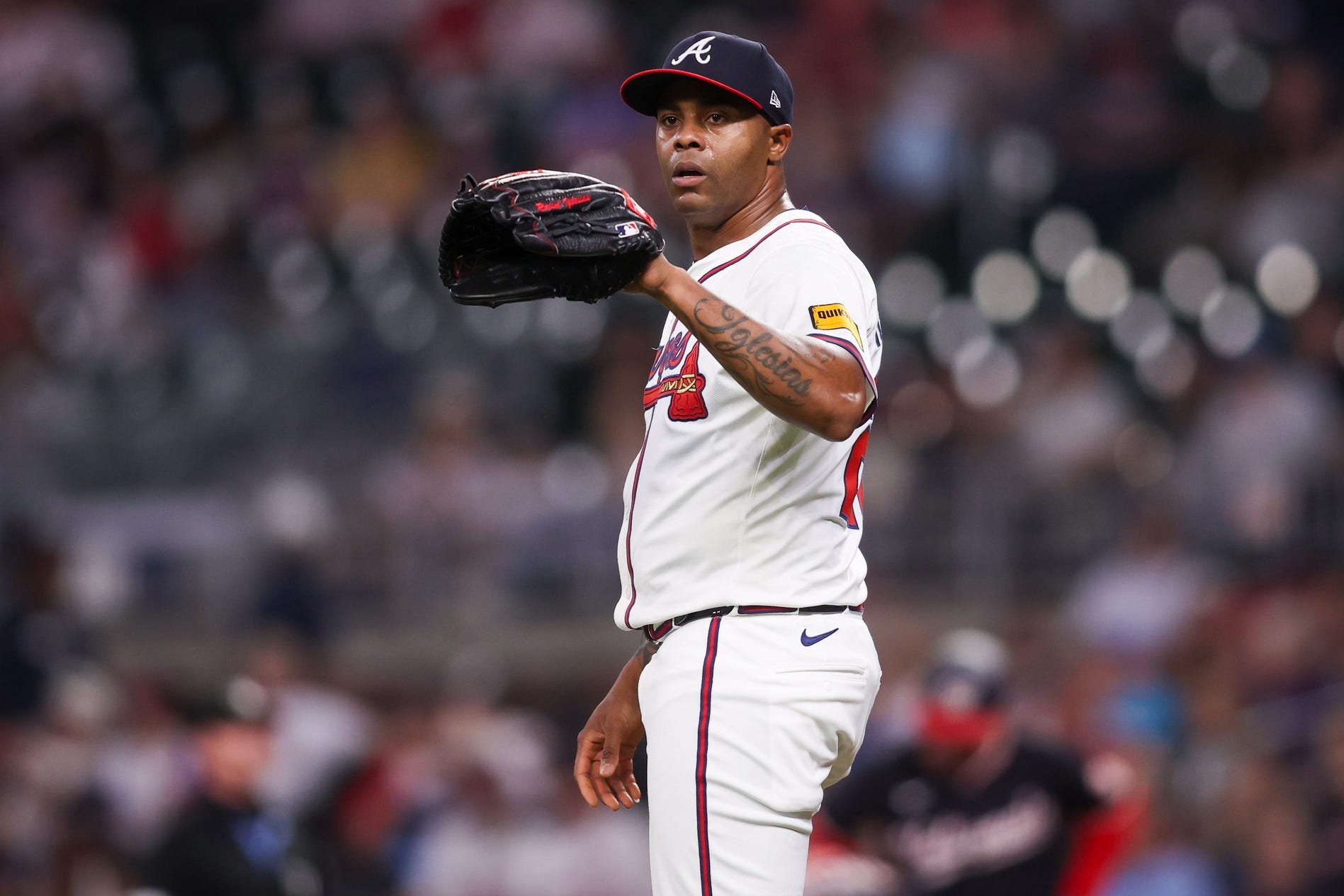
But now that the Braves have brought back Raisel Iglesias and signed fellow four-seamer/sinker/changeup closer Robert Suarez, have they fixed their late-inning woes, or is one more move needed? Let’s look at the state of the bullpen as of today and figure out who pitches where and if it’s good enough, or if one more signing is needed.
The current depth chart
The Braves technically have a depth chart available on their website, but as I’ve been told, it’s best not to rely on that as any sort of gospel. For instance, Nacho Alvarez Jr. is still listed as the starter at third base while Austin Riley is currently THIRD at the hot corner. I, uh, think Riley has a pretty good chance of winning the starting job next year.
Instead, let’s make our own. We’ll designate a closer, two set-up men, and delineate everyone else as either a middle reliever (which isn’t derogatory - plenty of leverage opportunities can come up in the middle innings) or a long man. We’ll start with eight spots and discuss the questions/battles as they come up.
As locked in as you can reasonably be
Closer: Raisel Iglesias
Set-up (R): Robert Suarez
Set-up (L): Dylan Lee
Barring health, this feels as locked in as you’re going to see from any team this winter. The Braves and Suarez both confirmed that he’d work as the setup man and backup closer after the former San Diego Padres reliever signed back in November, ostensibly being promoted to the closer for 2027 after Iglesias’ one-year pact is up. His contract reflects this, too, with his $13M salary for 2026 escalating to $16M for each of 2027 & 2028.
Dylan Lee is back as one of MLB’s most underrated whiff merchants, one of the only non-closers to be in the 95th or better percentile for Whiff percentage in both of the last two seasons. In that same group, Lee’s also had the best walk rate, although he struggled with homers late last year in a bit of bad luck I expect to regress to the mean next year.
After that, there’s a need for two more leverage relievers, but there are some incumbents for the roles that will get the first shots at proving their worth.
We’ve got favorites, but someone can surprise
Middle Relief (R): Joel Payamps
Middle Relief (L): Aaron Bummer
Casual fans are going to see their ERAs1 and hate this section of the newsletter, but y’all know ball and understand it’s about stuff and potential, not small-sample-size flukiness.
Payamps had a two-year average with Milwaukee of a 2.78 ERA/153 ERA+ entering last season, but was designated for assignment after a rough 7.23 ERA early in the year. There are two potential excuses, both of which I broke down in depth back in mid-December: bad luck and small-sample-size shenanigans.
With Joel Payamps Back, Can the Braves Afford to Pass on One More High-Leverage Reliever?

The common calculus for the back of Atlanta’s bullpen is that the Braves have a two-headed, changeup-driven monster for the late innings in returner Raisel Iglesias and free agent signing Robert Suarez. Those two will be backstopped by lefty Dylan Lee
Bummer’s a bit more of a concern, as he saw his velocity plummet nearly 2 mph before going on the injured list late in the year with left shoulder inflammation. Assuming that both he and his stuff is back (which isn’t guaranteed, obviously), he’d bring back some of the best raw stuff (as measured by Stuff+) and a propensity for ground balls into a 4th or 5th leverage role.
But there are other options here, as well. Atlanta signed former Cleveland Guardians ace reliever James Karinchak to a minor league deal last month, as well as giving non-guaranteed money to former New York Yankees righty Ian Hamilton. We know that Karinchak’s stuff is the closest to being back that it’s been since 2023, while Ian Hamilton feels like a very obvious Braves relief acquisition of previous seasons.
Like Pierce Johnson and Tyler Kinley before him, Hamilton has struggled due to an over-reliance on mediocre fastballs over a dynamic breaking ball - for him, a slider - that frequently sports whiff rates over 40%. While I don’t expect Hamilton to become a Johnson-style >70% breaking pitch guy, more variance between the fastballs (as well as maybe adding a cutter) and pushing the slider over 50% usage feels like an obvious way to get him closer to his earlier Yankees performance.2
Other candidates for middle-relief/backup leverage: Dylan Dodd (L), Daysbel Hernández, Hunter Stratton
Atlanta has several other options for roles on Opening Day. Dodd’s a former starter that has seen success in the bullpen thanks to his embrace of a cutter as his primary fastball.3 Hernández is a flamethrowing Big Boi4 out of Cuba that ended last season on the injured list with a shoulder ailment, but has the raw tools to be a closer one day if he can dial in the control a bit. Stratton’s poised for success under new pitching coach Jeremy Hefner as a three-fastball guy with a wicked slider (33.3% whiff rate, 112 Stuff+), he doesn’t throw enough, as well as a severely underused splitter.
The only reason these three guys don’t all make the OD bullpen will be logistics - both Hernández and Stratton are optionable, although Dodd needs a good showing in spring because he’s a bit less versatile than some of the options behind him for the final few roles.
Long-relievers: Joey Wentz (L), José Suarez (L)
Unlike Dodd, who has exclusively been a reliever for a few seasons now, both Wentz and Suárez have bounced back and forth between the rotation and bullpen, showing promise in relief and occasional flashes of brilliance as a starter. While I don’t expect Suarez to repeat last September’s quality start against Washington, one in which he went seven innings with only two runs allowed while striking out nine, he’s got the raw stuff (99 overall Stuff+, including a 122 grade on his curveball) to be at least passable in the back end of the rotation if needed for a few turns. Wentz allowed just three earned runs in his first four starts with Atlanta last year, although he suffered from both some blowouts and a lack of stamina late as the league adjusted to him. Atlanta has thrown out much worse emergency starting options than these two in the last few seasons, and if they both make the Opening Day roster, it’s a promising swingman duo that can help with spot starts and long relief as needed.
Let’s look at the proposed depth chart now before discussing how it could change. We’ll give Dodd that third middle relief spot, as he’s the only of the three without options, but it easily could be Hamilton or Karinchak.
Closer: Raisel Iglesias
Set-up (R): Robert Suarez
Set-up (L): Dylan Lee
Middle Relief (R): Joel Payamps
Middle Relief (L): Aaron Bummer
Middle Relief (L): Dylan Dodd
Long-relievers: Joey Wentz (L), José Suarez (L)
This isn’t the end of the story, though - there are some wild cards and prospects we need to discuss.
X-factors for this season’s bullpen
Wild cards: Joe Jiménez, Grant Homes
Different reasons here, obviously, but both are worth discussing. Jiménez has been fantastic as a setup man (2.81 ERA/151 ERA+)…when he’s been on the field, but he missed all of last season due to a knee injury suffered late in 2024 and then had a cleanup procedure this winter after he re-injured the knee throwing bullpens late in the year. He’ll be re-evaluated by the team as we get closer to spring training, but Alex Anthopoulos has the official position of the team “not counting on him for leverage innings,” so we’re placing him here. Clearly, his return to leverage work would push everyone in middle relief down one inning and likely result in the loss of either a third middle reliever or one of the two long men in the pen.
The other x-factor here is Grant Holmes. The Conway SC product and part-time Weird Al impressionist is reportedly “totally healthy,” as Alex Anthopoulos told us a few weeks ago, and is proceeding with a normal offseason after successfully completing non-surgical rehab on a slightly torn UCL. With the caveat that the team has not seen him throw in “live-fire” situations, Holmes relayed to Anthopoulos that his stuff is “better now than when he was totally healthy” and he is prepared for whatever role the team gives him next year.
Assuming his elbow holds up, which is never a given with any pitcher but especially not one attempting non-surgical rehab for a torn UCL, there are a lot of possibilities here. Grant reportedly took well to 2024’s deployment, calling himself a ‘utility pitcher’. He had outings of single-inning leveraged relief, but he also took bulk innings, spot/emergency starts, and even planned rotation stints. I’m a believer that not assigning a strict role to him is the best way forward, as he can likely be successful in each of those avenues if called upon.
Clearly, we need to see both Jiménez and Holmes throw in spring to know how they factor into next season’s bullpen, but they’re both auto-adds if healthy and able to take the ball.
Rookies that could eventually factor in here: Jhancarlos Lara, Rolddy Muñoz, Hayden Harris
One of these things is not like the other, but let’s discuss each of Atlanta’s young relief options in turn.
Despite Lara being listed as a starter on FanGraphs’ Roster Resource, he’s a reliever who was given starting innings down the stretch last year for workload reasons. As AA told me a few weeks ago when I asked about the team being hesitant to use starting prospects in relief at the major league level:
“In the minor leagues, you stick to these guys in the rotation from a development standpoint, right? Even though you ultimately might believe that they’re relievers, you want them to get as many reps as they can, as many innings as they can, have bullpens, side work, (and) go deep into the games. You have a guy in the minors who’s a one-inning reliever, you might have a ten-pitch inning and not really get to work on things.”
Lara and Muñoz both fit this description to a T. Lara actually made it to the majors, only to not get into a game despite a perfect opportunity in a blowout to give him an inning of work. While I expect them to have opportunities to pitch in Atlanta, working on their control is clearly the bigger limiting factor right now and they’ll get the most consistent work in Gwinnett.
Harris, however, has a bigger task ahead of him - translating his unique low-VAA fastball to major league hitters. Despite dominant numbers in the minors last season (0.52 ERA), he faced twelve batters in MLB last season and didn’t record a single strikeout. Furthermore, he threw 42 of that unique four-seam fastball and didn’t get a single whiff on the pitch - ten at-bats, ten batted balls. While only three fell for hits, a double and two singles, multiple people I’ve spoken to in and around the organization are concerned about the viability of the 92-mph pitch at the major league level without more velocity.
All three relievers, with options and clear areas to improve, are not expected to make the Opening Day bullpen but are possibilities to come up later in the year as guys either move out of the organization or go on the injured list.
Mid-season injured list adds: Danny Young, AJ Smith-Shawver (both had Tommy John surgery in 2025), Ray Kerr (Tommy John late in 2024)
It’s also worth pointing out that if you take out the two disastrous starts that former manager Brian Snitker pushed on Aaron Bummer, in which he was left out there for a combined 21 batters, Bummer put up an ERA of just 3.06.
Coincidentally, the reddest Statcast card of Hamilton’s Yankees tenure, as well as his best statistical production on the field, came when he was ripping 88 mph sliders over 50% of the time and backing them with high-90s fastballs at virtually equal usage.
I’m not saying it, but I’m not NOT saying it.
Scouting term
You asked for suggestions for topics of discussion. Here's mine: Compare the Braves' scouting department/system to other teams. This might include Number of Scouts Employed; total Money Designated for Scouting; ratio of 'Bad' Signings (presumably resulting from scouting recommendations) to 'Good' Signings over, say past four years; etc.
Great stuff Lindsay. More arms the better. There will be injuries. BTW, I spit my coffee out when you used (old) for Jesse. Very technical!! Thanks for the morning LOL.